Moment's Notice
Reviews of Recent Media
(continued)
Bobby Naughton Trio
Housatonic Rumble - Live at Charlie’s Tap
NoBusiness NBCD 182
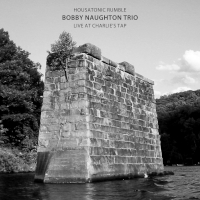 Vibraphone player Bobby Naughton was a model of musical self-determination. From his home base in Connecticut, he and a group of like-minded musicians banded together to create opportunities to perform and document their music. Naughton formed the label Otic and he and Wadada Leo Smith co-founded Creative Musicians’ Improvisers Forum which supported musicians and presented concerts. From the late 1960s onward, he played in various groupings with this cohort of musicians including Smith, Mark Whitecage, Perry Robinson, Laurence Cook, Mario Pavone, Randy Kaye, and Joe Fonda. In the fall of 1985, Naughton was able to secure a series of dates at Charlie’s Tap, a small neighborhood jazz club in Cambridge, Massachusetts with his working trio with Kaye on drums and Fonda on bass. He assiduously recorded the shows along with a session at the club during the day, archiving the tapes for potential release. After Naughton’s death, writer Ed Hazell gained access to Naughton’s archive and unearthed the recordings resulting in this release.
Over the course of a dozen pieces, all by Naughton with the exception of “Vashkar” by Carla Bley and “Composition 23J” by Anthony Braxton, the trio digs in with adroit collective interplay. This is truly three-way music imbued with a supple approach toward free lyrical improvisation. Naughton’s vibes playing owes much to his background as a pianist; his abstracted melodicism shaped by keen attentiveness toward attack and sustain. Fonda’s bass is a worthy complement to Naughton’s playing. His deep, rich plucked bass deconstructs the motifs of the tunes and wends around the vibist’s crystalline extrapolations. Kaye is one of Naughton’s longest collaborators, going back to the late 1960s and appearing on the leader’s debut recording Understanding. The drummer’s playing is focused more on timbral orchestration and accenting the group flow than it is about defining time or pulse. The drummer spent time playing with Jimmy Giuffre in the late 1970s into the 1980s and the fluid strategies toward ensemble interplay of Giuffre’s groups have many synergies with this trio.
Most of the performances range from three to just over seven minutes long. Eschewing the structure of thematic statement followed by solos, the group digs right into lithe spontaneous explication of the open lyricism of the leader’s pieces. It’s also intriguing to hear the way that the trio inhabits Bley’s lush “Vashkar,” letting the lines unwind slowly. One can hear how Bley’s music influenced Naughton’s writing, particularly on his tunes covered here like the languid “Shepaug Strut” or the floating interwoven harmonics of “Pomperaug Diversions.” Their reading of Braxton’s “Composition 23J” stretches to over nine minutes, allowing them more space to explore and expand on the piece with darting, overlapping angularities. NoBusiness Records and Ed Hazell have continued to do an invaluable job of mining the archives of Sam Rivers as well as projects like reissues from the Japanese Chap Chap label and more recently, the release of music recorded live at Studio Rivbea. It is fantastic that they also dive into lesser-known musicians like Bobby Naughton whose work deserves wider recognition.
–Michael Rosenstein
Angelika Niescier
Chicago Tapes
Intakt CD446
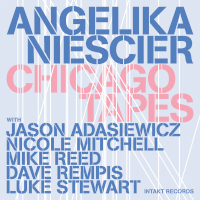 Poland-born Germany-based saxophonist Angelika Niescier has always demonstrated a strong exploratory impulse, not just in her music, but also in her choice of creative partnerships. She reveled in close alliances forged in New York’s improvising circles, and followed an arresting double act with pianist Alexander Hawkins on Soul In Plain Sight with the superb Beyond Dragons with cellist Tomeka Reid and drummer Savannah Harris in 2023. Now on Chicago Tapes, she deepens her engagement with the Chicago avant-garde, convening two sharply contrasted ensembles.
Niescier drew the material for the album from two studio sessions recorded on successive May days in 2025, each featuring a slightly different line-up. On four cuts, Niescier draws from a quartet completed by saxophonist Dave Rempis, drummer Mike Reed and vibraphonist Jason Adasiewicz, while on the remaining five she calls on Reed again, flautist Nicole Mitchell and bassist Luke Stewart. Though all nine pieces bear Niescier’s credit, several blur the line between composition and spontaneous architecture. Where an explicit theme manifests, she generally avoids complexity to facilitate freewheeling interaction.
Niescier and Rempis share some similarities: both are garrulous exponents of the free jazz saxophone, generating an onrushing flow of rapid-fire motifs and blood twisting intensity. Some of their best moments arrive when they come together in uneasy jostling, and perhaps the only fault is that this doesn’t happen enough. Reed’s jittery beats and Adasiewicz’ ringing vibes advance a restless undercurrent, chattering and rippling to buoy up the horns. Reed sits out “Great Horned Owl,” leaving the reeds to drone and hum over lurching vibraphone clanks, before they engage in further aerial dogfighting.
The tracks with Mitchell and Stewart benefit from more elastic pacing and wider registral separation from the blend of alto saxophone and flute, an effect compounded by Mitchell’s subtle electronics. On “Poranek” without Stewart, spiky saxophone and swooping flute joust with jagged drums, but on the subsequent “SAMO (bsqt)” his pizzicato throb anchors Reed’s polyrhythmic hints in tandem with first Mitchell, then Niescier, before taking center stage. The striking compositional structure of “Bouncin’ The Ledge” provides one of the highlights, as prolonged reed trills underpin explosive bursts of improvisation, with Mitchell and Niescier seeming to urge each other to ever greater heights.
In these sessions, Niescier proves less a guest in Chicago’s storied avant-garde than co-conspirator, albeit one with a language unmistakably her own.
–John Sharpe
John O’Gallagher
Ancestral
Whirlwind WR4840
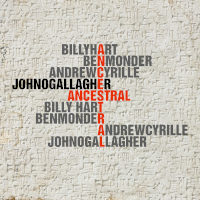 Ancestral draws inspiration from alto saxophonist and composer John O’Gallagher’s doctoral research on John Coltrane. No mere academic exercise, it exists as a document of transformation – the sound of an artist reshaping his voice. After leaving Brooklyn, O’Gallagher and his wife relocated first to the United Kingdom before settling in Lisbon, Portugal. That transatlantic journey, paired with intense scholarly reflection, catalyzed a major artistic evolution that permeates the album.
O’Gallagher’s focus here is Coltrane’s late-period Impulse! recordings, particularly Interstellar Space and Stellar Regions. These works informed his doctoral argument that so-called “free” music is not truly free. According to O’Gallagher, studying Coltrane’s final recordings for his PhD gave him “ideas about how to be freer within the systems that [he] had developed, and how to perceive them in a more organic way.” That philosophy underpins Ancestral, where freedom emerges not from abandoning structure, but from a more instinctive engagement with it.
Recorded in 2024, the album features guitarist Ben Monder alongside legendary drummers Billy Hart and Andrew Cyrille – appearing together on record for the very first time. Rather than compensating for the absence of bass with dense chordal textures, the ensemble embraces openness. At times, O’Gallagher sits out entirely, allowing Monder and the drummers to shape the music’s direction; elsewhere, the saxophonist carries the melody and harmony alone. When O’Gallagher and Monder play together, both exercise restraint. Hart and Cyrille are equally measured, often blurring individual identities as they listen and respond, creating a sound that is lighter and less dense than many two-drummer ensembles.
Most of the album consists of first takes, ranging from fully composed pieces to spontaneous improvisations. “Awakening” begins the date slowly, with soft unison lines between saxophone and guitar over mallet-driven percussion, gradually intensifying, like an ancient folk song gaining momentum until its final crescendo. “Under the Wire” follows with off-kilter swing, driven by Monder’s bass ostinato as the melody shifts from casual to animated, with spirited exchanges between the saxophonist and guitarist before dissolving into unexpected calm. The fully improvised “Contact” evokes foreboding solitude through rustling percussion and feedback-laced guitar. In contrast, O’Gallagher returns on “Tug” with elongated saxophone lines navigating the nuanced interplay between Hart and Cyrille – one tugging at time, the other anchoring it. As the intensity rises, O’Gallagher eventually yields to the drummers’ cymbal flourishes and Monder’s billowy chords.
On “Profess,” O’Gallagher states a bold melody before launching into a fervent, Trane-inspired improvisation that the quartet plays with feverish urgency. “Altar of the Ancestors” draws even closer to Coltrane’s spirit, recalling his “Vigil” duet with Elvin Jones, though Hart and Cyrille choose nuance over thunder. The penultimate “Quixotica” opens with comforting guitar chords and cymbal washes before O’Gallagher enters with a series of repeated melodic variations. The fully improvised closer, “Postscript,” is performed with collective verve; Monder’s descending figure suggests finality, but the drummers have the last word.
Far from nostalgic, Ancestral unfolds like a ceremonial ritual that vacillates between impressionistic introspection and emotional catharsis. By turns powerful, invigorating, and contemplative, Ancestral offers listeners the opportunity to hear O’Gallagher, Monder, Hart, and Cyrille collectively arrive at a place somewhere between discipline and intuition, where exploration supersedes certainty and risk yields revelation.
–Troy Collins
Ivo Perelman + Wadada Leo Smith
Dualogues 5
Ibeji
 Is it only a coincidence, or does Ivo Perelman actually quote, or distort, “Tea for Two” 1:47 into the second piece on the fifth volume of his Duologue series? It rears its head before disappearing into the murky waters of introspective reflection on which the finest improvisations are buoyed. Wadada Leo Smith floats a single trumpet tone to finish the phrase around which Perelman’s tenor saxophone bobs and weaves, all immediately following a pitch merger, rife with microtones; it’s one of the many felicitous moments defining this collaborative disc.
It is no mean feat to define exactly what separates the two musicians’ styles, especially in light of how often similar convergences occur. They trill their ways, often in tandem, through bits of the fourth piece’s humorous opening, and Perelman retorts with obvious glee to the phrase Smith lays down 3:50 into the final creation. A duologue indeed and on multiple levels, since a single pitch or a bandied phrase becomes the source of sinewy synchronicity and endless invention. All that said, and despite obvious and repeated forays toward collaborative vistas, they carve out separate territory. Perelman tends toward more rapid-fire and interregistral exploration, whereas Smith immerses himself in what he might call reflectativity. A penchant for space, a leaning into the rapt silence of meditation, regularly encompasses his motifs and lines. This introspective approach has been a constant since his 1967 debut, the gorgeous and ineffable “The Bell.” Even his denser lines in the sixth piece are wavy rather than melodically etched in a traditional sense. When melody does occur, it more often than not comprises points in tandem rather than traditionally contoured lines. Perlman can certainly inhabit similar forms and structures when he chooses, as in the fifth piece, but he favors a more “Romantic” approach to melody and to vibrato; he can sound remarkably close to Ben Webster or even Johnny Hodges, but with a lighter tone than either.
All of the above is, of course, overgeneralization, and the album is a constant renegotiation of these fluid interactive areas. The final movement of what sounds more and more like a suite upon repeated audition brings all elements into focus. Smith’s first notes bring a controlled fire whose glow Perelman inhabits moments later with some of that beautifully anachronistic vibrato. Smith listens amidst Perelman’s rapturous curves and crossings, Smith’s ensuing trills morphing into a quiet growl, itself conjuring traditions of yore. The ascent and pitch convergence at 4:32 brings repose and anticipation as the miniature, and the album, achieve fruition, in fact on another convergence. This duologue’s special, temporal and stylistic heterogeneity make it the strongest yet in an excellent series.
–Marc Medwin