Moment's Notice
Reviews of Recent Media
(continued)
The Tomeka Reid Quartet
dance! skip! hop!
Out Of Your Head OOYH041
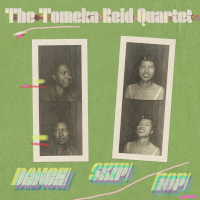 No other artist has increased the profile of the cello in contemporary creative improvised music in the past decade more than annual poll-winner Tomeka Reid. Beyond her celebrated improvisational prowess, Reid’s ear for melody and her continued growth as a composer manifest in a tuneful writing style that is adventurous but accessible. Currently living in New York, but originally from Washington, DC, Reid first came to prominence in Chicago, where she joined the AACM. Balancing tradition with innovation, Reid truly exemplifies the Association for the Advancement of Creative Musicians’ timeless motto “Ancient to the Future” and all that it implies.
Reid has a strong connection to her family, and her album art and song titles have often paid tribute to them – this recording being no exception. Estranged from the paternal side of her family until 2008, dance! skip! hop! features family photos of her great grandmother Francis Elizabeth Bean, her grandmother Estelle, and her great Aunt Cece, all of whom inspired the latest effort from her working quartet with guitarist Mary Halvorson, bassist Jason Roebke, and drummer Tomas Fujiwara.
Inspired in part by the title of Josh Berman’s A Dance and a Hop (Delmark, 2015), this heavily rhythmic date benefits from having one of today’s most adaptable drummers supporting two lower register string players who can each lay down a solid foundation as readily as take the lead. Playing in an energetic yet restrained manner, the rhythm section often finds Roebke and Fujiwara establishing a groove and Reid either joining or playing counterpoint. This self-control also characterizes Halvorson’s playing, who often doubles or accentuates Reid’s melodies with quicksilver fingerpicking and phantasmagorical bent notes, frequently comping unusual chords in a supporting role. There are moments, however, when Halvorson cuts lose with sudden bursts of noise and distortion, especially during the record’s dramatic centerpiece, “Oo long.”
The opening title track offers a perfect demonstration of the group’s intuitive interplay, building from Fujiwara’s swirling brushwork and Roebke’s buoyant plucking into a sprightly pizzicato solo from the leader and a swinging statement from Halvorson – all underpinned by Fujiwara’s spry accents. The rhythm section’s loose, shifting approach continues in the Latin-influenced “a(ways) For CC and CeCe,” which features Reid’s bowed variations, textured cymbal work, and Halvorson’s warped note cascades. In stark contrast to most of the session, “Under The Aurora Sky” unfolds glacially as an eerie ballad accentuated by Reid’s spectral bowing. The session concludes with the vibrant “Silver Spring Fig Tree,” a lilting ode to Steve Feigenbaum of Cuneiform Records and the city where Reid first started playing cello.
Throughout the date, Reid and Halvorson conjure a kaleidoscopic panorama of textures and timbres as they spar and feint, yet it’s the collaborative efforts of the quartet that resonate most profoundly. Working together for over a decade, the group’s seasoned rapport elevates their interactions, enhanced by Reid’s embrace of extended techniques and occasional use of electronic effects; her expansive sonic palette can make it difficult to tell where her percussive pizzicato and sinewy arco diverge from Halvorson’s crystalline fretwork and signature pitch bends. Underpinning their intrepid exchanges, Fujiwara’s forceful but subtle versatility is complemented by Roebke’s protean technique.
One can hear echoes of the influential post-war loft jazz scene in these engaging, folksy tunes. Part chamber jazz and part folk-fusion, dance! skip! hop! is one of Reid’s most unfettered quartet explorations, combining ebullient melodies with graceful swing and bracing solo improvisations. This is lively, modern jazz that expertly balances avant-garde virtuosity with a cheerfully unpretentious sensibility.
–Troy Collins
Dan Rosenboom
Coordinates
Orenda 0121
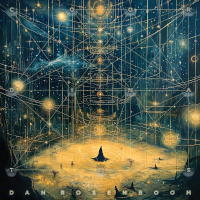 Coordinates is a comprehensive statement from Los Angeles-based composer, trumpeter, and arranger Dan Rosenboom. Conceived around a concept exploring abstract numerical relationships governing time, meter, and groove, the ambitious album functions as an all-encompassing self-portrait. Employing a cast of 28 musicians from Los Angeles’ jazz, experimental, classical, and film-music communities, Rosenboom arranges a series of unorthodox configurations that yield a broad palette of instrumental colors, textures, and moods.
Since founding Orenda Records in 2014, Rosenboom has developed a reputation for projects that blur genre lines. Many longtime collaborators appear on Coordinates, including saxophonist Gavin Templeton, clarinetist Brian Walsh, trombonist Ryan Dragon, keyboardist Jeff Babko, and pianist Joshua White. Most of the music is anchored by a formidable rhythm section, featuring guitarist Jake Vossler, bassist Jerry Watts Jr., and drummer Caleb Dolister, but Rosenboom also incorporates percussionists, a string quartet, extended brass and wind sections, harp, and a rotating cast of soloists. His most expansive project to date blends chamber music, cinematic scoring, progressive rock, funk, avant-jazz, experimental metal, and Eastern European folk elements into a multifaceted, yet cohesive whole.
Underpinning it all is Rosenboom’s interest in mythology, numerology, and astronomy, which shapes the album’s structure and concept. The coordinates referenced in the title – and named in five of the album’s nine tracks – serve as distinct points of Rosenboom’s musical imagination. While familiar hallmarks remain – virtuosic trumpet work, angular melodies, tight ensemble writing – Coordinates reveals a subtler side of Rosenboom’s artistry. Lending the music a cinematic feel, the expanded instrumentation allows texture, orchestration, and motivic development to convey as much expressive potential as incendiary fireworks.
The date opens with the ominous “Prisms, Mirrors, Portals,” a brief meditation that sets the stage before plunging into the date’s kinetic center. From there, the proceedings move fluidly through shifting terrain: the funky propulsion of “Coordinate 1: Many Worlds, Many Dances,” the metallic menace of “Coordinate 2: Apophis,” the ritualistic tension of “Oracles,” and the reflective calm of “Josephine’s Dream,” a delicate ballad featuring harp and strings. Rosenboom’s classical background is evident throughout, balancing precise scoring with open spaces for improvisation, enabling complex structures to sound organic rather than academic.
Individual moments stand out without distracting from the album’s ensemble concept: the snarling contralto clarinet against distorted guitar on “Apophis,” the groaning low-woodwind unisons of “Old Ghosts,” Katisse Buckingham’s flute soaring over funk-metal grooves on “Coordinate 3: Syzygy,” and Lauren Elizabeth Baba’s fiery, Mahavishnu-inspired viola on “Coordinate 4: Nemesis” are all highlights. The closing track, “Coordinate 5: Hyperion,” serves as a collective statement, integrating the full ensemble – brass, strings, and rhythm section – into a powerful, unified finale.
Despite its density and complexity, the suite never feels forced or overwrought, unfolding as a carefully composed journey, balancing virtuosity with sensitivity. At just over 40 minutes, Coordinates is a high-water mark in Rosenboom’s career as a composer. It is ambitious, meticulously crafted, stylistically unbound – and most importantly, engaging. Gathering the many strands of his musical life into a single, clear vision, Rosenboom delivers one of his most distinctive and compelling statements.
–Troy Collins
Simon Rummel Ensemble
Antworten auf seltene Fragen
Umlaut
 German composer/instrument inventor/musician Simon Rummel formed his Ensemble in 2012 to collectively explore and develop compositions and arrangements of pieces that range from long-form melodic extrapolations to microtonality to folk music to reinvention of popular song to jazz standards, or in his words, “to invent and perform joyful music.” With a stable group of participants, they have been able to workshop this idiosyncratic blend in a constantly shifting combination of reeds, brass, strings, electronics, keyboards, invented instruments, and voice. Antworten auf seltene Fragen (translated as “answers to rare questions”) is their fourth release, capturing the 11-piece group as they traverse a set of relatively compact compositions that incorporate hocketing counterpoint, musing lyricism, jaunty folk themes, jazz interpolations, and a cover of Clifford Brown’s “Joy Spring” thrown in for good measure.
The release kicks off with the ensemble wending their way across the dulcet theme of “Vienna Library” then slowly unraveling it, with trumpet and reeds peeking out against low-end growls as Michael Griener’s pin-prick percussion lances through, rounding out with the full ensemble restatement of the theme. Carl Ludwig Hübsch’s snaking tuba shines through on “Sieben” countered by gamboling ensemble playing and “Suessholz” where his low end toys against Joris Rühl’s clarinet. Tight, cheery ensemble voicings alternate with abstractions for brass as well as recorder, electronics, and percussion on “Unbeobachtet” which segues into “Fragen Sie mehr über Jazz” with charged free swing solos by violinist Radek Stawarz and Georg Wissel’s alto sax. The stately “Langsam” followed by the morphing lush layers of “Orgelschlag” and the brief cascading counterpoint of “Contrapunctus Ottogesima ottava” display a more introspective side to Rummel’s writing which the ensemble delivers with tight collective interplay. The group shifts to full-on jazz band romp with their reading of “Joy Spring” including stellar solos by trumpet player Brad Henkel and violinist Stawarz. The kaleidoscopic “Cleaning” closes things out, moving from spry theme to voluble interchange to striated abstraction. Each of Rummel’s previous Ensemble releases have revealed a new aspect of the group’s music and this newest one proves a welcome addition.
–Michael Rosenstein
Fred Van Hove
I-II-III
Edition Explico (Digital Reissue)
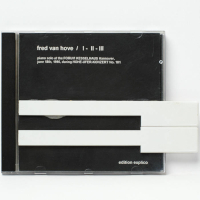 For those who know about the Edition Explico label, its reputation far exceeds the actual reach of the catalog. Formed by Günter Christmann, the label put out 24 releases, each in extremely limited editions from as few as 14 to a maximum of 250 with each packaged in handmade covers. Up until now, they’ve been all-but-unobtainable. Fortunately, that has all changed with the announcement by Corbett vs. Dempsey that they will be reissuing the entire catalog digitally including documentation of the original covers and packaging. Included in the first batch is Fred Van Hove’s solo outing I-II-III, originally released in a run of 50, each signed by the musician and adorned with white piano keys glued to the jewel case. Recorded live in 1996 at Forum Kesselhaus, Hannover, Germany, it captures the pianist’s singular approach to solo piano in a particularly inspired set.
Listening to Van Hove, one is struck by his formidable incorporation of harmonic abstraction along with his commanding attention toward attack and sustain. The digital release shuffles the original order of the pieces, opening with “II,” an 8-minute interpolation of an angular, lyrical motif. Stating with repeated clusters, he delves into the structure of the theme, fragmenting it and spontaneously regrouping the ringing shards with fleet, malleable momentum. Darting across the keyboard, he punctuates rising, crystalline lines with hammered notes at the lower register. The 27-minute “I” follows, opening up the clusters of “II” and focusing in on the percussive resonance of the instrument. Notes are struck, plucked, and activated with preparations; the reverberation of the strings ring out, get abraded and bent, or are cut short with a keen attention to timbral structure. Like on the first piece, Van Hove teases out repeated phrases, inverting and layering them with a meticulous sense of arc, harmonic interplay, and density. As the piece surges along, there is always a decisiveness at play as to how notes are placed within the gathering flow, building to a thundering torrent and then resolving with the spare ring of dark bass rumble.
The release concludes with the spiky, angular “III.” Van Hove constructs the improvisation with incisive deliberation. The piece begins with thundering chords which ring out, punctuated by stabs of upper-register notes. But gradually, he opens things up with cascades of rapid-fire sheets which flit in shimmering, declamatory dynamism, coalescing into clustered crescendos. Across 25-minutes, the pianist structures the improvisation with a resolute consideration of ebb and flow, mounting coursing momentum with repeated pealing motifs that accrue into torrents and then open up into probing harmonic explorations. This reissue unearths a stellar session by Van Hove, a particularly welcome addition particularly since many of his solo outings are currently out of print.
–Michael Rosenstein