Moment's Notice
Reviews of Recent Media
(continued)
Rahsaan Roland Kirk
Vibrations in the Village: Live at the Village Gate
Resonance HCD-2081
Rahsaan Roland Kirk
Seek and Listen: Live at the Penthouse
Resonance HCD-2080
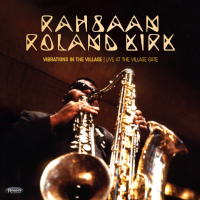
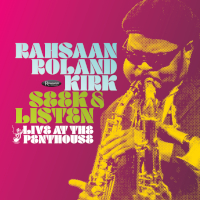 Everything that Rahsaan Roland Kirk has astonished listeners with for decades is heard in great abundance on these two new historical live recordings: his one-man-as-horn-section superpower, astounding flute playing, virtuosic command of the saxophone, and charismatic showmanship. As all Kirk fans know, no combination of any two or three saxophone players could ever get the range of timbres and overtones that Kirk could on his tenor, manzello (a King saxello), and stritch (a Beuscher straight alto). His genius was nonpareil.
The performances heard on Vibrations in the Village were recorded at the Village Gate on November 26 and 27, 1963. They were originally meant to accompany a documentary on Kirk that was never finished, and thus, the tapes languished unheard for decades. Kirk’s band for that run included Horace Parlan on piano, Henry Grimes on bass, and Sonny Brown on drums. Melvin Rhyne and Jane Getz sat in on three and two cuts, respectively. The disc’s opener “Jump Up and Down Fast” demonstrates Kirk’s uncanny ability to switch between horns at will and play each with a different approach so as to sound like a full front line. Parlan’s driving block chord based solo sets up Kirk’s freewheeling left of center manzello. He goes further out from there, soloing over his own drone, and then pouring his own sheets of sound from his tenor – each solo separated with a multihorn interlude. Kirk introduces Mingus’ “Ecclusiastics” with a brief but lush horn chorale before playing the melody on tenor. If one wasn’t paying very close attention, it might be easy to mistake the quartet for the entire Mingus band from Oh Yeah, which Kirk appeared on the year before. On the flute feature “Laura,” Kirk alternates a round beautiful sound with a punchy and breathy approach he punctuates with brief vocalizations. “Laura” is an example of the album’s inconsistent sound quality – at times his flute almost breaks up and at others it floats around the mix. The rhythm section sound is flat and distant. On other occasions over the course of the disc’s 77 minutes, the sound quality is only slightly above marginal. It is not so bad though to render this recording a difficult listen or mark it as for completists only. The music transcends the audio limitations. Listen to the closing track “Three for the Festival,” with its blistering stop time flute and nose flute (a modified recorder) trading and then try convincing anyone that this recording should have stayed in the vault. Good luck with that.
Seek and Listen is a two-disc set pulled from two dates recorded in September 1967 at the Penthouse jazz club in Seattle. Disc one is from September 8th, disc two from the 15th. Each features the same quartet of pianist Rahn Burton, bassist Steve Novosel, and drummer Jimmy Hopps. The sound quality was much improved at the Penthouse. A main highlight on this set is the inclusion of two captivating medleys, each on the first disc. “Ev’ry Time We Say Goodbye/I’ve Got It Bad (And That Ain’t Good)/Sophisticated Lady/Satin Doll” is a fourteen-minute opus. It is highlighted by Kirk’s flute and vocals on “Got It Bad,” his sensitive reading of “Sophisticated Lady” on stritch, and an upbeat, jaunty horn section presentation of “Satin Doll” that is only missing one thing: Harry Carney. “Blues for C & T/Happy Days Are Here Again/Down By the Riverside” begins with atmospheric little percussion, Kirk’s vocalizations, whistles, and a hypnotic swirl of saxophones. It’s a fun little prelude for Kirk blasting off on tenor, more percussion, and Kirk doing his best bagpipe impersonation. But the real fun comes at “Happy Days.” It’s a stomping backbeat romp the sort of thing that Mingus or Ayler might do. Sure, the wheels are about to come off, but Kirk doesn’t care. He sings with abandon, leading the congregation to salvation. Kirk and company play “Prelude To A Kiss” at a medium swing, and his treatment and voicing the melody on multiple horns is unconventional. Here he plays contrasting solos on tenor, manzello, and stritch before stepping back to highlight Burton. “Funk Underneath” is a prime example of Kirk as eminent entertainer. Like “Three for the Festival” from the Gate date, he blows the flute and nose flute. At one point he stops to inform his audience they are witness to “the most educated nose in the world,” much to their delight. The disc closes with Kirk’s tune “Making Love After Hours.” It has a funky Les McCann type groove over which he blows a mean vocalized flute (where does man and technology begin and end?). Kirk sings the blues lyrics asking where his baby is, complete with backing horn section.
Each set gets the typical Resonance Records treatment with an ample collection of photographs, liner notes, and contributions from notable figures: Kirk biographer John Kruth, Kirk’s widow Dorthaan, novelist May Cobb, Adam Dorn, James Carter, Steve Turre, and others. If forced to choose between the two sets, I would pick the Penthouse over the Village Gate, as the sound quality on the former is uniformly better, the performances feel looser and more spontaneous, and I prefer the material played in Seattle. Each though, is an exceptional document of Kirk’s singular brilliance.
With the proliferation of live archival releases in the last few years – if we have not reached peak saturation of live Bill Evans trio recordings from the 1960s, we will soon – it can be hard to sort out the essential from the good from the superfluous. Which releases add to or change our understanding of an artist’s oeuvre? Which fill in gaps that only these recordings can fill? Which add to or cement an artist’s legacy? In the instance of Kirk, this question is hard to answer. The people who know, know that Kirk is a giant among giants. But he is not treated by jazz history or record companies as his heavyweight contemporaries are. He recorded dozens of albums before his untimely death at 42, and despite the long-term efforts of Joel Dorn – Kirk’s Atlantic and Warner Brothers producer – to reissue them on CD in the 1990s and 2000s, many can only be found used. The complete Mercury recordings box set is almost a rare commodity. A handful of Kirk’s classics such as We Free Kings, The Inflated Tear, and Now Don’t You Cry Beautiful Edith are recently reissued on LP, but those new to his music might be unwilling to shell out $30 or $40 for one LP of an artist they don’t know much about. While the Penthouse and Village Gate sets might not necessarily tell Kirk’s fans and jazz history writ large anything they did not already know about his music or offer any revelatory insights, they are important for several reasons: they are great, easy to find, affordable, well done, and representative of Kirk’s art. The release of the LP versions as part of Record Store Day also gives them and Kirk himself a certain cache that they might not have otherwise. For these reasons and more, they are both an ideal gateway into Kirk’s works and something that most Kirk fans will want to have. Will they help cement Kirk’s legacy as one of the greatest? Only time can tell. Meanwhile, listen and spread the word.
–Chris Robinson
Oliver Lake
Live From Studio Rivbea, 1975 & 1976
NoBusiness NBCD 183
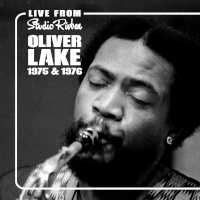 Another astonishing find from the late Sam Rivers’ Rivbea Archives unites two loft era dates by reedman Oliver Lake that capture a pivotal time of accelerated growth for Lake, fresh back in New York after a sojourn in Paris. The pieces recorded during the 1976 Rivbea summer festival constitute the main reason for excitement, rounding out the two tunes from the same set (including one under guitarist Michael Gregory Jackson’s name) already issued on the legendary Wildflowers (Douglas, 1977) survey of the NYC loft scene. Also of interest, although less satisfying both musically and sonically, are the pieces from an earlier Rivbea Festival in 1975. However, the sleeve credits for the two sets seem awry. More on that later.
Lake revisits much of the repertoire on his contemporaneous releases Holding Together (Black Saint, 1976), his duo disc with trombonist Joseph Bowie (Sackville, 1976), Life Dance Of Is (Arista Novus, 1978), and Shine! (Arista Novus, 1979). But the live versions reveal much of what follows after the opening themes to be open improvisation, sometimes markedly dissimilar to later iterations, although nonetheless often consistent in maintaining the initial mood. As in his writing, Lake’s lines frequently rotate between the intervallic leaps of his inspiration Eric Dolphy and tender slightly bittersweet melodies. On alto, he moves with a snaking urgency, while his flute playing veers bucolic.
For the 1976 occasion, Lake called on a crew of close associates – bassist Fred Hopkins, drummer Phillip Wilson, both familiar from the AACM, and the 22-year-old guitarist Michael Gregory Jackson who he recruited in New Haven. In ensemble music, Jackson (an acknowledged influence on both Bill Frisell and Pat Metheny) stands out for his expansive style which navigates between folky song-inflected picking, volume pedal swells, Hendrix-inspired snarl, and feedback. Hopkins too is a revelation here, eschewing pulse to bring a super resonant tone to percussive rattlings as well as bowed slashes and assertive pizzicato. Wilson avoids steady meter, instead commenting, coloring, accenting as part of the ongoing interaction.
Lake’s themes beget untethered interplay notable for its use of space and its restraint, offering a stark contrast to the fire music tropes often equated with the loft community. “Six Beats Out” waxes tranquil and melodic before unfurling into divergent drifting strands underpinned by Wilson’s intermittent clatter, by turns spacious and subject to sudden spurts. “A Space Rotonto” mixes raw-boned phrases with long tones, before choppy free-floating bass and drums take hold, with Hopkins’ sawing out front, preceding acerbic dialogue between alto and guitar.
On the 1975 performance, Jackson again complements the front line, joined by Hopkins on bass (although only on the first two selections, contra the sleeve credits), while Jerome Cooper, best known for his tenure in the Revolutionary Ensemble, occupies the drum stool. A soprano and guitar unison positions “Re-Cre-Ate” on a serene pathway, from which it quickly digresses, the improvisation becoming explosive and fragmentary. “Lodius” begins more angular, but constantly dissolves and reforms thereafter. In their commitment to group interaction, both cuts match the excellence of the 1976 Wildflowers date. The drummer in fact plays much more akin to Wilson, than on the remaining pieces.
The sound and tenor of the last three tracks from 1975 seem to originate from a different sound source, carrying somewhat more distortion, with a WKCR radio station ID intruding at one point. In terms of instrumentation, they also differ. “Rite-ing” presents Lake unaccompanied, alternately gnarly and lyrical. Trumpeter Baikida Carroll appears on the other two (contra the sleeve, where he is credited to one track only), but notwithstanding Hopkins’ name among the personnel, there is no bass on these pieces, as confirmed at the close of the final “Trailway Shake,” where Lake introduces the band without mention of the bassist.
For much of its 23-minutes, “Rue Roger” erupts in a full-on blow out, raw and abrasive and by some measure the album’s least interesting stretch. The horns bicker over a drum tattoo, and Jackson when he enters shreds and wails. Lake’s switch to flute promises a brief respite, but Cooper’s active attack retains a cymbal pulse even here. Carroll’s wah-wahed trumpet fleetingly features on “Trailway Shake”, but again Cooper’s martial bursts and drum rolls fill out the spaces which lend depth and subtlety to the exchanges elsewhere.
Still in spite of the drawbacks, the first four cuts in a generous 73-minute program account for much of the set’s musical value. It is a revealing archival snapshot of a wobbly and undervalued period, in which creativity blossomed away from the commercial imperatives of clubs and bars, and affirms Lake as one of the era’s most probing and durable voices.
–John Sharpe
Joëlle Léandre + Evan Parker
Long Bright Summer
Rogueart ROG-0146
Un film de Christian Pouget
MAELSTRÖM for Improvisers
Films UtòpïK
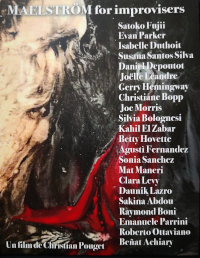 Although Joëlle Léandre and Evan Parker had improvised together in many ensembles for more than 40 years, the 2023 performance documented on Long Bright Summer was, somewhat astonishingly, their first duo concert. “Better late than never” and “well worth the wait” apply. This is a thoroughly engaging album from start to finish – and at seconds less than 55 minutes, a finish that comes too soon. What is especially gratifying to hear is how they respectively touch upon their entire skill sets in an organic way, everything from how they establish pliant parameters with skeletal figures to pure abstraction. If the ease with which voices jell within an improvisation, regardless of the material, is the gauge of mastery, then there’s no doubt about theirs. The other endearing aspect of the recording – granted: “endearing” is a quality rarely applied to improvised music – is that there are tracks that the blindfolded listener could easily presumed to be from the 1980s or ‘90s, and others that could have only been created in the past few years. The former is particularly true when Parker’s soprano is its spikiest and Léandre’s arco is jabbing and scratchy; the latter when Léandre’s bowing yields plummy lines that coax a smoldering legato from Parker’s tenor. Any dialogue nearing a half-century in duration will freely mix past and present, and that is the case on Long Bright Summer. It lightens a long dulling winter of discontent.
Léandre, Parker, and 20 others are featured in filmmaker Christian Pouget’s feature-length MAELSTRÖM for Improvisers. There is a refreshing diversity of artists featured in conversation and in performance in terms of generation, gender, ethnic background, and nationality. Without heavy-handed pedantry, Pouget makes a solid case for the universality of improvisation in music. He also smartly stays out of the frame, so that his fingerprints are not on the commonalities that emerge from the interview clips. There are numerous dots connecting artists not usually mentioned in the same breath: Kahil El Zabar to Isabelle Duhoit; Christiane Bopp to Satoko Fujii; Joe Morris to Agusti Fernandez; and on and on. There are also ample opportunities for North Americans to see artists they have previously only heard, like Raymond Boni, Roberto Ottaviano, and Susana Santos Silva. French and English subtitles enable monolingual Americans full access. Beyond containing a wealth of music, MAELSTRÖM for Improvisers is a potent educational tool. The question is: How many American academics will take advantage of this valuable resource?
–Bill Shoemaker
Gianni Mimmo
The Lonesome Thing
Rosebud Relevant RRR001
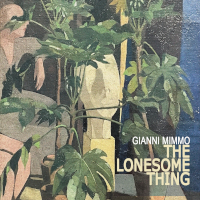 Pushing beyond sound into a susurrant space 6:19 into “Exceller – Esteem,” soprano saxophonist Gianni Mimmo captures an instant of disruption. It is one of many such seeds, cultivated and coming into bloom on The Lonesome Thing, his latest solo album and the inaugural release on his new Rosebud Relevant imprint.
Like the stories in Jean Toomer’s Cane, the 1923 novel auguring certain facets of the Harlem Renaissance, Mimmo employs multidirectional moments to fashion episodic narratives that cohere and transform through contrasting repetition. They may be regular, as with the first sultry salvos of “Sideline,” where symmetrical phrases elongate around silence, or disjunctural, as with the jagged lines out of which the first two pieces are formed. As each phrase connects to the next in the blurred lines demarcating episodes, form and structure diverge and converge in a seemingly infinite variety of perspectives. Melodies unfurl in leaps and steps, strategically implying harmonies via thwarted motion and encroaching stasis as on the aptly titled “The Slurring Dancer,” a miniature revealing many of the album’s secrets. Mimmo bends into pitches that he then sustains and repeats, setting up dramatic expectations only to dispel them in the next moment. A two-note exhortation expands to three, promising growth until the third note wavers, sags and dissipates. The following phrases build on that model, microtonal inflections rendering each utterance an unsteady footstep or a botched curtsy. Mimmo brings similar freedoms to “A Flower is a Lonesome Thing,” which will resonate with all who cherish what can be done when such a songful melody is viewed from deep within its already radical, even impressionistic, delineation.
Freedom is at the heart of what Mimmo does, but it’s born of inculcation. Listen to any track here and hear past and present in symbiosis. Yes, Steve Lacy informs Mimmo’s buttery, sweet, and spicy tone, often extending to dizzying heights, but Coltrane’s notions of phrase, line, and their atomistic interaction imbue each moment. Mimmo’s dynamic range and all the subtleties attendant to it are complemented by a lush acoustic befitting each slur, slope, and sudden switch. Delicious reverberation turns “Sloping Patience” into a harmonic thicket, ghostly curves and spires emerging only to fade into the impalpability of recollection and imagination. Like Toomer’s characters traveling between North and South, the essence of each region is instilled, present even when physically absent, informing event and recollection. Histories dialogue in such exquisite playing, each note, growl, and breath an inflection viewable from multiple angles. Solo ventures are too rare in Mimmo’s discography, so here’s hoping there will be many more to come.
–Marc Medwin