Moment's Notice
Reviews of Recent Media
(continued)
Caroline Davis’ Alula
Captivity
Ropeadope RAD-728
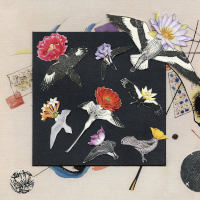 Throughout history, jazz has been a staunch supporter of civil rights. From the lyrics of singers like Ma Rainey and Bessie Smith to the political statements of activists like Max Roach and Abbey Lincoln, jazz musicians have long protested social injustices. Brooklyn-based alto saxophonist and composer Caroline Davis’ first social justice album, Captivity, is a contemporary reflection on the shocking racial inequalities of America’s industrial-scale incarceration program. It’s a cause that’s been a personal concern of hers since visiting an uncle in prison as a young girl.
Davis’ recent recordings have all been conceptually based, including Portals Volume 1: Mourning (Sunnyside, 2021), which dealt with the loss of her father, and Alula (New Amsterdam, 2019), a study on the structure of bird wings. Countless authors and poets have written allegories about birds in cages; Captivity updates the bird imagery of Davis’ Alula ensemble with caged birds as symbols of incarceration. The music, which ranges from meditative to confrontational, is inspired by correspondence Davis has had with people who have been (or are) in prison.
These new compositions fuse post-bop harmony, hip-hop rhythms, and densely layered electro-acoustic soundscapes with spoken word samples. Accompanied by Chris Tordini on double and synth basses, Tyshawn Sorey on drums, and Val Jeanty on turntables and samples, Davis often takes center stage as primary soloist; her pithy phrases pack emotional heft by augmenting angular cadences with bluesy inflections, while navigating complex, shifting rhythms.
The striking opener, “[the day has come]” conveys urgency, with Jeanty’s jarring electronics and a sample of a reading of a speech from 1867 by the abolitionist Sojourner Truth, which segues into “burned believers [for Agnes and Huguette],” written in honor of accused heretics Agnes Franco and Huguette de la Cote, both burned alive in the 14th century. The piece features excerpts from a Lorraine Hansberry speech from 1964 and a talk by Astrid Dalais, while Davis’ alto expresses outrage underpinned by Sorey’s driving beats and Jeanty’s turntable scratching. The next seamless transition, “and yet it moves [for Galileo]” and its companion “[the malignity of fate],” were inspired by the persecution of a truth seeker; Davis soars above Sorey’s elastic pulse with altissimo motifs that reflect the mood.
The album midpoint, “synchronize my body where my mind had always been [for Jalil Muntaqim]” and “[terrestrial rebels]” were both composed for a former member of the Black Panther Party who spent almost 50 years in prison before his release. On the former, Davis and Sorey sound invigorated; the latter is awash in vexing electronics. During the heartfelt “a way back to myself [for Keith LaMar],” Jeanty intersperses a talk that LaMar (who is on death row) gave during the pandemic. After Davis’ elegiac alto statement, Qasim Naqvi joins on modular synth and stays for the simmering hip-hop vibe of “the promise i made [for Joyce Ann Brown].” Brown was wrongly convicted of murder in 1980 and exonerated in 1990.
The penultimate “[i won’t be back, ms. Susan Burton],” is a standout; undulating with pneumatic frenzy, Davis delivers some of her most impassioned playing in collusion with Sorey. Davis composed it for the founder of the nonprofit organization, A New Way of Life, to help formerly incarcerated women. The album closes with “put it on a poster [for Sandra Bland],” an emotional rumination for a victim of the criminal justice system whose death in prison was suspiciously marked a suicide. Featuring another guest (Ben Hoffmann on Prophet 6), Davis ends the record on an introspective note, providing contrast to all that came before.
A notable effort, Captivity is an absorbing journey featuring virtuosic musicians juxtaposing high-wire acoustic improvising with programmed electronics. Reinforced by carefully selected samples, Captivity succeeds in creatively conveying its message – a heartfelt expression that delivers a compelling musical and social statement.
–Troy Collins
Moppa Elliott’s Advancing on a Wild Pitch
Disasters Vol. 2
Hot Cup Records Hot Cup 231
Moppa Elliott’s Acceleration Due to Gravity
Jonesville: Music By and For Sam Jones
Hot Cup Records Hot Cup 232
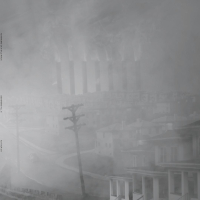
 Bassist, bandleader, and composer Moppa Elliott’s most recent offering is a brace of albums from two wildly different bands: a hard bop inspired quintet called Advancing on a Wild Pitch and a rowdy nonet that goes by Acceleration Due to Gravity. The former’s album, Disasters Vol. 2, is organized around the theme of human-made disasters in Pennsylvania. Each song title names a town struck by calamities ranging from mining accidents to oil spills to police violence. I first listened to this album without reading the liner notes and found it a pleasant, swinging, straight-ahead date by a simpatico quintet consisting of Charles Evans on baritone saxophone, Sam Kulik on trombone, Danny Fox on piano, Elliott on bass, and Christian Coleman on drums. Then I read the liner notes, and with each subsequent listen my perception of the album changed as I tried to match up each song with its attendant disaster. No one would expect the music to be programmatic – how would one depict a deadly cloud of smog choking a city (“The Donora Smog”) with a conventional five-piece combo? Or capture the moment when the Philadelphia Police bombed the MOVE headquarters (“Cobb’s Creek”)? At the same time, the emotion and imagery conjured by each of the disasters doesn’t translate to the music. In another context, “Van Meter” could be a sentimental ballad rather than an elegy to 239 coal miners that perished in Pennsylvania’s worst mining disaster. The final cut, “Dimock,” has a buoyant, perky, upbeat feel with spright solos from Evans and Kulik and a half time, low-down solo from Fox. But then I read about Dimock and learn that the town’s entire water source was poisoned by fracking. The music and the story don’t track. There’s a disconnection that I can’t reconcile. The bari-bone front line does give the music a more melancholy feel due to the lower range of the instruments. “Marcus Hook” is a blues with dreary overtones and a wonderfully constructed and fluid solo from Evans, and yet I can’t make the connection between the tune and the two tanker ships that collided on the Delaware River causing a major fire and oil spill. Perhaps I’m expecting the music to do too much work and that Elliott’s city/disaster-based song titles and album liner notes are enough to convey the horror of pollution, anti-Black violence, and train collisions. Or maybe the music isn’t meant to do that work. Either way, Disasters Vol. 2 lost its charm once I became aware of its context. Maybe that’s the point?
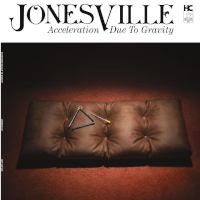
Acceleration Due to Gravity’s Jonesville is dedicated to and inspired by Elliott’s favorite bassist, Sam Jones, who spent time in the bands of Cannonball Adderley and Oscar Peterson and was one of Riverside’s house bassists. The album’s seven crisp cuts are spread over a tidy twenty-two minutes. Elliott penned four tunes, each of them containing elements from one of Jones’ recordings. The other three tracks are Elliott arrangements of Jones originals: the medium-up swing “Choice”; the slinky, sly “Miami Drag”; and a bonkers, quasi-Latin rendition of one of Jones’s better-known tunes, “Stack of Dollars.” The on-paper formula for Acceleration Due to Gravity is simple: at least one soloist is always improvising over rhythm section and background horn parts that repeat, loop, and morph. There is no “tune” per se for the listener to grab onto as a frame of reference and each song is jam packed. Space between soloists and phrases comes at a premium and the music is thick. “Unity” features a raucous solo from Stacy Dillard on tenor followed by Bobby Spellman on trumpet, Ava Mendoza on guitar, and George Barton on piano. Spellman’s frenetic lines and long phrase length sound like he’s drowning, and he’s only able to catch his breath between spells of Mendoza’s shredding. All of this happens over horn backgrounds. “Cedar Run” is a straight-eighth rock tune. Deep down below Barton’s piano solo lies a bari sax background line from Kyle Saulnier that would be nice to hear in the foreground and with space to stand out. Later, but not much later, Saulnier grabs the solo baton and sends his bari through effects. And then just as on other tracks, the music stops cold. Next song. There are so many solos and different background parts that each cut is hard to process. It’s the sonic equivalent of too many people in an elevator: crammed, stuffy, and claustrophobia inducing. There’s nowhere to breathe. That being said, the music is clean, polished, and perfectly executed throughout. The solos are inventive and spirited and the background writing is interesting. There’s just enough sideways soloing, compositional wrinkles, and humor to give Jonesville away as an Elliott production. From a musician’s standpoint, the music does sound fun to play, but too much all at once makes this twitchy album sound and feel a lot longer than twenty-two minutes.
–Chris Robinson
Rich Halley Quartet
Fire Within
Pine Eagle 015
 Rich Halley is one of today’s most imposing tenor saxophonists; boasting a classic, burnished tone, his keen sense of melodic development enables his long-form improvisations to flow in logical, albeit often surprising narratives. Based in Portland, Oregon, Halley would probably be better known if he lived in New York or Chicago but is nonetheless a well-established artist.
For the aptly named Fire Within, Halley once again teams with three leading improvisors: pianist Matthew Shipp; bassist Michael Bisio; and drummer Newman Taylor Baker. This album follows The Shape of Things (Pine Eagle, 2020) and Terra Incognita (Pine Eagle, 2019), both recorded with the same line-up. Halley’s third album with Shipp’s working trio finds the quartet honing their chemistry in a series of visceral, long-form improvisations. Shipp, Bisio, and Baker pair well with Halley’s vision, using swinging old school tenets of the jazz tradition to construct musical conversations that exude their own intrinsic logic.
The title track begins with Halley playing a rapid series of unaccompanied tenor variations, setting the stage for Shipp’s entry. The pianist’s fleet cadences and Bisio’s muscular contributions intensify in momentum; when Halley reenters the fray, his richly toned attack is even more lyrical. Towards the end, Baker makes his own kinetic statement before Halley returns in a bluesy mode and Shipp fades them out. Bisio introduces “Inferred” quietly, leading into another lengthy piece that inspires slow but fervent articulations from Halley, underscored by Shipp’s sensitive accompaniment. Halley blows sustained lines over Shipp’s descending, heavily pedaled chords, then embarks on a series of abstract variations as Baker ramps up the furor and Shipp drops out. The maelstrom recedes and Shipp returns unaccompanied, his hands engaged in sustained contrapuntal invention.
Halley elicits a raspy, boppish line on “Angular Logic” and Shipp dexterously counters; his thunderous attack maintains the pulse, allowing Baker and Bisio to react dynamically as Halley bounds through registers, the band racing as Shipp takes the lead. Requisite calm finally appears in the rubato ballad “Through Still Air,” as Halley’s lilting lines float over Shipp’s shimmering piano chords; the spectral sound of Bisio’s bowing and Baker’s cymbal washes establish a delicate foreground for Halley and Shipp to explore.
The whirlwind closer, “Following the Stream,” clocks in at a quarter hour. Baker begins with a quiet tom tom solo, before exploring every part of his kit. Halley enters, building to ecstatic levels over Shipp’s jagged comping, exchanging phrases with the pianist. Shipp commences his own solo with increasing intensity and hypnotic repetition, before engaging in a ruminative search; he elicits bluesy expressions while Bisio walks his bass, and Halley embraces the mood. The pianist turns more aggressive comping behind Halley, with staccato bursts and low register notes; the exchanges between the two go further out, with multiphonic bleats from Halley and flinty chords by Shipp modulating into a stately finale that recalls Miles Davis’ “Milestones.”
The near-clairvoyant interactions heard on Fire Within are the result of Halley joining forces again with this sympathetic trio, who reveal a seasoned maturity in their free improvising. Playing with finesse, flexibility, and inexorable momentum, the veteran trio undergirds Halley’s bop-based lines with controlled chaos, keeping the music unpredictable yet coherent, making Fire Within another winning effort by Rich Halley and the Matthew Shipp Trio.
–Troy Collins
Darius Jones
fLuXkit Vancouver (its suite but sacred)
Northern Spy NS163 / We Jazz WJCD54
 Alto saxophonist Darius Jones has been praised for his collaborative sensibility over a wide range of projects, dating back to his debut album, Man’ish Boy (A Raw & Beautiful Thing) (AUM Fidelity, 2009). Whether as a bandleader, member of a collective ensemble, or as a duo partner, Jones has never made the same album twice, approaching each one with conceptual forethought and attention to detail.
Jones’ new release, fLuXkit Vancouver (its suite but sacred) is a four-movement suite that incorporates challenging ensemble playing with room for individual spontaneity. The work was commissioned by Vancouver’s Western Front, an artist-run center for multi-disciplinary experimental collaboration that is also known for being an early supporter of the 1960s and ‘70s art movement Fluxus. Jones created the work during several residencies with drummer Gerald Cleaver and a quartet of string players: violinist siblings Jesse and Josh Zubot; cellist Peggy Lee; and double bassist James Meger.
Intrigued by the Fluxus movement and its concept of the “fluxkit,” in which artists packaged artwork into attaché cases intended for use in performance, Jones’ open-ended writing recalls Fluxus’ emphasis on event-based works where the process is as important as the outcome. Although motifs recur throughout the hour-long suite, it can be unclear where Jones’ ensemble writing ends and collective interpretations begin; the pieces balance composition and improvisation, placing the act of conception on the same level as performance. Jones considers the album, which combines a score based on traditional and graphic notation, cover art by Stan Douglas, and liner notes by poet Harmony Holiday, to be akin to a fluxkit.
The opening track, the intricately woven “Fluxus V5T 1S1,” starts with Jones playing mournful tones over Cleaver’s snare and the low-pitched underpinning of bass and cello, while the violins create slight dissonances. Cleaver and Merger increase the tempo, and the ensemble complies. But Jones offers a contrasting theme that steals the show with a dazzling, multi-layered performance of expressionistic feeling. The ensemble engages tentatively at first, but midway through they move into an intense improvisation; the stringed instruments diverge, claiming the spotlight in the final section.
The more frenetic “Zubot” is named for the violinists, who balance between post-bop structure and improvised dialogue, but the cut doesn’t only focus on them. Jones and Cleaver assert modal authority over the siblings’ dissonant challenges and the drummer and cellist eventually lead, establishing a course for Jones’ alto to sail over.
The sole ballad, “Rainbow,” begins with Cleaver’s tasteful solo demonstrating fluid dynamics and timbral control. The strings enter, moving both parallel and in counterpoint, creating a dreamy pulse followed by a long, unaccompanied bass solo, after which Jones converses with the strings before joining Cleaver and Meger in a driving groove.
The album closes with “Damon and Pythias,” a fierce ode to the Greek mythological tale about the virtues of friendship. Cleaver dances around Lee’s cello vamp as the Zubots swirl in unison, and Meger explores his lower register. Jones eventually enters with a minimal, contrapuntal phrase, buoyed by violins and drums before engaging in a solo filled with multiphonics and alternate fingerings that reveals his tremendous technique. Transitioning suddenly from foreboding to soulful, the final movement ends lyrically, on a prayerful note.
fLuXkit Vancouver (i̶t̶s suite but sacred) is one of the most captivating recordings in Jones’ discography, revealing an imaginative musical language that is confidently communicated by his talented collaborators. The players wholeheartedly embrace these inventive compositions, while Jones confirms he’s one of today’s most intriguing saxophonists.
Jones initially made a grammatical error in the album’s punning title – “its suite” rather than “it’s suite” – but decided to add a strikethrough rather than correct the mistake. Therein lies the spirit of the album – Jones allows us into his creative process, much like the Fluxus artists he has drawn inspiration from.
–Troy Collins