Moment's Notice
Reviews of Recent Media
(continued)
James Brandon Lewis Quartet
Transfiguration
Intakt CD 400
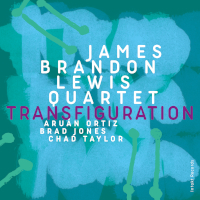 James Brandon Lewis is perfecting the rhythm of releasing albums by two ensembles with contrasting instrumentation and artistic agendas. While his Red Lily Quintet focuses on seldom celebrated aspects of African American history like George Washington Carver’s Jessup Wagons and the midwifing of present-day gospel music by the majestic Mahalia Jackson, his Quartet extends the trajectory of the tenor saxophonist-led quartet still largely determined by John Coltrane, which makes it more vulnerable to the quicksand of influence. Lewis consistently and skillfully steers clear and delivers strong, well-shaped statements like Transfiguration.
Where Lewis’ quartet is comparable with both Coltrane’s and David S. Ware’s classic units is an immediately recognizable ensemble sound, attributable to his well-honed rapport with Aruán Ortiz, Brad Jones, and Chad Taylor. Arguably, this is a lift made heavier by the span of Lewis’ materials. Transfiguration is packed with impressive track-to-track leaps, typified by following the anguish-laced questing of “Trinity of Creative Self” with the pungently accented rhythms of “Swerve” and the bright Latin tinge of “Per 6.” Lewis also writes chimeric themes. The album’s finale, “Élan Vital,” blends nods to late Coltrane balladry, South African hymn, and the paeans of Keith Jarrett’s American quartet, then amps the intensity to a righteous scalding scream, and takes it out on a cooling groove.
Lewis calls his composition method Molecular Systematic Music, a name that suggests dry science and complexity for complexity’s sake. Time and again on Transfiguration, method is overwritten by expression, the keen responsive interplay within the quartet giving knotty ideas a visceral, even soul-shaking impact, particularly on Lewis’ 12-tone title piece. “Taking it to the next level” is a phrase signaling artistic ascent; it certainly has applied to Lewis’ previous quartet albums. Transfiguration emphatically suggests this to be an ongoing process. Most artists would believe they have arrived with such work, but it is obvious that Lewis will keep on pushing and that this recording and his next efforts should not be missed.
–Bill Shoemaker
Rob Mazurek Exploding Star Orchestra/Small Unit
Spectral Fiction
Corbett vs. Dempsey CvsDCD104
 Spectral Fiction captures a pared-down iteration of Rob Mazurek’s Exploding Star Orchestra performing live in Chicago in March, 2023. Joining Mazurek are Damon Locks on voice and electronics, Tomeka Reid on cello, Angelica Sanchez on Wurlitzer electric piano, Ingebrigt Håker Flaten on bass, and Chad Taylor on drums. “Equations of Love in Prismatic Waves of Color” is a thirty-eight-minute odyssey in which the band searches and usually finds peak after peak of intensity. The music is cosmic and daring, expansive and dynamic, alternating between funky fusion and abstract free jazz. Near the beginning a section of lovely arco playing from Reid morphs into a thicker, more ominous vibration that cues up a sample of a young girl saying “I haven’t been out of my own too much but I guess what impresses me the most in other neighborhoods is the sense of space.” As this girl repeats and repeats and repeats the phrase her voice gets louder and lower and the musicians play around her voice, sometimes burying it in a polyphonic texture. As she fades out the band creates a dreamy soundscape of trumpet, rolled Wurlitzer chords, shaker, and bass. Things become agitated and in need of direction. Locks enters, reciting his poetry. His words become the impetus and glue for what becomes a galloping beat and the direction the music was looking for. Lock often manipulates his voice, looping and layering it, presumably sampling and chopping his words in real time. The thicker his vocal layers get, the deeper the band digs into its energy reserves, becoming an unstoppable oncoming force. “Tear down the walls, rip up the floor” Locks intones, drums bashing around him, thick block Wurlitzer chords bearing down. Lock’s voice isn’t heard very often throughout the piece, but when it appears his poetry immediately intervenes into the music, becoming either the catalyst for the music’s zenith or the zenith itself. The final episode of the piece finds Sanchez and Reid jamming over Taylor’s sprightly groove before it fades to nothingness.
The shorter “Driftless” – it clocks in at a relatively tidy fourteen minutes – isn’t as episodic as what came before. Here Mazurek opens with a dry sound, playing a solo cadenza. Taylor begins to lay down a light groove composed of high hat, shaker, and sticks hitting the sides and rims of the drums. Reid and Sanchez quickly join in. Where Lock’s vocals on the previous cut signaled more of a zenith to each section, here, when he recites “... as we create a new universe/a universe that’s electric ...” he stands out more like another instrument soloing with the rhythm section. Taylor’s brisk groove falls back and Mazurek plays a series of trills and flourishes in free time over a slowly tumbling bass and Sanchez’s Wurlitzer zigs and zags. Locks cues up a vocal sample of a man, whose speech is deep in the texture, hard to parse, and gets stuck in a loop. Taylor sets up a new groove and Mazurek charges in with a big, bold theme that sounds like it could have been composed. In fact, snippets of it can be heard earlier in the piece, suggesting that it may have been. He develops the stately theme, with Reid and Sanchez following along, echoing and commenting on it. As Mazurek fades out the band quickly winds down and the piece ends.
Throughout the performance one has the tendency to want and try to make connections between the different vocal samples, Locks’s words, and the music. This is especially difficult given the frequently thick textures, polyrhythms, and competing lines. Perhaps trying to discern this meaning is a fool’s errand. I hear something new in the music and texts with each listen, and in that way, the album renews itself with each spin and new connections and relations become apparent. In this way, we should be thankful that the performance was recorded, so that we may return to it again and again as if almost for the first time.
–Chris Robinson
Rachel Musson
Ashes and Dust, Earth and Sky, LLudw a Llwch, Daear a Nef
Self-released
 In his Page One column for PoD Issue 75, Bill Shoemaker offered up an inciteful profile of UK saxophonist Rachel Musson focusing on her ambitious project I Went this Way for octet and text. This new release marks the debut of a new working strategy. During the pandemic, Musson spent time exploring her ancestry in West Wales, visiting the remote rural expanses of the Gwaun Valley and collecting recordings of the countryside. Simultaneously, she captured domestic and urban sounds in and around London, musing on “our shifting relationships to land, and how estranged from land and earth I felt two floors up in the city during the pandemic.” For this project, Musson intermixes field recordings, saxophone, flute, and small percussion to create a series of improvised/composed soundscapes that explore “a sense of the place of a specific little corner of Wales, juxtaposed against the more familiar to me sounds of the city.”
Musson has dug deeply into the sound sources she gathered, melding them into a series of pieces imbued with a contemplative sense of timbral richness and spatial expansiveness. She maximizes the use of differing recording techniques to weave together richly-layered, immersive pieces. Each probes the balance between instrumental lyricism, site-specific phonography, and abstracted treatments. There are sections of clear sonic denotation with nature sounds, trickling and dripping water. These are augmented with sounds that connote places; the distant chatter of crowds, urban bustle, chiming bells, and billows of wind. The pastoral sounds of chattering birds are juxtaposed with slight crackling textures, chiming church bells are panned across the sound plane, layered into urban hum and avian warbles. Instrumental parts are developed and tightly interwoven into the multidimensional creations.
Each piece is caringly assembled from the accumulation of variegated components, layered in with a keen ear toward densities and dynamics. Field recordings shift between central aural focus and orchestrated voices. Musson’s deftly constructed instrumental contributions provide an additional facet. Trilling piccolo is overdubbed into a pan pipe choir, flute plays tag with bird songs, and saxophone is used as a euphonious lyrical voice or layered with striking harmonic depth. Wind chimes and singing bowls are commingled with field recordings. Overtones of a tro, a Cambodian spike fiddle, get blended into the multifaceted harmonic mix. The result is a series of pieces which coalesce the underlying parts into absorbing wholes. Musson has been performing this music live which adds yet another layer to this deeply personal project. One looks forward to hearing where that experience leads and what comes next.
–Michael Rosenstein
Roberto Ottaviano Eternal Love
People
Dodicilline Dischi Ed560
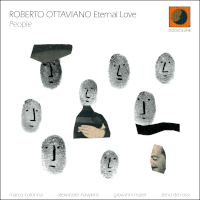 Roberto Ottaviano is one of his generation’s great soprano saxophonists. His pedigree is impeccable: mentored by Steve Lacy, Ottaviano has collaborated with Mal Waldron, Albert Mangelsdorff, and a host of other luminaries. The bulk of recordings under his leadership have been issued on Italian labels that require some effort to obtain in the US, but they are all well worth the effort, particularly People, a collection of 2022 and ‘23 festival performances by his Eternal Love quintet with bass clarinetist Marco Colonna, pianist Alexander Hawkins, bassist Giovanni Maier, and drummer Zeno De Rossi.
There are several traits that distinguish Ottaviano as a saxophonist, composer, and bandleader. He does not simply go to the well, but infuses what he draws with other essences to achieve refreshing results. Many celebrate Coltrane, but Ottaviano had the distinctive red-lining energy of Elton Dean’s quartet with Keith Tippett, Harry Miller, and Louis Moholo in mind when penning “Ohnedaruth,” which distinguishes the performance from the generic nod to Trane. On “Mong’s Speakin’,” a tribute to Mongezi Feza, Ottaviano retains the festive spirit of South African music without a heavy layer of kwela vernacular.
Despite the wide span of the album’s materials, Eternal Love maintains a finely calibrated brand of interplay throughout, whether they are navigating a winding Indian-tinged line like “Hariprasad” or basking in the Brazilian warmth of Rodrigo Manhero’s “Caminho Das Aguas.” Colonna is an ideal frontline partner for Ottaviano, his chortles and squalls bouncing off the leader’s sinuous lines. Hawkins, Maier, and De Rossi, have one of the deeper pockets in present-day jazz. All hands turn in very well-crafted solos.
People is an excellent album that, probably, too few people in the US will hear.
–Bill Shoemaker
Ethan Philion Quartet
Gnosis
Sunnyside SSC 1706
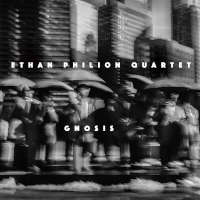 Chicago-based bassist Ethan Philion’s first recording as a leader, Meditations on Mingus (Sunnyside, 2022), was a well-received effort that featured novel arrangements of compositions written by the legendary Charles Mingus. Philion’s sophomore release, Gnosis, scales down the prior album’s 10-piece ensemble to an economical piano-less quartet to focus mostly on his own originals, save for one more Mingus tune. Philion is reunited with trumpet player Russ Johnson and drummer Dana Hall, who return from the previous session and are joined by alto saxophonist Greg Ward, who mentored Philion when he was earning his Masters at DePaul University. Together, these four work through a half dozen lengthy pieces, one of which is an epic reworking of “What Love” (Mingus’ deconstruction of the Cole Porter standard “What Is This Thing Called Love”).
Mingus’ spirit can be heard in the rambunctious energy of this spirited combo, but Philion’s chord-less arrangements also invoke shades of Ornette Coleman’s early piano-less quartets, especially in the dynamic opener “The Boot.” Johnson and Ward kick start the number with a strident fanfare that sets the stage for Philion to establish a vamp with Hall allowing the horns to explore at length before the rhythm section gets it due.
Philion has made no secret of his admiration for Mingus, and his arrangement of “What Love” confirms that. Stretching to 11-minutes, the album’s longest track is also its most episodic, allowing the group to solo and interact freely throughout a series of changing moods: Johnson smears notes while Ward’s intervals recall bebop changes; and the leader alternates between expressive and introspective approaches, underpinned by Hall’s prodding, who negotiates sudden changes in rhythm and tempo with ease.
“Sheep Shank” is even more animated and unconventional. Hall’s tumultuous solo introduces the number; the tune inverts tradition by having the horns support the rhythm section at first, before the frontline eventually takes the spotlight. Conversely, the atmospheric ballad “Nostalgia” begins and ends quietly with Philion using hushed pinch harmonics to bookend a lilting, lyrical solo from Ward. As a metaphor for today’s caustic online discourse, the following “Comment Section” is a cacophonous tirade.
The hymn-like title track concludes the album on a somewhat exotic note. Based on an Iberian-tinged riff, Philion bows while Hall swings, the horns engaging in lively, conversational discourse that builds in intensity before the leader takes the reins for an unaccompanied soliloquy. Eventually, the full band re-enters for a rousing coda that ends the album with poetic fervor.
Gnosis proves that Philion is no mere Mingus acolyte; avoiding the sophomore slump, he proves his mettle as a bandleader, composer, and soloist of merit on a program of material that expertly balances freedom with form. The group’s chemistry is palpable, with numerous examples of deep listening and interactivity, whether plying sensitive ballads or engaging in riotous call-and-response. Along with his sidemen, Philion demonstrates his abilities as a virtuosic soloist, but it is notable that the album is credited to the quartet, as the group’s intuitive rapport lends symbolic credence to the album title, which is defined as spiritual knowledge acquired through lived (rather than taught) experience.
–Troy Collins