Moment's Notice
Reviews of Recent Media
(continued)
Ab Baars + Joost Buis + Berlinde Deman
Cecil’s Dance
Wig 34
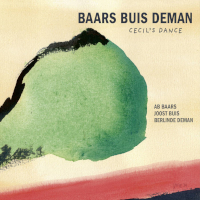 Ab Baars and Joost Buis first teamed up for 2005’s Kinda Dukish, the trombonist joining Ab’s trio in a two horns/two rhythm context. Their 2018 CD Moods for Roswell was for duo, contrapuntal. For Cecil’s Dance, recorded live in 2023 at a very quiet Bimhuis (whose advance publicity had promised “disjointed jazz”), the duo added Belgian tubist Berlinde Deman, for the polyphonic possibilities, and a darker, more somber ensemble profile. There are echoes of “early” music – they end with a setting of a 14th-century song by Guillaume de Machaut – not least when Deman picks up the serpent, the archaic, S-curved Euro bass horn with a trombone-like mouthpiece and woodwind-like fingering, as if melding her fellow players’ axes. Her serpent kicks off and is heard to good advantage on “The Sky and the Sea” with slow solos all around – Ab on shakuhachi to really air it out – over an open Wadadian landscape. There are near-unison (dis)harmonies: sounds that rub the air. The ensemble sound is at once airy, delicate, and tough.
Ab left his tenor home, and mostly plays clarinet, leading off with a salute to his teacher John Carter, whose precisely squealy stratospherics remain a Baars touchstone. A fragmentary theme shows itself here and there, and as elsewhere there are birdcall echoes. (Some enterprising scholar might research birdcall motifs in Dutch improvised music, starting with Fred van Duynhoven’s drum recital Bellbird.) “Jackdaws” gets a bit mimetic, but also lets you hear how overtone-soaked shakuhachi has stamped Baars’s clarinet, accompanied here by scooping scored backgrounds from the low horns which slip in halfway through. Eventually clarinet falls away to foreground those backgrounds – Ab then reentering to quietly support them: a simple, effective switcheroo.
Trombonist Buis may shadow Baars closely, ever the team player, but Joost gets his features. His understated wah-wah animal cries are the ear-catchers on “Kikiriki,” which works itself around to a Mengelbergian staccato episode, and where tuba keeps advancing even where the time is broken. They all end quoting Wallace Stevens’ 1918 poem “Depression Before Spring,” with its multilingual cockadoodle onomatopoeia: “Ho! Ho! But ki-ki-ri-ki/Brings no rou-cou/No rou-cou-cou.” More birds. Buis’ big showcase is the only 20th-century standard, Richard Rodgers’ “This Nearly Was Mine” from South Pacific, no new-music favorite despite Cecil Taylor’s and Sunny Murray’s versions. Trombone alone paraphrases and weaves unhurried variations around the shapely line until his partners sneak under, claro voicing the melody almost sotto voce over high tuba bass.
“Portrait of the Selfkicker” salutes a very Dutch cultural figure, Johan van Doorn aka Johnny the Selfkicker, poet/soundpoet with a very animated style – he’d come to a boil in seconds. (You can find filmclips online – have a peek.) Ab Baars who knows something about runaway excitability himself begins by declaiming a few of the poet’s lines in pale imitation, leading to some fine trio polyphony, Deman’s tuba catching the duo’s idiosyncratic rhythm. There is also a short free improvisation for Tristan Honsinger that sounds like an excerpt from a longer performance.
The titular “Cecil’s Dance” is one of the more expansive pieces at seven-and-a-half minutes, the three horns paralleling Cecil Taylor’s ways of organizing music, adapted to their own lineup. They jump off with a pithy themelet repeated and paraphrased and overlapping itself, the iterations and elaborations growing more expansive. A contrasting, faster motif is introduced; there are slow, agitated and percussive-sounding episodes. And still more birdcall echoes.
–Kevin Whitehead
Marc Baron + Mark Vernon
Post-Chance
Erstwhile 097
 In 2024, Erstwhile celebrates its 25th birthday. The label’s first release in this special year is a collaboration between Marc Baron and Mark Vernon, two artists that had not met before working on the aptly named Post-Chance. The disc aligns with the bulk of the Erstwhile catalog both for its methods of production and for the sounds and silences comprising its execution.
Without completely rehashing the duo’s description of the complex process of mailing, copying, and editing materials, the album is meant to consider and document loss. In the hands of these two radical musicians, that means a precis of loss, of decay, to engage and highlight the processes behind what is missing. Over the course of more than a year, the two musicians mailed tape fragments back and forth with a magnet in each package, purposely placed to facilitate a random decay. Both originals and the decayed copies made it into sections of the final mix. An hour was then distilled from these virtual collaborations.
From the first sounds comprising the many vignettes giving this hour-long dialogue its contour, there is a warmth to the music as it unfolds along its choppy and unpredictable path. Even the sustains ending at 3:39 resonate with a luminous analogue glow, a kind of respite from the previous hiss and crackle’s tension but also anticipating the succeeding silence punctuated by what sound like disembodied bits of dulcimer. Disembodied but not de-environmentalized, because each of the sounds in play brings its surroundings along for the dream-like episodic ride, like the large space inhabiting the soundstage from 6:11-6:45 or the presumably sped-up voices that live in a much smaller room, dialogue in snarky miniature and then blink out of existence at 16:51. It seems, and this is only the case in certain instances, as if the right channel contains the decaying tape while the left the more pristine original, as with the garbled rumble-and-squeak episode at 31:39.
Technology is at the heart of the whole affair, very consciously at certain points as discussion of the process takes center stage, even though it is located in the left channel. The whole begins with a sudden plunge into tape fuzz, and various types of analogue silence provide a throughline as the musical events unfold. Some bits conjure shades of Keith Rowe’s pristine and near-silent infatuation with the static grindings and scrapings of every-day objects in the stark relief afforded by contact microphones, while other moments channel the same common-place forces through the gritty reality checks laced with fantasy that Vanessa Rossetto might offer. The silences bring Wandelweiser composers to mind, but the humorous approach to technology might tickle the fancy of Michael Pisaro-Liu in his Revolution Shuffle mode. Through it all run the unpredictable strains of instruments, home-life and environmental bait and switch that defines so much of Graham Lambkin’s work, whether solo or in collaboration with Rowe or Jason Leskaleet.
As with so many Erstwhile releases, the album defies any one category or aesthetic. This is an extremely clever collaboration. The “post” in the title is revealing. The music is both indicative of Musique Concrete’s whimsical aftermath and a deeper and more earthy concept emerging in aleatory’s ubiquitous wake, but the relationship is also more personal. It’s as much an indicator of the Baron/Vernon duo’s intrepid approach as it is of Erstwhile’s Jon Abbey’s penchant for giving them a space to unleash their collaborative vision. Just as Baron and Vernon’s music seems to settle into a physicality, drone or multileveled rhythmic intrigue, the carpet is pulled from underfoot leaving room for the next episode to begin. Any overarching terminological concerns are jettisoned in favor of an approach knowing no laws but its own. Long may the process continue.
–Marc Medwin
Olie Brice + Rachel Musson + Mark Sanders
Immense Blue
West Hill 004
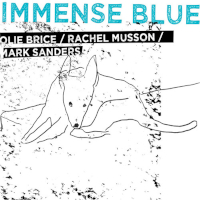 The trio of bassist Olie Brice, tenor saxophonist Rachel Musson, and drummer Mark Sanders, has two important things going for it: they have played with each other in several settings over recent years; and they have independently evolved beyond the bell curve from traditional to improvised music. A set recorded at The Vortex in October 2022, Immense Blue benefits from both the players’ feel for each other in the continuous unfolding of an improvisation, and their resourcefulness in nudging the music away from the formulaic.
Half hour-plus improvisations can seem like an eternity without frequent sparks being thrown. The nearly 32-minute “Jump the hidden balcony the air” opens the proceedings with plenty tossed into the mix by all hands, which is why it feels like a significantly shorter piece. Brice, Musson, and Sanders, are not content merely filling space; their every utterance has amperage that pushes the music ahead. Maintaining a brisk pace requires precise moment-by-moment calibrations by each improviser so that the accumulated energy does not suddenly and irrevocably flag nor is it starved of oxygen from an all-consuming explosion. This trio elegantly maintains such balance, even when the music approaches and spills into red-line intensity.
“Stretched polyphone” has an interlude-like quality, a relatively short piece that weaves textures and nuances into a subtly shaded soundscape, while “Hollow circle and round edge scream” forcefully concludes the set. Whereas the continuous unfolding of the improvisations is front and center on an initial listening, formal properties are subsequently revealed: it is a story-like set with a beginning, middle, and end. It is no surprise: Sanders’ solos consistently have a salient Roach-like design sensibility; motivic development is one of Musson’s strong suits; and Brice is like super glue – he makes everything stick together.
Immense Blue is immensely satisfying.
–Bill Shoemaker
Don Byas
Classic Don Byas Sessions 1944-1946
Mosaic MD10-277
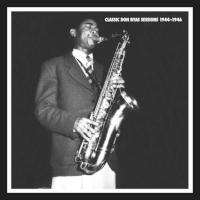 In Dutch filmmaker Nick van den Boezem’s 1970 documentary capturing Don Byas’ first visit to his homeland in 24 years (Don Byas Come Home, which may be viewed on YouTube), we see and hear the tenor saxist perform with the Thad Jones-Mel Lewis Orchestra at the Village Vanguard and a pickup group at the Newport Jazz Festival. On the first, “Lover Man,” Byas teases but doesn’t lean on the melody, he hints at several alternate keys, and shows off his penchant for double-timing; the second is a twisting, sublimely ornamented account of “’Round Midnight” – both are evidence of a master at work.
When he left America in 1946 on a European tour with a band led by Don Redman, Byas’ career was on an upswing. He had emerged as a featured soloist, filling in for no less than Lester Young, in the Count Basie Orchestra from 1941 to ‘43, was thereafter a fixture at the clubs on New York’s 52nd street, and a notable presence on the earliest swing-to-bop recordings with Coleman Hawkins and then Dizzy Gillespie in ‘44 and ‘45. But his post-tour decision to relocate to Spain and eventually the Netherlands invalidated over time his previous reputation at home, although his harmonic resourcefulness and often-breathless phrasing would prove prophetic to the styles of Paul Gonsalves, Johnny Griffin, Warne Marsh, Sonny Rollins, and John Coltrane in the 1950s.
The Don Byas introduced to us in Mosaic’s ten-CD treasure trove was no novice; already in his 30s, he had developed a brilliant technique that translated into an intense edginess uptempo, and a voluptuous tone especially seductive on ballads – so much so that he seemed in danger early on of being typecast as a romantic, as producers of the time were always looking for a sentimental jukebox hit. The most distinctive quality of his playing came from a thorough harmonic knowledge that allowed him to color and shape his solos with surprising chromatic note choices. Despite these virtues, however, he was not an innovator; instrumentally he derived from Coleman Hawkins, and he insisted his conceptual approach was based on Art Tatum, nevertheless his playing displays a consistent drama and fervor all his own.
Though not a complete survey of Byas’ recordings over these two years due to lack of availability, Mosaic has collected 193 total tracks from 52 separate sessions and divided them into three categories: primary releases, private jam sessions, and obscure label items. More often than not, producers like Teddy Reig, Bill Simon, and Buck Ram called the shots for the record company – including frequently choosing the musicians and supplying the tunes – which accounts for an excess of vocalists and emphasis on ballads, but when the circumstances clicked it resulted in some of the most exciting small group dates of the period. Among those who worked best with Byas were the flamboyant trumpeter Charlie Shavers, drummer Sid Catlett, a one-shot group featuring trumpeter Frankie Newton and pre-Cool clarinetist Hank D’Amico, and especially the underrated pianist Johnny Guarnieri. But there are questionable additions too, such as the cringe-worthy bassist Slam Stewart – immensely popular for his bowing/groaning shtick, but to me an acquired taste, like asparagus.
Several sessions achieved classic status. One is the May 1946 quartet date that gave us the master take and four alternates of “Cherokee.” Byas double-times a breathtaking solo through each, perhaps in part inspired by Charlie’s Parker’s “Koko” released some six months previously. (Ironically, the flip side of Parker’s legendary Savoy 78 release was Byas performing “How High the Moon,” recorded the same day in the same studio – meaning he likely heard Bird’s version first-hand.) The three sessions from January 1945 that connected Byas with his Onyx Club employer Dizzy Gillespie find the trumpeter exploding out of the changes of “Salt Peanuts” and “Bebop,” with Byas equally aggressive and potent, while Diz shrieks and Byas wails on “Something For You,” waxed the same day with the Oscar Pettiford Big Band. Alas, the quartet session of August 1945 could have been a classic, even with Erroll Garner on piano (who has a surplus of notes at his disposal), without Slam’s intrusion – as Byas renews his authority, with exquisite understatement, on Basie’s “Harvard Blues” and “One O’Clock Jump.”
Nevertheless, the rarest and most unusual music here comes from the intimate, informal performances taped at jazz-lover Timme Rosenkrantz’s apartment. Accompanied by piano (with an occasional bass), Byas stretches out on ballads, often shading or retracing a melody with swirling paraphrases like an artist experimenting on a sketch pad, a relaxed, effortless brilliance. The stakes were significantly raised in Autumn 1944 when tenorman Lucky Thompson and Thelonious Monk sat in. The two tenors are more complimentary than competitive; on “Body and Soul” Lucky squeezes notes into extended phrases and Byas counters with a ripe flowering of his own florid style, while this “Cherokee” launches Thompson into hyperspace, and Byas follows suit. Both are voracious eating up the changes on “Lullaby in Rhythm.” Meanwhile, Monk had encountered Byas as much as three years earlier at Monroe’s and Minton’s jam sessions, as well as on Coleman Hawkins gigs, and though his first Blue Note sessions were still three years in the future, his characteristic off-kilter harmonic injections and tumbling, angular arpeggiations are fully intact.
Though Byas’ opportunities for recording dropped precipitously in Europe over the next two-and-a-half decades, what there is shows he lost none of his proficiency or inventiveness (for a latter-day example, try the pair of 1963 Copenhagen club dates at one time on Black Lion). In the meantime, the breadth and consistency of Mosaic’s collection should go far in reinstating an unfairly overlooked reputation.
–Art Lange
Patrick Crossland + Alexander Frangenheim
Basic Tracks Baltimore and New York
Concepts of Doing COD010
 In 1946, Arnold Schoenberg wrote an essay concerning, in part, music’s need to appeal to both heart and brain. Largely a self-justification, it nevertheless touches several nerves, even concerning music well beyond his own. It is so often disheartening to hear very emotional improvised music so heavily based on cliché. Yes, every performer cultivates a syntax, but sacrificing spontaneity is too high a cost. Trombonist Patrick Crossland and bassist Alexander Frangenheim’s new collaborative release demonstrates that they’ve circumvented this stumbling block, achieving an astonishing rapport in which the heart and the brain are both well served by striking detail in a constantly shifting context.
Basic Tracks Baltimore and New York comprises portions of two live performances from 2022, both recorded under different circumstances. The Baltimore set, split into two tracks, captures the expansiveness of a concert hall setting with each detail still in sharp focus. A beautifully aphoristic example of Frangenheim’s arco opens the second piece, an exquisitely sustained bow in windy motion birthing a pitch rife with slight quaver. The elongated phrase paves the way for a few struck and plucked bass percussives that illustrate just how completely the balance between ambiance and detail forms the bedrock of this superb production. An equally sensual entrance from Crossland speaks not only to the vivid spatial presentation but to the dialogue these two completely assured improvisers have now documented again after nearly ten years. As exciting as Ape Green could be, a certain sonic constriction comes across on reaudition when compared to this new effort. As the wah-ed sustain continues via subtle pitch changes, each of Crossland’s circularly executed breaths adds to the atmosphere of event, each gesture mirrored and enhanced by its resonances in the space.
That interaction, the moment-to-moment execution of serial and parallel development in the service of unpredictability, unifies both performances despite their vast sonic disparities. Check out Crossland’s dare-devil octave leaps and Frangenheim’s bowed staccati in the last of the New York pieces, captured in a record store’s much more intimate environment. Crossland ultimately settles on a pitch at 0:26, fluttering it to Frangenheim’s rhythmic bowing nearly an octave below. The octave finally emerges but not until another battery of microlevel sound and silence derail any sense of facile narrative. While moments might describe symptoms, the underlying cause and effect is far too complex to articulate in anything approaching the listening experience. The duo’s dynamic contrasts are as vast as their respective vocabularies are complete, the latter even including “extra-musical” sounds for good measure, such as what sounds like a plastic water bottle. Each player might just as easily slip into a conventional melody as batter at the walls of sensibility a la first-generation European free improvisation. Yes, one of the album’s dedicatees, Gunther Christmann, is certainly an influence on the music and on Crossland’s playing in particular, but to suggest lineage is to impose an unnecessary limit. Along those fractiously drawn lines, one of the album’s most striking sequences begins 4:18 into the second Baltimore piece, where I’ll admit to being completely befuddled by how Crossland produces what occurs over the rest of the track. It shrills, wheezes, and bites as Frangenheim responds in both kind and opposition, the duo’s sonic scope shifting even as each moment passes, a staggering wall of sound that remains somehow transparent and bright, pitched and not, a perfect exemplar of what is at the heart of all these two veterans have accomplished. It all ends with a suddenness similar to the way each gesture becomes the next, a fitting encapsulation of the album as a whole.
–Marc Medwin