Moment's Notice
Reviews of Recent Media
(continued)
James Brandon Lewis Quartet
Molecular Systematic Music Live
Intakt CD 389
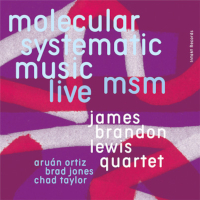 Although the James Brandon Lewis Quartet (Aruán Ortiz, Brad Jones, Chad Taylor) released Molecular in October of 2020, COVID prevented them from publicly performing its music until May 15, 2021. As Lewis tells the Zurich audience two-thirds through that performance – released here as a double CD set Molecular Systematic Music Live – that evening was the first time they played the music together since recording it. I’ll take Lewis at his word, even if it’s hard to believe him, given the group’s vibrancy, power, and agility. There is not a single sign of pandemic rustiness, which speaks to the rapport the musicians share, their command of the material, and the group’s identity.
The quartet played nine of Molecular’s eleven compositions, often in a much-expanded form. “A Lotus Speaks” opens both the studio and live recordings. Where the studio performance is a taught, sub-five-minute cut, the live version exceeds eleven minutes; in fact, each live rendition nearly doubles the length of the studio recording. It’s clear from the downbeat that the group was hyped to take the stage. “A Lotus Speaks” begins with a piano ostinato over quasi-martial drums that introduces the tenor melody. The music spills forth from Lewis’ saxophone, as if a dam broke, releasing a torrent of sound. The group’s urgency and sense of purpose only rises on the next tune, the galloping “Helix.” It sounds like Lewis is setting free the music that had been pent-up for a whole year. He blows and blows with force and conviction. Ortiz begins his solo with block chords that slowly transform into single notes in the middle and lower range. Here, and throughout, he uses more time and space than Lewis, providing a palate cleanser and alternate viewpoint. The title track, which closes the first disc, is less fiery, as if the group’s initial burst of adrenaline had worn off and they finally settled in. Even so, Lewis lets out “wooooo’s” of delight at Ortiz’s angular solo. During his turn Lewis finds little ideas that he briefly obsesses over, repeats and reworks, all over a funky vamp before the tune ends cold.
Usually, I have little patience for two-disc sets or single albums that exceed 70 minutes. This album is one of those rare exceptions where as soon as the first disc was over, I couldn’t start the second fast enough. “An Anguish Departed” features Lewis’ rhapsodic tenor, which he later uses to dial up a big rock ending. “Cesaire” opens with Lewis alone, playing single note melodies that almost recall a Bach flute partita. His Bach-esque lines loosen up and zoom ahead a few centuries to set up the tune – a waltz where Taylor almost recalls Elvin Jones’ work with Trane. Throughout “Cesaire,” one realizes how numerous, varied, and endlessly creative Jones and Taylor’s grooves and interlocking patterns are. Their playing is unfailingly dynamic and complex: it is as if on each tune they offer up at least one groove I’ve never heard before. The evening concludes with “Breaking Code.” At the top, the rhythm section attempts to have a conversation without sharing a language. It’s stilted and awkward. Jones’ arco bass doesn’t match up with Ortiz. Ortiz can’t understand Taylor’s attempts at sign language. Then Taylor makes a bold gesture, laying down a driving, medium tempo pattern on toms and cymbals. His mates soon join in, having found their common language. Ortiz offers his most forceful and propulsive solo of the concert, with strong left hand block chords stoking the single note phrases in his right hand. Lewis ends the evening as he began it, full bodied and out for blood. In long stretches he tongues almost every note, giving a jarring, powerful emphatic punch to his phrases. As Lewis blows, the rhythm section develops an ostinato that is somehow both loping and subtle, which Lewis uses to ride out into the sunset.
If this date represents a one-off for a band after a long hiatus, I can’t imagine what it would sound like in mid-tour form. Scary, to be sure. Make sure to save a space on your year-end favorite lists for this scintillating release from a leader and a band that is in the midst of an extraordinarily fine run of form.
–Chris Robinson
OM
50
Intakt CD388
 In 1982, after recording five albums in ten years, the innovative Swiss electro-acoustic quartet OM disbanded, leaving its four members – Christy Doran, Fredy Studer, Urs Leimgruber, and Bobby Burri – to go their separate ways. A one-off reunion in 2007 to open an exhibition commemorating the youth movement of the 1960s and 1970s eventually led to a series of festival appearances. Those concerts yielded the live album, Willisau (Intakt Records, 2010), and ten years later, It’s About Time (Intakt, 2020), the band’s first studio album in forty years. And the journey continues; on 50, OM celebrates its 50th anniversary.
Formed in Lucerne, Switzerland in 1972 and named after John Coltrane’s album of the same name, the members of OM were inspired by both the popular music of Jimi Hendrix and cutting-edge developments in free improvisation. During the heyday of jazz rock, OM was one of the few bands to approach jazz from a rock perspective, rather than vice versa, by combining the amplification and volume of rock music with the unfettered power of free improvisation. All in their 20s when the group was formed, the members of OM achieved early success at the 1974 Montreux Festival, resulting in the live album Montreux Live & More (Indian Records, 1975), which brought them to the attention of ECM. Four albums were subsequently recorded for ECM’s sister label Japo between 1976 and 1980: Kirikuki; Rautionaha; Om with Dom um Ramao; and Cerberus.
Despite disbanding in 1982, OM’s members continued to collaborate. Doran, Studer, and Burri all appeared on the ECM album Musik für Zwei Kontrabässe, Elektrische Gitarre und Schlagzeug in 1991, while Doran founded New Bag in 1997. Doran and Studer were also part of the power trio Red Twist and Tuned Arrow, and Studer was in Pierre Favre’s Singing Drums collective, as well as Rainer Brüninghaus’s Continuum band with Markus Stockhausen. Leimgruber has been consistently active in the free improvisation and new music arena since then; he formed the Reflexionen Quartet with Burri after OM split and currently plays with Marilyn Crispell, Fritz Hauser, and Joëlle Léandre, among others.
As the liner notes suggest, there is risk when bands reunite after decades apart. In the 1970s this Lucerne-based quartet was an important part of European free jazz, but their reunification never sounds like an attempt to re-live past glories. The band’s imaginative energy is implicit in their name – the primal sound of creation. That protean vitality manifests in a variety of modes, ranging from pastoral impressionism to ecstatic free jazz to cosmic funk. Deep listeners all, they leave ample space for one another without pyrotechnics or grandstanding, embracing a truly collective ethos.
That commitment is in evidence from the surging power of the first cut, “P-M-F/B.” Leimgruber’s plaintive lines, Doran’s crystalline harmonies, and Burri and Studer’s ritualistic groove build gracefully in intensity without ever descending into cacophony. “Fast Line” follows, embracing contrast, with Leimgruber’s variable phrasing squaring off against Doran’s electronic washes over nimble rhythms, while “A Frog Jumps In” goes even further, following the quartet into pointillistic territory. The Milesian “Diamonds on White Fields” spotlights the rhythm section, featuring melodic interactions between squalling soprano, processed guitar, scintillating percussion, and distorted bass. “Im Unterholz bei Kiew” swaps harmoniousness for mood, and “Behind the Eye” closes the set with a vibrant combination of ringing chords from Doran, Burri’s sinewy arco, Leimgruber’s acerbic tones, and Studer’s nuanced commentary.
What has changed for OM is time. Technological advances can be heard in Doran and Burri’s electronic manipulations, which convey more bite than earlier efforts. Studer’s incorporation of bowed metal similarly updates the group’s sound, lending a greater percussive element. These changes blur the lines between the acoustic and electric; distinguishing between quietly whistling saxophone and crying cymbals or guitar feedback and electronic manipulations can be difficult. Despite the untimely passing of Studer mere months after this recording was made, the communal expressionism heard throughout 50 proves that OM has remained a vital force in creative improvised music, transcending decades and trends.
–Troy Collins
Jeff Parker + Eric Revis + Nasheet Waits
Eastside Romp
RogueArt ROG-0113
Jeff Parker
Mondays at the Enfield Tennis Academy
Eremite MTE-76/77

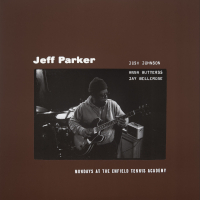 Over the past two decades, guitarist Jeff Parker has made a name for himself as a genre-bending artist, including a long tenure with the post-rock band Tortoise, collaborations with Rob Mazurek in the Chicago Underground, and his recently acclaimed efforts as a bandleader for International Anthem and Nonesuch. And yet rarely have any of Parker’s most recent efforts demonstrated his protean abilities as a jazz-trained soloist in a small group setting. Two new releases remedy that oversight, providing a fascinating study in contrast between Parker’s approach towards both short-form and long-form improvisation; Eastside Romp exemplifies the former, whereas Mondays at The Enfield Tennis Academy is indicative of the latter.
Parker is joined on Eastside Romp by fellow West Coast resident Eric Revis on bass and lifelong New Yorker Nasheet Waits on drums. In addition to being the rhythm section for Tarbaby (with pianist Orrin Evans), Revis and Waits each have an impressive CV; together they have worked with Peter Brötzmann, Kurt Rosenwinkel, and Armen Nalbandian, while Revis has kept time for Branford Marsalis and JD Allen, and Waits can be heard with everyone from Tim Berne to Jason Moran. Together, Parker and company embark on an old-fashioned blowing session, where the guitarist’s kaleidoscopic fretwork and instrumental proficiency is illuminated in a far more intimate setting than the larger sonic palettes of some of his newer albums. In truth, the session is not Parker’s alone; this collaborative effort features ample space for the subtle but powerful playing of Revis, and keen, sensitive work from Waits.
All of the songs are concise, focused originals written by members of the trio, except for one improvised piece and a cover of Marion Brown’s “Similar Limits,” from his 1969 Polydor album Porto Novo. They open the set with Brown’s jubilant theme, launching into a propulsive three-way conversation that climaxes in a chaotic breakdown before a brief restatement of the melody. Spurred on by Revis and Waits, Parker assumes the role of primary soloist, using ring modulation, phase shifting, and other pedal-driven effects to warp his sound. A thrilling opener, it doesn’t take long to hear how intently these three listen and respond to each other.
For the remainder of the date, the trio plays a variety of tunes, with Parker using different effects to change the timbre of his guitar on each number, adding sonic variety to the program with pithy, colorful solos. The evocative quietude of Parker’s “Wait,” a haunting ballad, is dappled with shimmering, reverb-laden notes, as Revis steps to the fore with a muscular bass solo. Waits’ “Between Nothingness and Infinity” is similarly spacious, with an unaccompanied intro by Revis, while Parker gradually adds cinematic layers of guitar, mixing Middle Eastern tonalities and minor key blues with dramatic flair.
The lead shifts to Waits on Revis’ intense “Drunkard’s Lullaby,” first heard on his 2017 Clean Feed release, Sing Me Some Cry. The rhythm section gracefully navigates a zigzagging path with dexterous precision, keeping time even after Parker’s heavily-processed guitar enters, smearing dissonant notes and stabbing skronk across the composition’s lumbering form. “That Eastside Romp,” a brief spontaneous collective improvisation, finds the rhythm partners careening in sync, letting Parker roam freely across his pedalboard. In contrast, Waits’ “A Room for VG” uses sparse notes and minimal percussion to reconcile accessibility and abstraction. Parker takes the lead on the closing “Watusi,” a tuneful number from his album Like-Coping (Delmark, 2003), unspooling clean modal lines over a fractured but swinging groove that ends the album on a high note.
Parker, Revis, and Waits had never recorded together as a trio before taping this session in a Pasadena studio one day in May of 2016. Given Parker’s growing reputation and the in-demand status of Revis and Waits, it seems odd that it took so long for this album to be issued, especially since it was mixed in 2018. Nonetheless, Eastside Romp is a most welcome release and a boon for fans of Parker’s idiosyncratic guitar stylings.
At double the length and half the number of selections, the concurrently released Mondays at The Enfield Tennis Academy is Parker’s first double album and first live recording as a bandleader. Featuring Parker’s working IVtet with alto saxophonist Josh Johnson, bassist Anna Butterss, and drummer Jay Bellerose, the program’s four album side-length cuts were selected from over 10 hours of recordings made between 2019 and 2021 at ETA, a bar in Los Angeles’ Highland Park neighborhood named after a fictional location in David Foster Wallace’s Infinite Jest. Titled by the dates they were taped, these extended, mid-tempo forays into lyrical, groove-based improvisation resound with hypnotic melodies and trancelike beauty.
All four members of the quartet are trained jazz musicians, and while the IVtet is occasionally known to play standards and originals, it is primarily a free improv group. The ensemble members move gracefully between foreground and background positions, lending the music a harmonious, composed aspect. Spacious, expansive, and relaxed, the proceedings are infused with a range of subtle stylistic influences, including ambient, drone, and dub.
Improving on a rapport developed over the past few years in Parker’s New Breed, Parker and Johnson alternate lead and support positions by intertwining cadences in real time or by using pedals to generate sampled loops that add buttressing layers of texture. Bellerose is similarly capable of emulating the sampled drum loops heard on Parker’s more beat driven projects, although his battery of percussion imbues these excursions with a folksier, acoustic quality, while Butterss’ sagacious bass lines provide the band with a solid foundation. Together, their cooperative approach yields a continuous reconfiguration of ensemble dynamics, as grooves loop and repeat into epic vamps that flow with deep focus and a sense of controlled freedom.
Despite the collective ethos, these long-form improvisations sound like extended extrapolations on the sort of brief, inimitable sketches Parker wrote for The New Breed (2016) and Suite For Max Brown (2020), his acclaimed efforts for International Anthem and Nonesuch. However, in stark contrast to the highly dynamic, compact renditions featured on Eastside Romp, these lengthy, minimalist forays – with only subtle gradations in articulation, density, and volume to differentiate between motifs – sometimes overstay their welcome, moving from mesmerizing to monotonous. Nonetheless, the leader’s signature sound is omnipresent throughout these long-winded jams, although the audacious sonic experimentation heard in the aforementioned trio session is largely absent from these four sides, where crisp lines dominate rather than painterly expressionism.
Having earned critical accolades for his independent releases and mainstream acceptance for his major label projects, Parker’s oeuvre embodies an artistic integrity where experimentation and accessibility exist in tandem. As exemplified by these two very different releases, Parker’s generosity as a bandleader and a collaborator encourages both personal autonomy and collective expression – a trait worth admiring in today’s highly divisive world.
–Troy Collins
Eve Risser Red Desert Orchestra
Eurythmia
Clean Feed CF609CD
 For a decade, the bulk of Eve Risser’s recordings have been in intimate settings – solo, duos, and two stand-out dates with En Corps, a trio with bassist Benjamin Duboc and drummer Edward Perraud that is roughly comparable to The Necks. All of them emphasize the pianist’s adept use of preparations and her propensity to skillfully stretch materials over considerable durations. To date, the outlier has been Les Deux Versants Se Regardent by her White Desert Orchestra, a conventionally configured tentet, save for a bassoon. On that 2018 album, Risser not only successfully transposed onto a larger canvas the use of space and texture that distinguished her other recordings, but she also penned themes whose somber gravity approximated that of Carla Bley and Kenny Wheeler, and deftly layered fierce, intersecting lines to create outsized orchestral weight. It revealed Risser to be a formidable composer.
The 12-piece Red Desert Orchestra’s Eurythmia irrevocably changes how to consider Risser’s place in contemporary music. It is now obvious that her horizons are even more vast than she previously established. Aside from the hushed, hymn-like bearing of a few passages, there are few resemblances between her two ensembles. Only electro-acoustic bass guitarist Fanny Lasfargues and alto saxophonist Antonin-Tri Hoang (who also played analog synthesizer on the current recording) are retained from the earlier lineup. Enlisting several African musicians whose balafons, djembes, and baras supply infectious rhythmic buoyancy and drive throughout the album, Risser has transformed her music. She mixes European and African ingredients with boldness and sensitivity, without relegating the African components to mere garnishes or starches. Her plying of teaming grooves, incisive background figures, and compelling soloists like Hoang and tenor saxophonist Sakima Abdou, are consistently spot on in terms of raising the music’s temperature and releasing its energy.
Eurythmia is one of the more rewarding recordings of the year. Eve Risser has taken a giant step in her creative journey.
–Bill Shoemaker