Moment's Notice
Reviews of Recent Recordings
(continued)
Gianluigi Trovesi + Gianni Coscia
La misteriosa musica della Regina Loana
ECM 2652
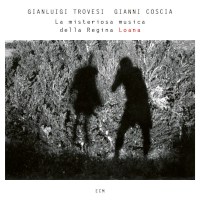 In his booklet essay for In cerca di cibo, the 2000 ECM album by clarinetist Lianluigi Trovesi and accordionist Gianni Coscia, Umberto Eco wrote of being “in the presence of a new transversality” that ignored the guardrails between genres while taking a deep dive into Italian folk music. With La misteriosa musica della Regina Loana, the duo pays homage to the great novelist, a friend of Coscia’s since they were teenagers. The album’s name is derived from the title of Eco’s 2004 novel, La misteriosa flamma della Regina Loana, in which the 59-year-old protagonist rummages through the attic of his childhood home in search of memories erased by a stroke. Ultimately, it is not his comic books, 78s, and magazines, but his grandfather’s original copy of Shakespeare’s First Folio that revives his memories; that is, all but the one he yearns for most – the face of the first girl he loved.
Trovesi and Coscia, the model for the lifelong friend of Eco’s autobiographical protagonist, have rummaged through the novel, collecting its many musical references to structure the album’s 19 tracks, of which only two exceed five minutes. Subsequently, their use of the popular Italian music of the 1930s and ‘40s, American chestnuts like “As Time Goes By” and “Sentimental Journey,” and fragments culled from Janáček’s “In the Mists,” float by just long enough to reach out and discover them gone. In doing so, Trovesi and Coscia extend Eco’s idea of transversality beyond one about musical genres, to suggest ideas about the relationship between music and memory, and the intertextuality Eco embraced in his novels.
Anyone who has seen Trovesi and Coscia perform can attest not only to their virtuosity and their captivating blend of textures, but also to their impeccable comic timing and touch, charming traits more pointedly framed on this collection than on their prior recordings. Charm is routinely mistaken for mere cuteness or cleverness, instead of being associated with mystery; on this recording, Troveri and Coscia’s is both sweetened with sentimentality, and leavened by the darkness that lurks in Eco’s novels. La misteriosa musica della Regina Loana is an utterly charming album in the fullest sense.
–Bill Shoemaker
Jeremy Udden
Three In Paris
Sunnyside SSC1545
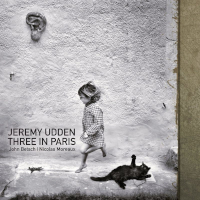 Saxophonist Jeremy Udden had moved away in recent years from the Americana-tinged jazz of the mid-sized Plainville project to focus on a more stripped-down approach. This has led to solo concerts, and back to one of his formative influences, Steve Lacy. The innovations pioneered by Lacy have long been an inspiration for Udden, who studied under the master while at the New England Conservatory. After Lacy passed in 2004, Udden performed at a memorial concert with Lacy’s friends and collaborators, including drummer John Betsch.
Betsch has been the driving force behind ensembles led by many high-profile musicians like Dewey Redman, Archie Shepp, and Henry Threadgill. More significantly, Betsch had a two-decade affiliation with Lacy, and a deep understanding of the saxophonist’s unique improvisational approach, being featured on many of Lacy’s albums. The American born Betsch has called Paris home for decades, performing with French bassist Nicolas Moreaux on occasion. Over the past few years, Udden began his own collaboration with Moreaux, recording the Belleville Project for Sunnyside in 2015. The idea of incorporating Betsch into a trio project with Moreaux eventually yielded Three In Paris.
After reconnecting with Betsch, Udden flew to Paris with thirty pieces (mostly originals and a few compositions by Lacy) and time for a single rehearsal, which yielded ten tunes; unsurprisingly, four are Lacy’s. Those songs exemplify the album’s most experimental aspirations. Udden performs “Who Needs It?” as a roiling duet with Betsch, transposing the lyrical melody into a freeform maelstrom. The dirge-like “Prayer” channels its composer’s quixotic aesthetic, with a moody, neo-noir atmosphere and supple rhythmic contours. Udden and Betsch waver in and out of time on a playful duo rendition of “The Crust,” while the final Lacy tune, “Bone,” is so spontaneously executed that it spurs on impromptu vocals from Betsch at the finale.
Although not penned by Lacy, Ellington’s “Azure” was a favorite of the saxophonist’s, especially in duet with pianist Mal Waldron. A throwback to the sort of pieces Udden played in Either/Orchestra, the quasi-Latin number is given a bright reading by the trio. The group also pays homage to Don Cherry (one of Lacy’s earliest collaborators), whose “Roland Alphonso” (a tribute to the Jamaican saxophonist) opens the date with a breezy ska rhythm that encourages inspired flights from Udden. There are a handful of original compositions by Udden as well, including the buoyant swinger “Hope” and the opulent ballad “Folk Song 2.” The program concludes with the freely improvised “One For Us,” which showcases the intuitive interplay the group developed over two days.
Steve Lacy’s mentorship and influence has been instrumental in Udden’s musical development. What a coincidence then that just as Udden began to explore a more stripped-down format, he reconnected with Betsch through Moreaux, which resulted in Three In Paris, an album not only inspired by, but directly indebted to his former teacher.
–Troy Collins
John Yao’s Triceratops
How We Do
See Tao Recordings 003
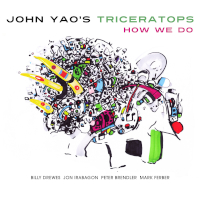 First, the good. John Yao’s Triceratops (Yao, trombone; Billy Drewes and Jon Irabagon, saxophones; Peter Brendler, bass; Mark Ferber, drums) is a cracker jack ensemble. Over the course of How We Do’s eight original compositions – seven by Yao; one by Irabagon – the quintet puts in a virtuosic performance. The three horns complement each other nicely, with Drewes’ more rambunctious stream of consciousness playing matching up well against Irabagon’s more logical constructions and Yao’s measured approach. This is immediately apparent on the album’s opener “Three Parts as One.” The ensemble playing is tight, and Brendler’s and Ferber’s inventiveness is often surprising. The only thing issue detracting from the performance is Drewes’s sound: he plays a tenor mouthpiece on alto, and even though what he plays is great, his tone lacks core and the intonation can get pretty squirrely. Others might not mind, but it’s a distraction.
Despite the above, and really wanting to like this album, it leaves me cold and occasionally comes off flat. While I can’t be sure as to the exact cause, I suspect it has to do with Yao’s studied, tricky, and expertly executed compositions. Whether it’s the sly, slinky “Triceratops Blues” or the medium-up swing of “Two Sides,” they all seem to exist in a kind of stylistic no man’s land or suffer from an identity crisis. The harmonic and melodic structures suggest that there should be more tension and release, but that’s rare. And I can’t help feeling that there’s a voice missing or that the lines could lie a little more naturally in the harmonic and rhythmic context. What end goals are the tunes working toward? Are they supposed to be catchy and pithy? Or angular and abstract? Tuneful or tense? Are they launchpads for freewheeling solos, or the album’s raison d’ etre? It’s hard to decide if they aren’t “out” enough, or if they secretly wish they were a bit more conservative. Either way, the compositions feel like their top button needs to be undone, tie loosened, and shirttails untucked. Maybe then the sextet could open up and see what it could really do.
–Chris Robinson
Yimba Rudo
Yimba Rudo
Barking Hoop BRH-012
 Kevin Norton revived his Barking Hoop label for the first album by Yimba Rudo, a co-op trio with percussionist Jim Pugliese, with whom he goes way back, and bassist Steve LaSpina, who is one of the percussionist-composer’s colleagues at William Paterson University. During the label’s lengthy dormancy, Norton increasingly gravitated towards playing vibraphone, and sought to integrate his roots in creative music with post-modern chamber music. With Norton penning seven of the thirteen compositions included on the album, these trajectories are updated in fine detail. However, the larger picture is the trio itself; only does Pugliese, who also has long straddled the same sub-genres as Norton, and LaSpina, whose extensive mainstream credentials have somewhat obscured his more adventurous projects, contribute complementary compositions of their own, but they are equals in creating the type of cohesive interplay that, for many, trios best offer.
The trio stakes out a wide swath of conceptual terrain in the opening tracks. Norton’s lead-off “Reconcile the Classical View” echoes the lithe chestnuts Michael Gibbs wrote in the ‘60s for Gary Burton. Pugliese’s episodic “Toronto” follows, which links the stop-go phrases of post-war jazz depictions of Manhattan, the slyly turned phrases of composite music-era Braxton, and a surging concluding passage, with freely improvised interludes highlighted by finely bowed bass textures. Arco bass takes the lead on LaSpina’s “Winter Retreat,” a lovely ballad that is provocatively brief. It is the restraint of the latter that brings into focus one of Yimba Rudo’s core virtues as an ensemble, one evidenced on these and every subsequent track: a bit less is much more, not just in terms of duration, but also in density – their spacing of materials, filigrees, and asides is impressive.
Yimba Rudo is one of the more refreshing albums of the year. Hopefully, Norton will keep the lights on at Barking Hoop WHQ.
–Bill Shoemaker