Moment's Notice
Recent CDs Briefly Reviewed
(continued)
William Parker
+ The Little Huey Creative Music Orchestra
For Percy Heath
Victo CD 102
 Some
may find Percy Heath an unlikely dedicatee
of a concert-length work by William Parker.
Heath's legacy as the bassist for The Modern
Jazz Quartet and The Heath Brothers is primarily
that of an ensemble player, not a virtuoso
soloist. This should not suggest that Heath
merely blended in with artful efficiency.
He carried the MJQ by their collars without
rumpling the tuxes, which is perhaps why
he is more renowned for elegance than power
and torque, even though these qualities have
equal presence in his playing. It is therefore
intriguing that Heath dubbed Parker "Iron
Fingers" after first hearing Parker
with Cecil Taylor in the early 1980s, a story
Parker tells in his brief booklet notes for
this four part composition for the 14-piece
Little Huey Creative Music Orchestra. Instead
of extrapolating what he heard in Heath's
playing, Parker emphatically sets out to
live up to Heath’s nickname, commencing
this largely hard-charging set with a brisk
solo walk. What’s different about Parker’s
approach to this staple of jazz bass playing
is that it is phrase-based, not changes-based.
The rolling and tumbling phrases don’t
enable the easy anticipation of harmonic
movement, turnarounds, etc. Subsequently,
Parker’s charts initially seem to have
loose-fitting parts; but, in short order,
they adhere, creating riveting passages that
inevitably launch a solo from a member of
Parker’s extremely deep bench, including
trumpeters Roy Campbell and Lewis Barnes,
saxophonists Rob Brown and Sabir Mateen,
and trombonist Steve Swell. The piece rarely
downshifts, but when it does, the poignancy
contrasts well against the prevailing ferric
fervency of the performance. It is a inspired
tribute.
Some
may find Percy Heath an unlikely dedicatee
of a concert-length work by William Parker.
Heath's legacy as the bassist for The Modern
Jazz Quartet and The Heath Brothers is primarily
that of an ensemble player, not a virtuoso
soloist. This should not suggest that Heath
merely blended in with artful efficiency.
He carried the MJQ by their collars without
rumpling the tuxes, which is perhaps why
he is more renowned for elegance than power
and torque, even though these qualities have
equal presence in his playing. It is therefore
intriguing that Heath dubbed Parker "Iron
Fingers" after first hearing Parker
with Cecil Taylor in the early 1980s, a story
Parker tells in his brief booklet notes for
this four part composition for the 14-piece
Little Huey Creative Music Orchestra. Instead
of extrapolating what he heard in Heath's
playing, Parker emphatically sets out to
live up to Heath’s nickname, commencing
this largely hard-charging set with a brisk
solo walk. What’s different about Parker’s
approach to this staple of jazz bass playing
is that it is phrase-based, not changes-based.
The rolling and tumbling phrases don’t
enable the easy anticipation of harmonic
movement, turnarounds, etc. Subsequently,
Parker’s charts initially seem to have
loose-fitting parts; but, in short order,
they adhere, creating riveting passages that
inevitably launch a solo from a member of
Parker’s extremely deep bench, including
trumpeters Roy Campbell and Lewis Barnes,
saxophonists Rob Brown and Sabir Mateen,
and trombonist Steve Swell. The piece rarely
downshifts, but when it does, the poignancy
contrasts well against the prevailing ferric
fervency of the performance. It is a inspired
tribute.
Odean Pope
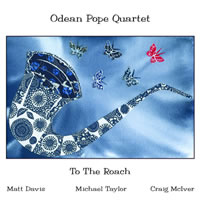
To The Roach
CIMP #353
 24
years -- it's Gonsalves' stint with Ellington;
and tenor saxophonist Odean Pope's tenure with
Max Roach. While Pope never had a singular
recorded performance like "Diminuendo
in Blue and Crescendo in Blue" with Roach,
he helped the drummer maintain a forward-leaning
edge in his working unit when other bop-birthed
legends meandered or played it relatively safe.
In particular, Roach's preference in concert
for the long form -- with tunes stretching
out to 20 minutes or more -- took on a reactionary
aspect in the neo-classic '80s, a militancy
of sorts. Though Roach made his greatest albums
before Pope replaced Billy Harper in the drummer's
quartet in the late 1970s, Roach's quartet
with Pope, Cecil Bridgewater and Tyrone Brown
is a splendid late chapter in a great epic.
Pope has sustained Roach's unbending spirit
on his own recordings, so it's no surprise
that it permeates To
The Roach, especially
the magisterial title piece. The presence of
guitarist Matt Davis is something of a surprise,
but only on paper, as his lean sound and propulsive
lines fit in with bassist Michael Taylor, another
well-suited newcomer to Pope’s fold,
and Pope’s steadfast drummer, Craig McIver.
McIver gives the necessary nods to the Jo Jones-Roach
lineage with well-designed solos and impeccably
timed fills, and continues to support Pope
in the open field with an easily asserted power
and an unerring knack for echoing key phrases
in Pope’s solos, perhaps his most refined
Roach-like attribute. Pope is simply stoked
throughout the set, whether the vehicle is
a playfully Monkish romp, a chestnut-flavored
ballad replete with a sweeping cadenza, or
a bristling flag-waver. As his most cited asset
is his indomitable sound, it is somewhat counter
intuitive to think of Pope as a tenor player
with great range, but his albums always prove
him to be so, and To
The Roach is no exception.
24
years -- it's Gonsalves' stint with Ellington;
and tenor saxophonist Odean Pope's tenure with
Max Roach. While Pope never had a singular
recorded performance like "Diminuendo
in Blue and Crescendo in Blue" with Roach,
he helped the drummer maintain a forward-leaning
edge in his working unit when other bop-birthed
legends meandered or played it relatively safe.
In particular, Roach's preference in concert
for the long form -- with tunes stretching
out to 20 minutes or more -- took on a reactionary
aspect in the neo-classic '80s, a militancy
of sorts. Though Roach made his greatest albums
before Pope replaced Billy Harper in the drummer's
quartet in the late 1970s, Roach's quartet
with Pope, Cecil Bridgewater and Tyrone Brown
is a splendid late chapter in a great epic.
Pope has sustained Roach's unbending spirit
on his own recordings, so it's no surprise
that it permeates To
The Roach, especially
the magisterial title piece. The presence of
guitarist Matt Davis is something of a surprise,
but only on paper, as his lean sound and propulsive
lines fit in with bassist Michael Taylor, another
well-suited newcomer to Pope’s fold,
and Pope’s steadfast drummer, Craig McIver.
McIver gives the necessary nods to the Jo Jones-Roach
lineage with well-designed solos and impeccably
timed fills, and continues to support Pope
in the open field with an easily asserted power
and an unerring knack for echoing key phrases
in Pope’s solos, perhaps his most refined
Roach-like attribute. Pope is simply stoked
throughout the set, whether the vehicle is
a playfully Monkish romp, a chestnut-flavored
ballad replete with a sweeping cadenza, or
a bristling flag-waver. As his most cited asset
is his indomitable sound, it is somewhat counter
intuitive to think of Pope as a tenor player
with great range, but his albums always prove
him to be so, and To
The Roach is no exception.
Enrico Rava
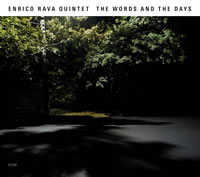
The Words and the Days
ECM 1982
 Much
has been written about Manfred Eicher’s
penchant for a reverberant recorded sound,
but too often the discussion centers predominantly,
if not exclusively on the piano. Enrico Rava’s
newest quintet album is a timely reminder
that the trumpet also benefits from Eicher’s
approach, as it intensifies the mystique
and the brio Rava conveys. Not that Rava
needs sweetening; his tone is luminous and
his shadings subtle even when he plays acoustically
in a slightly dry room. Still, those extra
few nanoseconds of decay repeatedly serve
the music extremely well, whether Rava and
trombonist Gianluca Petrella are slaloming
through long-lined themes, or the trumpeter
is letting a single note hover over the refined
interplay of pianist Andrea Pozza, bassist
Rosario Bonaccorso and drummer Roberto Gatto.
It is especially evocative when ballads like
Rava’s “Todamor” are brought
to a simmer, and the splash of cymbals and
the deep bass vibrato seep into the foreground.
On the Chet Baker-associated “The Wind,” the
mix emphasizes Petrella’s shadowing
of Rava’s statement of the theme with
a very live mid range and low end, creating
a voluptuous sound not commonly identified
with the pouting trumpet icon. However, the
engineering does not diffuse the quintet’s
edge when Rava ramps up a rapid-fire solo
and his cohorts kick into high gear. Eicher’s
approach supplements rather than supplants
Rava’s concepts, making the producer
an invaluable sixth man.
Much
has been written about Manfred Eicher’s
penchant for a reverberant recorded sound,
but too often the discussion centers predominantly,
if not exclusively on the piano. Enrico Rava’s
newest quintet album is a timely reminder
that the trumpet also benefits from Eicher’s
approach, as it intensifies the mystique
and the brio Rava conveys. Not that Rava
needs sweetening; his tone is luminous and
his shadings subtle even when he plays acoustically
in a slightly dry room. Still, those extra
few nanoseconds of decay repeatedly serve
the music extremely well, whether Rava and
trombonist Gianluca Petrella are slaloming
through long-lined themes, or the trumpeter
is letting a single note hover over the refined
interplay of pianist Andrea Pozza, bassist
Rosario Bonaccorso and drummer Roberto Gatto.
It is especially evocative when ballads like
Rava’s “Todamor” are brought
to a simmer, and the splash of cymbals and
the deep bass vibrato seep into the foreground.
On the Chet Baker-associated “The Wind,” the
mix emphasizes Petrella’s shadowing
of Rava’s statement of the theme with
a very live mid range and low end, creating
a voluptuous sound not commonly identified
with the pouting trumpet icon. However, the
engineering does not diffuse the quintet’s
edge when Rava ramps up a rapid-fire solo
and his cohorts kick into high gear. Eicher’s
approach supplements rather than supplants
Rava’s concepts, making the producer
an invaluable sixth man.
Ned Rothenberg’s
Sync with Strings
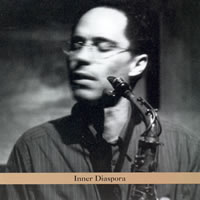
Inner Diaspora
Tzadik TZ 8114
 An
album teeming with bristling melodies, elegantly
unfurling arrangements, and strong rhythms,
Inner Diaspora could be the most important
album Ned Rothenberg ever makes. It speaks
truth to power on a couple of counts. It
is a decisively secular response to what
Rothenberg describes in his booklet notes
as Tzadik boss John Zorn’s long-standing
request for “a Jewish record” (Rothenberg’s
italics). Given Sync’s multi-cultural
mandate, it is also an implicit critique
of the conundrum of Jewish identity politics,
which Rothenberg compares to a well whose
water both nurtures and alienates. The Jewish
tinge of Rothenberg’s music is as likely
to be based on the Arabic and Iberian scales
and rhythms of Sephardic music as it on the
Eastern European forms used in klezmer, and
the tinge intensifies into a blush only occasionally.
Even when the dramatic sweep of Mark Feldman's
violin and Erik Friedlander's cello presence
are front and center, Samir Chatterjee's
tabla patterns and Jerome Harris' lap steel,
acoustic bass and steel stringed guitars
sufficiently fuse the cultural bearings of
the music into a paradoxical polyglot: This
is Jewish music and it's not. If one can,
take this issue off the table, as defining
to the album as it is, and consider the material
using only Rothenberg's recordings to date
as the evaluative criteria. The album still
retains a somewhat exclusive stature in Rothenberg's
discography as it documents his range as
a composer and multi-instrumentalist, and
his specificity of expression and idiomatic
detail, at their fullest. Each piece brings
an aspect of Rothenberg's identity into bold
relief, be it a treacherous odd-metered theme
reflecting his considerable research into
Indian music or an alto saxophone solo that
affirms his roots in the creative music of
the 1970s. As there are bright sensuous melodies
the listener can slip into like a bath as
well as goose bump-raising compositional
structures, the album can be heard primarily
as an aesthetic statement, apart from the
issue of Jewish identity. Inner
Diaspora works as both.
An
album teeming with bristling melodies, elegantly
unfurling arrangements, and strong rhythms,
Inner Diaspora could be the most important
album Ned Rothenberg ever makes. It speaks
truth to power on a couple of counts. It
is a decisively secular response to what
Rothenberg describes in his booklet notes
as Tzadik boss John Zorn’s long-standing
request for “a Jewish record” (Rothenberg’s
italics). Given Sync’s multi-cultural
mandate, it is also an implicit critique
of the conundrum of Jewish identity politics,
which Rothenberg compares to a well whose
water both nurtures and alienates. The Jewish
tinge of Rothenberg’s music is as likely
to be based on the Arabic and Iberian scales
and rhythms of Sephardic music as it on the
Eastern European forms used in klezmer, and
the tinge intensifies into a blush only occasionally.
Even when the dramatic sweep of Mark Feldman's
violin and Erik Friedlander's cello presence
are front and center, Samir Chatterjee's
tabla patterns and Jerome Harris' lap steel,
acoustic bass and steel stringed guitars
sufficiently fuse the cultural bearings of
the music into a paradoxical polyglot: This
is Jewish music and it's not. If one can,
take this issue off the table, as defining
to the album as it is, and consider the material
using only Rothenberg's recordings to date
as the evaluative criteria. The album still
retains a somewhat exclusive stature in Rothenberg's
discography as it documents his range as
a composer and multi-instrumentalist, and
his specificity of expression and idiomatic
detail, at their fullest. Each piece brings
an aspect of Rothenberg's identity into bold
relief, be it a treacherous odd-metered theme
reflecting his considerable research into
Indian music or an alto saxophone solo that
affirms his roots in the creative music of
the 1970s. As there are bright sensuous melodies
the listener can slip into like a bath as
well as goose bump-raising compositional
structures, the album can be heard primarily
as an aesthetic statement, apart from the
issue of Jewish identity. Inner
Diaspora works as both.