Moment's Notice
Recent CDs Briefly Reviewed
(continued)
Keith Tippett +
Julie Tippetts + Louis Moholo-Moholo + Canto
Generàl
Viva La Black Live At Ruvo
Ogun OGCD 020
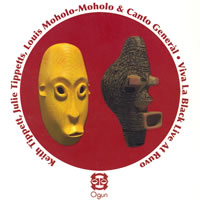 Pianist
Keith Tippett and drummer Louis Moholo-Moholo's
decades-long collaboration is an important
ongoing chapter in the history of Moholo-Moholo
and his fellow South African exiles' impact
on British jazz. Since such 1970s benchmark
as Moholo-Moholo's Spirits Rejoice sextet and
Tippett's Ark orchestra, they have shuttled
easily between each other's projects. This
exhilarating concert recording with vocalist
Julie Tippetts and Canto Generàl, an
Italian orchestra with 17 instrumentalists
and 6 singers, surveys Tippett's compositions
stretching back to "Septober Energy," penned
at the dawn of the '70s for his 50-piece Centipede,
sifting in four Dedication Orchestra charts
and a reading of the South African national
anthem in the process.
Pianist
Keith Tippett and drummer Louis Moholo-Moholo's
decades-long collaboration is an important
ongoing chapter in the history of Moholo-Moholo
and his fellow South African exiles' impact
on British jazz. Since such 1970s benchmark
as Moholo-Moholo's Spirits Rejoice sextet and
Tippett's Ark orchestra, they have shuttled
easily between each other's projects. This
exhilarating concert recording with vocalist
Julie Tippetts and Canto Generàl, an
Italian orchestra with 17 instrumentalists
and 6 singers, surveys Tippett's compositions
stretching back to "Septober Energy," penned
at the dawn of the '70s for his 50-piece Centipede,
sifting in four Dedication Orchestra charts
and a reading of the South African national
anthem in the process.
This is not the best setting to hear how Tippett and Moholo-Moholo ramp up each other's intensity, though it is reflected in the warp speed tempo of Dudu Pukwana's "MRA" and Harry Miller's "Dancing Damon." Both arrangements use tightly meshed section writing to convey incessant drive, and it's a measure of Canto Generàl's brinkmanship that the readings don't fray from the heat. Tippett's compositions span a smoldering ballad dedicated to Mingus, the to-the-ramparts call of "Septober Energy," and the rhythmically-charged complexities of "Cider Dance;" again, there are few opportunities for Tippett and Moholo-Moholo to volley lightning bolts, but the pieces do flesh out their common ground, which extends far beyond the exiles' canon.
Throughout the proceedings, Canto Generàl provides cut muscle and profuse colors as the charts require, and proves to have a deep bench of soloists. Soprano saxophonist Roberto Ottaviano shows considerable range with his ache-filled solo on "Archie's Chair" and his sinewy blues lines on "Septober Energy;" his dovetailing the ever-luminous Tippetts on the latter is a high point. So too are the duos between trumpeter Luca Calabrese and baritone saxophonist Nicola Pisani in the wake of the fuming opening section of "Cider Dance" and the trombones of Beppe Caruso and Michele Marzella on the Mongezi Feza's magnificent "You Don't Know Me 'Cos You Think You Know Me."
McCoy Tyner
Mosaic Select: McCoy Tyner
Mosaic Select 25
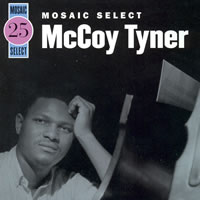 Although
McCoy Tyner had already delved into African materials
and demonstrated a distinctive approach to orchestration
on earlier Blue Note albums like Tender
Moments,
an undervalued nonet date from '67, the '68-'70
sessions collected on this 3-CD Mosaic Select
collection are often viewed as transitional,
paving the way for the pianist's definitive Milestone
dates of the 1970s. While taking nothing away
from such borderline desert island discs like
Song For My Lady, a revisiting of albums like
Expansions, Extensions
and Asante, as well as
the adventurous tracks assembled on the mid-'70s
2-fer, Cosmos, suggests that this work constituted
a great leap forward for the pianist, and that
he then spent a decade consolidating these gains
on his Milestone albums.
Although
McCoy Tyner had already delved into African materials
and demonstrated a distinctive approach to orchestration
on earlier Blue Note albums like Tender
Moments,
an undervalued nonet date from '67, the '68-'70
sessions collected on this 3-CD Mosaic Select
collection are often viewed as transitional,
paving the way for the pianist's definitive Milestone
dates of the 1970s. While taking nothing away
from such borderline desert island discs like
Song For My Lady, a revisiting of albums like
Expansions, Extensions
and Asante, as well as
the adventurous tracks assembled on the mid-'70s
2-fer, Cosmos, suggests that this work constituted
a great leap forward for the pianist, and that
he then spent a decade consolidating these gains
on his Milestone albums.
Expansions was a substantial first step in this process, a septet date featuring Ron Carter on cello, who nimbly moved between a front line of trumpeter Woody Shaw and saxophonists Gary Bartz and Wayne Shorter, a rhythm section rounded out by bassist Herbie Lewis and drummer Freddie Waits, and several gray areas in between, his pizzicato sometimes having an oud-like quality. Tyner also elicited additional colors from Bartz and Shorter, who doubled on wooden flutes and clarinet, respectively. Compositionally, Tyner's skill at mixing vamp-driven motives and exciting bop-derived lines on pieces like "Vision" was complemented by an emergent articulation of non-Western materials on compositions like "Song of Happiness;" Tyner progressively wound these strands together to create his signature style. At the same time, Tyner aired out his penchant for straight-up blowing on tunes like "Smitty's Place," which facilitated great duels between Tyner and Shorter and Shaw and Bartz, and a refreshing exchange between Carter, Lewis and Waits.
Before convening the summit-like Extensions with Alice Coltrane and Elvin Jones in 1969, Tyner recorded three compositions combining a jazz quintet and a string quartet, including the joyous waltz, "Song for My Lady." Though the strings -- and, for that matter, everyone on the date except for Lewis and Waits -- are left behind when Tyner takes flight, the ensembles strike a real balance between the strings, soprano saxophonist Harold Vick, and Al Gibbons (who plays flute and reeds), whether the material is rhythmically insistent or has the sweep of a spiritual. Producer Michael Cuscuna's postscript to the original liner notes mentions how a depressed market forced Tyner to drive a cab during these years, a fact sadly supported by these three dangling tracks, a facet of Tyner's artistry kept in suspended animation until the recording of Song of the New World in 1973.
Arguably, 1969's Extensions is the pivotal album of Tyner's career. The elemental force of his playing and writing is both intense and uplifting on "Message from the Nile," which moves a five-note motive across a simple set of changes. His knack for creating dramatically resolving themes sharpens on compositions like "The Wanderer," and his approach to a billowing rubato feel on "His Blessings" no longer rides the draft of John Coltrane's. This is the album on which Tyner really begins to fill the void left by the saxophonist's premature death, and the fact he does so in tandem with Alice Coltrane's majestic cascading harp and Jones’ sky-opening drums in nothing less than astounding. Rounding out the sextet is Bartz, Carter and Shorter, who hand.
Extensions was not pivotal only in that it set a new predicate for Tyner's work, but that it opened conceptual doors as well, as evidenced by the two 1970 sessions that comprise the set's third disc. The first features a sextet with the unusual front line of oboe, flute and saxophone, played respectively by Andrew White, Hubert Laws and Bartz. Instead of emphasizing subtle shadings, Tyner elicits a robustness not usually associated with such a palette. With Lewis and Waits feeding the fire, both White and Laws deliver solos that have comparable gravity to those of the ever-gritty Bartz. Though Tyner's compositions for the most part revisit familiar terrain -- the buoyant "Asian Lullaby" being something of a diversion, a theme that would have fit into a Jones date from that time period -- the instrumentation gives his music a distinctive sheen.
Since it was not released until 1974, the prescient quality of Asante has been somewhat obscured. This septet date with White (on alto saxophone), vocalist Songai Sandra Smith, guitarist Ted Dunbar, bassist Buster Williams, drummer Billy Hart and percussionist Mtume is Tyner's contribution to the triangulation of post-Coltrane jazz with a more populist sensibility, one that was being articulated by artists a noteworthy swath of artists at the time, including Bartz and Doug and Jean Carn. Up to this point, Tyner was an artist of the 1960s. With Asante, Tyner recognized that the music was on the move, and was willing to go with it on his terms.
Various Artists
New Music For Electronic & Recorded
Media: Women In Electronic Music 1977
New World Records 80653-2
 Produced
by Charles Amirkhanian for 1750 Arch, Women
In Electronic Music 1977 articulated three
important points that should be periodically
reiterated. The first is that there is a trajectory
of women composers working with cutting-edge
sound sources that stretches back to the late
1930s. This point is strongly anchored with
the inclusion of Johanna M. Beyer's 1938 composition, "Music
of the Spheres," which calls for everything
from a "lion's roar" to subtle glissandi
as it explicates a series of complex canonic
relationships. Since Beyer never specified
any of the 20-odd electric instruments in use
at the time (she also devised an alternate
score for strings), it's impossible to comment
on the sonic authenticity of this late '70s
performance by The Electric Weasel Ensemble,
which utilizes Music Easel synthesizers and
other anachronistic devices. Despite some attributes
that now seem quaint, Beyer demonstrated an
approach to pitch relationships that is forward-leaning
by today’s standards.
Produced
by Charles Amirkhanian for 1750 Arch, Women
In Electronic Music 1977 articulated three
important points that should be periodically
reiterated. The first is that there is a trajectory
of women composers working with cutting-edge
sound sources that stretches back to the late
1930s. This point is strongly anchored with
the inclusion of Johanna M. Beyer's 1938 composition, "Music
of the Spheres," which calls for everything
from a "lion's roar" to subtle glissandi
as it explicates a series of complex canonic
relationships. Since Beyer never specified
any of the 20-odd electric instruments in use
at the time (she also devised an alternate
score for strings), it's impossible to comment
on the sonic authenticity of this late '70s
performance by The Electric Weasel Ensemble,
which utilizes Music Easel synthesizers and
other anachronistic devices. Despite some attributes
that now seem quaint, Beyer demonstrated an
approach to pitch relationships that is forward-leaning
by today’s standards.
The anthology also cogently argued that women
were in the front ranks of composers in the 1960s
and 70s who took New Music out of academia and
gave it street cred. Gloriously grating pieces
like Pauline Oliveros’ “Bye Bye Butterfly” (’65)
shredded existing norms by running a recording
of Madam Butterfly through a gauntlet of oscillators,
line amps, and tape recorders to bring on the
noise in a way that presages onkyo artists like
Sachiko M by decades. Likewise, Megan Roberts’ “I
Could Sit Here All Day” (1976) mixes Moog,
bird calls, drums and caterwauling voices, creating
a skull-rattling intensity that foreshadows the
withering vocal style of Diamanda Galas and,
more generally, New Music’s dalliances
with punk and new wave rock. The anthology closes
with two short 1977 pieces by Laurie Anderson, “New
York Social Life” and “Time To Go;” their
pithy texts and loopy parts for Anderson’s
violin and Scott Johnson’s guitar, organ
and tambura go a considerable distance to explain
why Anderson became New Music’s superstar.
Perhaps most importantly, the three pieces
that rounded out the collection demonstrated
that at any given point in time -- and the
mid 1970s is as arbitrary as you can get, in
this regard -- women are creating richly diverse
work. Annea Locwood's "World Rhythms" (1975)
constructed vibrant polyrhythms from such seemingly
incongruous environmental sounds as birds,
geysers and volcanic activity. Inspired by
regional fiddle and banjo music, Laurie Spiegel
spooled out dueling computer-generated modal
hockets on "Appalachian Grove I" (1974).
And, Ruth Anderson used sine waves as a balm
on "Points" (1973-74).
Iannis Xenakis
Percussion Works
Mode 171/73
 Much
is made about the duality of Iannis Xenakis,
and rightly so. There is the Turing-like savant
who saw through the lead shield of FORTRAN and
devised UPIC. And then there’s the mythologist
with an Artaudian sense of cruelty. Xenakis reconciled
these seemingly contrary facets by using objective
processes to compose pieces seething with primordial
power. This is why his music speaks to many listeners
who otherwise have no use for composition, history,
et al. Arguably, these aspects of the composer’s
sensibility collide with the greatest force in
his compositions for percussion, where the common
starkness of numbers and ritual is unfiltered.
Presented in chronological order, this 3-CD collection
of Xenakis’ percussion works (a term that
encompasses both pieces scored only for percussion
and duets scored for percussion and another instrument)
details how this starkness prevailed. Even though
the titanic clashes between instruments on “Persehassa” (the
earliest, written in ’69) were largely
mitigated by the penning of “Pléïades”,
the silence-punctuated ensembles, the languorous
ripples and Reich-like pulse of keyboard-configured
instruments and the gamelan-tinged phasing of
sixxen (Xenakis’ pitched metallic invention)
in the 1978 consensus-pick masterpiece retain
the earlier piece’s demand for clarity.
This demand is perhaps most stringently expressed
in the duets with harpsichord, “Komboï” and “Oophaa,” composed
in the early and late ‘80s, respectively,
where the material’s intense rhythmic drive
is tempered by the dynamic restraints imposed
by the harpsichord. There are numerous daunting
challenges to present this body of work as a
whole, which the project’s director, Steven
Schick, meets in the only appropriate way – head-on.
Whether he leading the red fish blue fish percussion
ensemble or tackling the set’s two percussion
solos and the duets with oboe and voice, Schick
demonstrates a palpable understanding of Xenakis’ intents
and purposes, a key reason why this is a monumental
collection.
Much
is made about the duality of Iannis Xenakis,
and rightly so. There is the Turing-like savant
who saw through the lead shield of FORTRAN and
devised UPIC. And then there’s the mythologist
with an Artaudian sense of cruelty. Xenakis reconciled
these seemingly contrary facets by using objective
processes to compose pieces seething with primordial
power. This is why his music speaks to many listeners
who otherwise have no use for composition, history,
et al. Arguably, these aspects of the composer’s
sensibility collide with the greatest force in
his compositions for percussion, where the common
starkness of numbers and ritual is unfiltered.
Presented in chronological order, this 3-CD collection
of Xenakis’ percussion works (a term that
encompasses both pieces scored only for percussion
and duets scored for percussion and another instrument)
details how this starkness prevailed. Even though
the titanic clashes between instruments on “Persehassa” (the
earliest, written in ’69) were largely
mitigated by the penning of “Pléïades”,
the silence-punctuated ensembles, the languorous
ripples and Reich-like pulse of keyboard-configured
instruments and the gamelan-tinged phasing of
sixxen (Xenakis’ pitched metallic invention)
in the 1978 consensus-pick masterpiece retain
the earlier piece’s demand for clarity.
This demand is perhaps most stringently expressed
in the duets with harpsichord, “Komboï” and “Oophaa,” composed
in the early and late ‘80s, respectively,
where the material’s intense rhythmic drive
is tempered by the dynamic restraints imposed
by the harpsichord. There are numerous daunting
challenges to present this body of work as a
whole, which the project’s director, Steven
Schick, meets in the only appropriate way – head-on.
Whether he leading the red fish blue fish percussion
ensemble or tackling the set’s two percussion
solos and the duets with oboe and voice, Schick
demonstrates a palpable understanding of Xenakis’ intents
and purposes, a key reason why this is a monumental
collection.