Moment's Notice
Recent CDs Briefly Reviewed
by
Bill Shoemaker
Uri Caine
Plays Mozart
Winter & Winter 910 130-2
 Remember
the whole deal about how listening to Mozart
made you smarter? It would be interesting
to rerun the experiments, replacing straight
readings of his compositions with Uri Caine’s
brilliant subversions. Mozart’s smarty-pants
facility and pat emotional string-pulling
become launching pads for spectacular deconstructionist
fireworks, while the depths of his last works
are scoured for seeds of the angst that bloomed
in the work of other Caine subjects like
Schumann and Mahler. At the same time, Caine
uses Mozart to give shout-outs to a wide
swath of jazz pianists, from romp-prone stylists
like Tatum to jazz's arch classicist, John
Lewis.
Remember
the whole deal about how listening to Mozart
made you smarter? It would be interesting
to rerun the experiments, replacing straight
readings of his compositions with Uri Caine’s
brilliant subversions. Mozart’s smarty-pants
facility and pat emotional string-pulling
become launching pads for spectacular deconstructionist
fireworks, while the depths of his last works
are scoured for seeds of the angst that bloomed
in the work of other Caine subjects like
Schumann and Mahler. At the same time, Caine
uses Mozart to give shout-outs to a wide
swath of jazz pianists, from romp-prone stylists
like Tatum to jazz's arch classicist, John
Lewis.
Caine and Lewis are far closer as conceptualists than the vast differences in their work suggest. Both defy the idea that there are legitimate and illegitimate forms of music. It's counterintuitive to think of the MJQ as defiant; however, both Lewis and Caine pursue a stereotype-nullifying agenda. The difference reflects profound sociological change; in the 1950s, jazz was the outsider, a role now played by DJs, computers, et al. Even when Caine digs into a fierce, fleet Tynerish groove as he does on his take on an aria from Don Giovanni, it is far better mannered than the ensuing outbursts of DJ Olive, electric guitarist Nguyên Lê, clarinetist Chris Speed, and drummer Jim Black.
Lewis' legacy is cautionary in that it points up how decisively music moves on. It is ongoing amazement how infrequently Lewis' compositions are performed now. It's hard to imagine another ensemble tackling Caine's technically treacherous, player-specific constructions. Most of this ensemble (including trumpeter Ralph Alessi) has contributed to previous composer projects of Caine's, which accounts for the close-order precision of their hair-raising take on first movement of "Symphony 40 in G Minor" and the hi jinx of "the Turkish Rondo." Additionally, Caine places equal weight on both the light and dark in Mozart's music, sometimes requiring musicians to repeatedly regear their attack and tone throughout a composition. A consummate ensemble player, violinist Joyce Hammann can convey grandeur or a glint of caprice as required. Lê shows enormous range; he is a valuable second to Olive in providing noise, and can even slip in a few runs that seem plundered from a Queen album.
Through these means, Caine coaxes, cajoles and strong-arms the listener to rethink Mozart, and perhaps become smarter in the process.
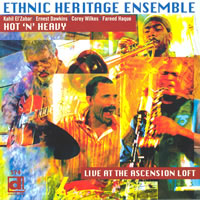
Ethnic Heritage Ensemble
Hot 'N' Heavy
Delmark DE 574
Delmark DVD 1574
 Singing
and dancing. Modes of entertainment, some would
say. Chanting. That's ritual. Kahil El'Zabar
does all three in the course of a set, as well
as excavating ancient grooves on handmade congas,
pushing rhythms outward on traps, and thumbing
charming patterns on kalimba. It is all of
an obviously single fabric in performance.
Still, it has taken 30 years for "the
African implications, the spirit of community," for
El’Zabar’s approach to be fully
recognized by stentorian musicians, El'Zabar
observes in conversation for Neil Tesser's
notes to Hot 'N' Heavy. The set showers the
listener with buoyant rhythms, bright-moment
melodies and solos combining sustained heat
and sharp focus – exactly the mix that
elicits scorn from Puritanical commentators.
Director Tom Koester’s eye-moving shots
and Steve Wagner’s crisply paced editing
of the DVD reinforces the seasonal aspect of
the music and the setting. It is summer in
Chicago, the musicians are dripping sweat (after
the ebullient opener, “Major to Minor,” El’Zabar
pithily welcomes the audience to Miami) and
the audience is seated on folding chairs; but,
there’s a body moving to the music in
each shot. And, there’s a quality of
movement, be it a heat-defiant sway or an energy-efficient
nod, that signifies real engagement. It’s
this engagement that best argues that this
projection of creative music is as essential
to the AACM’s legacy as its most experimental.
It’s also significant that the recording
was made at the Ascension Loft, El’Zabar’s
performance space/gallery/residence; as a result,
the performance is part parlor recital, part
rent party, part civic association meeting,
and part open house.
Singing
and dancing. Modes of entertainment, some would
say. Chanting. That's ritual. Kahil El'Zabar
does all three in the course of a set, as well
as excavating ancient grooves on handmade congas,
pushing rhythms outward on traps, and thumbing
charming patterns on kalimba. It is all of
an obviously single fabric in performance.
Still, it has taken 30 years for "the
African implications, the spirit of community," for
El’Zabar’s approach to be fully
recognized by stentorian musicians, El'Zabar
observes in conversation for Neil Tesser's
notes to Hot 'N' Heavy. The set showers the
listener with buoyant rhythms, bright-moment
melodies and solos combining sustained heat
and sharp focus – exactly the mix that
elicits scorn from Puritanical commentators.
Director Tom Koester’s eye-moving shots
and Steve Wagner’s crisply paced editing
of the DVD reinforces the seasonal aspect of
the music and the setting. It is summer in
Chicago, the musicians are dripping sweat (after
the ebullient opener, “Major to Minor,” El’Zabar
pithily welcomes the audience to Miami) and
the audience is seated on folding chairs; but,
there’s a body moving to the music in
each shot. And, there’s a quality of
movement, be it a heat-defiant sway or an energy-efficient
nod, that signifies real engagement. It’s
this engagement that best argues that this
projection of creative music is as essential
to the AACM’s legacy as its most experimental.
It’s also significant that the recording
was made at the Ascension Loft, El’Zabar’s
performance space/gallery/residence; as a result,
the performance is part parlor recital, part
rent party, part civic association meeting,
and part open house.
Hot ‘N’ Heavy is also noteworthy because it marks the debut of Corey Wilkes with the EHE. The brilliant young trumpeter displays complementary assets to those he brings to the Art Ensemble of Chicago. He employs electronics, which are triggered downstream from his microphone; the resulting gurgles and smears give his fat bluesy phrases and darting lines a ‘70s tinge (which is vividly underlined when saxophonist Ernest Khabeer Dawkins gets out the police whistle). Wilkes’ two-horn passages are pungently Kirkish at times, a thorough mixing of the idiomatic and the idiosyncratic. And, his solos ricochet off the scrappy comping of periodic guest artist, guitarist Fareed Haque, and El’Zabar’s simmering grooves in unexpected directions. Most importantly, Wilkes alters the overall sound of the EHE, much more than Haque or other previous guest artists. The replacement of Joseph Bowie’s tailgating trombone with Wilkes’ soaring trumpet, particularly when paired with Dawkins’ exultant alto, places even greater bottom-supplying responsibility to El’Zabar. Fortunately, the percussionist is singularly deft at keeping the most elemental rhythmic information of a composition audible even when determinedly pushing the envelope of a piece. This is also what allows Haque a free hand in developing his flinty solos without a tethering bass.
In documenting the ongoing evolution of an esteemed, long-lived ensemble and encapsulates vital issues of community, Hot ‘N’ Heavy clears a high bar most recordings don’t even attempt.
Expanded Botanics
Refugium
Ninth World Music NWM 039CD
 One
of the more intriguing aspects of electro-acoustic
improvisation is that, even though its methods
can be all but concealed from the listener,
even a relatively unqualified listener can
quickly knows when the sparks – or
the sine waves – are flying. Of course,
engagement with the music does not necessarily
get the listener as close to its workings
than is the case with, say, blues or bebop.
That’s the delicious conundrum of Expanded
Botanics second album, Refugium. The parameters
violinist Philipp Wachsmann (who also employs
electronics), percussionist Peter Ole Jørgensen,
and laptop player Jakob Riis are working
with remain below the surface for the most
part. But, whatever processes and protocols
are embedded in the music, it makes small
matter. It works. Jørgensen draws
on an uncluttered, markerless syntax, which
stands in marked contrast to the barrages
he unleashes in full-throttle blows with
the likes of Peter Brøtzmann and Mats
Gustafsson. Wachsmann lets timorous violin
timbres merge with his own electronics and
Riis’ output, resulting in exchanges
where no sound’s source can be immediately
IDed. It takes the coyly folkish “Field” to
make one realize the subtle role of rhythm
in this music – not in the sense of
jazz-related ideas of pulse, but in the primary
idea that divisions of time can convey the
sensation of movement. To this end, the electronics
are co-equals of the percussion, and not
simply because Jørgensen is frequently
the source of samples and loops. Wachsmann
and Riis repeatedly supply forward movement
with soft-edged textures and motif-like sounds.
Expertise in electro-acoustic improvisation,
however, is not required to hear it.
One
of the more intriguing aspects of electro-acoustic
improvisation is that, even though its methods
can be all but concealed from the listener,
even a relatively unqualified listener can
quickly knows when the sparks – or
the sine waves – are flying. Of course,
engagement with the music does not necessarily
get the listener as close to its workings
than is the case with, say, blues or bebop.
That’s the delicious conundrum of Expanded
Botanics second album, Refugium. The parameters
violinist Philipp Wachsmann (who also employs
electronics), percussionist Peter Ole Jørgensen,
and laptop player Jakob Riis are working
with remain below the surface for the most
part. But, whatever processes and protocols
are embedded in the music, it makes small
matter. It works. Jørgensen draws
on an uncluttered, markerless syntax, which
stands in marked contrast to the barrages
he unleashes in full-throttle blows with
the likes of Peter Brøtzmann and Mats
Gustafsson. Wachsmann lets timorous violin
timbres merge with his own electronics and
Riis’ output, resulting in exchanges
where no sound’s source can be immediately
IDed. It takes the coyly folkish “Field” to
make one realize the subtle role of rhythm
in this music – not in the sense of
jazz-related ideas of pulse, but in the primary
idea that divisions of time can convey the
sensation of movement. To this end, the electronics
are co-equals of the percussion, and not
simply because Jørgensen is frequently
the source of samples and loops. Wachsmann
and Riis repeatedly supply forward movement
with soft-edged textures and motif-like sounds.
Expertise in electro-acoustic improvisation,
however, is not required to hear it.
Guillermo Gregorio
+ Pandelis Karayorgis + Nate McBride
Chicago Approach
Nuscope CD 1019
Mat Maneri + Denman Maroney
Distich
Nuscope CD 1018
 Although
these albums are rightly paired by Nuscope
for their respective connections to the vibrant
Boston scene, Guillermo Gregorio's 1998 Red
Cube(d) (hatOLOGY) provides a useful genealogical
reference point. While Gergorio's trio with
pianist Pandelis Karayorgis and violinist
Mat Maneri largely focused on the clarinetist/saxophonist's
deconstructions of 1940s jazz compositions,
there was a tug between cool abstraction
and churning emotions in the album's improvised
exchanges that was not only thoroughly engaging,
but crystallized a way to sublimate but not
snuff out the use of idioms. These two fine
recordings parse out the two essences that
created this exquisite tension. Though Chicago
Approach is comprised mainly of collective
improvisations, the inclusion of pieces by
Jimmy Guiffre and Don Friedman is a reminder
of the pull of cool jazz on both Gregorio
and Karayorgis, while Gregorio's original
compositions reinforces the notion that he
triangulates ideas of structure found in
abstract art. On the freely improvised Distich,
Maneri's melting pot of influences -- which
extend far beyond the reflexively cited microtonal
work of his father, Joe Maneri, to include
baroque and folkloric sources -- is boldly
offset by Denman Maroney's hyperpiano.
Although
these albums are rightly paired by Nuscope
for their respective connections to the vibrant
Boston scene, Guillermo Gregorio's 1998 Red
Cube(d) (hatOLOGY) provides a useful genealogical
reference point. While Gergorio's trio with
pianist Pandelis Karayorgis and violinist
Mat Maneri largely focused on the clarinetist/saxophonist's
deconstructions of 1940s jazz compositions,
there was a tug between cool abstraction
and churning emotions in the album's improvised
exchanges that was not only thoroughly engaging,
but crystallized a way to sublimate but not
snuff out the use of idioms. These two fine
recordings parse out the two essences that
created this exquisite tension. Though Chicago
Approach is comprised mainly of collective
improvisations, the inclusion of pieces by
Jimmy Guiffre and Don Friedman is a reminder
of the pull of cool jazz on both Gregorio
and Karayorgis, while Gregorio's original
compositions reinforces the notion that he
triangulates ideas of structure found in
abstract art. On the freely improvised Distich,
Maneri's melting pot of influences -- which
extend far beyond the reflexively cited microtonal
work of his father, Joe Maneri, to include
baroque and folkloric sources -- is boldly
offset by Denman Maroney's hyperpiano.
A cursory listening to Maneri and Maroney's nine improvisations suggests a fundamental incompatibility between Maneri, who plays 5-string viola throughout, and Gregorio. Much of this impression is prompted by Maroney's jarring, iridescent vocabulary. Some of the pianist's techniques are based on methods of direct string excitement -- as opposed to passive preparations -- first devised by George Crumb. Whereas Crumb developed his approach in service of his Appalachian magic realism, Maroney has no such template-like sensibility. As an improviser, Maroney thoroughly operates in the moment, which is reflected in his sudden shifts in direction and methods of attack. Ultimately, this registers as an aura of instability, which is not suggest anything unsure about his intentions and execution; it is a cosmology of sorts that Maroney proffers. In a way, Maroney's work is as lucid and self-circumscribed as Gregorio's constructions, and it is the similarity of Maneri's responses to both – a mix of hesitancies, mulled phrases, and flaring intensities – that slowly rises to the surface after listening to the albums in tandem.
Conversely, the limpid surfaces of the improvisations by Gregorio, Karayorgis and bassist Nate McBride take on translucent layers with repeated listening. The trio's abilities to sustain a sense of spaciousness and to buttress form with timbre (particularly Karayorgis, who dampens with great finesse) produce pockets into which the listener can delve and recalibrate the music's motivations and movements. Subsequently, Gregorio's clarinet takes on an urgency not initially felt, one that further separates him from the implicit Giuffre mold of the instrumentation and the inclusion of "Variation." Likewise, when McBride's bow scrapes and skitters across the strings, evocative shadows are cast. Mix in the respective idiomatic facets of Gregorio and Karayorgis' playing, and there are many elements vying to be heard.
In addition to their individual merits, Chicago Approach and Distich suggests that a reunion of Gregorio, Karayorgis and Maneri is in order.