Moment's Notice
Reviews of Recent Recordings
(continued)
Jon Irabagon + Joe Fiedler + Todd Neufeld
In Formation Network
Nuscope CD 1031
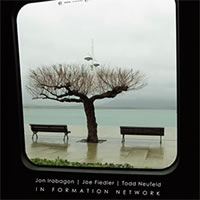 The unorthodox combination of saxophone, trombone, and guitar dates to the late 1950s, when trombonist Bob Brookmeyer was recruited to fill the bass position (then occupied by Ralph Peña or Jim Atlas) in Jimmy Giuffre’s trio with guitarist Jim Hall. The same instrumentation was reprised by alto saxophonist John Zorn, trombonist George Lewis, and guitarist Bill Frisell thirty years later on News For Lulu (Hat Art, 1990) – a bold reimagining of classic hard bop tunes by the likes of Sonny Clark, Kenny Dorham, Hank Mobley, and Freddie Redd. Now, three decades afterwards, In Formation Network, which features saxophonist Jon Irabagon, trombonist Joe Fiedler, and guitarist Todd Neufeld, explores the untapped potential of this unique format, while simultaneously acknowledging the innovations of their forebears.
Together, Irabagon, Fiedler, and Neufeld reflect the divergent aspects of Giuffre’s seminal efforts and Zorn’s revisionist experiment, bolstering their collective interest in textural nuance with a mercurial attitude. Eschewing unscripted collective improvisations, they reveal a varied set of harmonious compositional strategies, with each member contributing at least one original. Neufeld’s opener, “C.G.F.,” reveals the trio’s ethereal, chamberesque sound as it drifts between serenity and impetuousness, while a number like Fiedler’s “I’m In” offers funky swing dappled with a bluesy hue. Although Fiedler’s brassy multiphonics and Neufeld’s efx pedals imbue the proceedings with an array of kaleidoscopic colors, it’s the assured virtuosity of Irabagon’s extreme tonal manipulations that virtually steal the show. The saxophonist’s mastery of extended techniques comes to the fore on the album’s most arresting cut, “Wai’ anapanapa.” Translated from Hawaiian as “glistening water,” it conjures dramatic visions of blood spilt by a vengeful husband – a gripping juxtaposition of heartrending pathos and assaultive dissonances.
In addition to the handful of originals, the session includes two noteworthy covers: “Voodoo” by Sonny Clark, and “Mayday Hymn” by German trombonist Albert Mangelsdorff. The former’s lock-step rhythms and contrapuntal interplay recall the swinging renditions of Clark’s tunes on News For Lulu, while the latter is a lush paean to its author, interpreted with fervent lyricism. The expertly sequenced program is thematically book-ended by two takes of Swiss trombonist Samuel Blaser’s “Pieces of Old Sky,” a meditative dirge culled from the album of the same name (Clean Feed, 2009) that featured Neufeld. The set gracefully concludes with a hushed rendition of Blaser’s haunting tone poem, providing a perfect ending to a most remarkable recording.
–Troy Collins
Joe McPhee + Pascal Niggenkemper + Ståle Liavik Solberg
Imaginary Numbers
Clean Feed 455
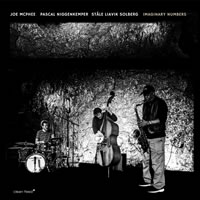 Sometimes it’s hard to keep track of how many righteous records Joe McPhee puts out, but this one is especially worth your time. An LP-length live hit from Brooklyn in December 2015, this set is a 3-track dedication to Coltrane.
The immediate impression is that this is music of vast space in the playing. These fellows aren’t content to just start out with a generic free jazz boil. Rather, there’s patient, linear work from Niggenkemper, some lovely pinched textures from McPhee’s trumpet, and pointillism from Solberg, who plays with gravity but a lightness of touch that I really dug. The opening piece “i” pivots around a stirring, melancholy tenor section. But on the way there and out are multiple, rapidly changing environments that emerge and transform with a real sense of musical purpose and heft. The transitions can be catalyzed by something as judicious as a mute being added to McPhee’s trumpet for a few moments, a new percussion texture like scraping with a stick, or a pregnant pause in the bassist’s motion. But there’s also a winning attention to harmonic shifts that’s sadly too rare in free music.
The dark motivic playing that opens “A” is certainly indebted to Trane in a general sense. But whereas Trane preferred to explore these kinds of ideas over marathon durations, this trio opts for density and compactness. The concluding “Zero Supreme Love” opens up with a tasteful, economical drum solo. It’s a great place for studying Solberg’s very distinctive aesthetic, which often has him bouncing sticks off the rim or alternating different registers of tuned drums. And when Niggenkemper enters it’s almost imperceptible, so dialed in is he to the sounds and patterns that he could almost be another drum. The trio packs more into a few minutes than many groups do into an hour. There’s a sizzling, hushed bass/drums duo, a sustained and intense trumpet feature, and a bracing, bright groove to close things out. With all kinds of sound swirling about, and very distinctive personalities, this concert is a riveting reminder of the power of improvised music.
–Jason Bivins
Roscoe Mitchell + Matthew Shipp
Accelerated Projection: Live at Sant’Anna Arresi
RogueArt 0079
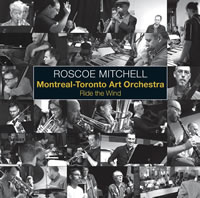
Roscoe Mitchell + Montreal-Toronto Art Orchestra
Ride the Wind
Nessa 40
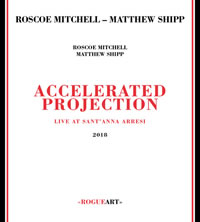
 These past two decades have been an especially rewarding and prolific period of Roscoe Mitchell’s art and Accelerated Projections is one of the very best improvisations he’s ever created. It comes from a 2005 celebration of the AACM’s 40th anniversary, in Sardinia, no less. Pianist Matthew Shipp is in his own way as intense as Mitchell and his atonality is at one with saxist-flutist Mitchell’s harmonic world. Better yet, as he develops his ideas he ranges more widely than Mitchell, in long lines. He can move independently of Mitchell’s alto sax, as in part I; he can develop a line of drama to amplify alto sax violence, as in part IV; he can lead Mitchell’s soprano sax high and low, as in part VI, the longest improvisation. The seventh and final track is Shipp’s second piano solo, quiet, ruminative, the calm after Mitchell’s storms.
“Accelerated Projections II” is Shipp’s other, very lively solo and part III is Mitchell’s brilliant, unaccompanied alto solo – again, one of his very best, ever. The singular elements of his art, the close evolution of ideas, the repetitions, the small variations are so imaginative here that this solo is an ideal introduction to Mitchell. The super-ferocious momentums of other improvised Mitchell works are not in this concert, so his lyricism is especially evident, as in his terrific alto in parts III and I. His musical lines, like Henry Threadgill’s, are all thorns and spikes, but much busier, longer, heavier, crueler. “Accelerated Projections V” is a soft, slow-moving piano-flute duet. Part VI moves from piano-soprano chords and tones in rubato space, to a slow momentum, to fast momentums and independent, simultaneous storms. Altogether, Mitchell’s music is so vital, it seems like he wants to live forever.
Roscoe Mitchell’s large-ensemble works have been rare and include some highlights of his career like his 1979 big band and 2009 symphony-orchestra setting of Non-Cognitive Aspects of the City. Ride the Wind is another highlight. Stuart Broomer’s extensive program notes illuminate the long process that yielded six of these seven new pieces. They’re orchestrations, by Mitchell and three colleagues, of pieces from his two Conversations CDs (Wide Hive, 2013), those bright, tight, closely felt improvisations by Mitchell, keyboardist Craig Taborn, and drummer Kikanju Baku. And hoo boy, the Ride the Wind expansions sound nothing like the originals. New material got added, interpretations are free as can be, with different dynamics, and there’s some more improvising, too. For instance, the title piece and “RUB” originally began as rubato explorations of sound-space tension, which disappears completely in the 21-piece-orchestra version. Instead, the “Ride the Wind” track now has slow momentum and long-tone harmonies, while “RUB” is a veritable zoo of awakening sounds and colors.
The young orchestra includes five brass, two violas, five rhythm, vibes, and six woodwinds from piccolo to contrabass clarinet. With such resources, no wonder the orchestrations blew the originals up into such a colorful spectrum of sounds. The most drastic reinterpretation is “Shards and Lemons,” which originated as a concentrated, 3:41 duet of tensions. Mitchell himself blew this one up into 12 minutes of all kinds of contrasts, high vs. low, long tones vs. tiny, fast tones, tense sounds in space vs. full ensemble. Christopher Luna-Mega’s orchestration of “Splatter” may come closest to the contours of the original, but oh, my, what rich sounds. “They Rode for Them” is divided into two parts, which include the CD’s only solos, Yves Charuest on alto and Mitchell on sopranino. Finally, there is yet another interpretation of “Nonaah,” a quartet version by Nicolas Caloia. Are we now in the Era Of The Composer? Because there’s sure been some stimulating music recently and Ride the Wind is sure a beauty.
–John Litweiler
Adam Nussbaum
The Lead Belly Project
Sunnyside SSC 1500
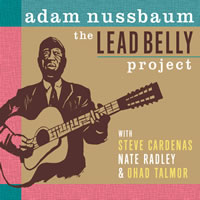 Adam Nussbaum’s The Lead Belly Project focuses squarely on the blues, specifically the seminal efforts of one Huddie Ledbetter (1888-1949), aka, Lead Belly. An immensely influential artist, Lead Belly’s work has inspired countless artists from multiple generations, including jazz musicians, ranging from Clifford Jordan, whose These Are Our Roots: The Music of Lead Belly (Atlantic Records, 1965) is a classic of its kind, to Geof Bradfield’s more recent endeavor, Our Roots (Origin Records, 2015).
Less raw than Robert Johnson, Charlie Patton, or Son House, Lead Belly is generally considered one of the more erudite of early-century musicianers. Nussbaum and his band, which features guitarists Steve Cardenas and Nate Radley, as well as saxophonist Ohad Talmor, reinterpret some of Lead Belly’s most popular songs with panache. Talmor’s breathy, yet resonant tone blends well with the guitarists’ protean fretwork, which veers from the countrified twang of “Bring Me A Little Water, Sylvie” to the swaggering rockabilly of “Black Girl (Where Did You Sleep Last Night).” The often-covered “Black Betty” is delivered with rocking intensity – a riot of intertwining guitars and lunging rhythms, while the dusky lyricism of the closer, “Goodnight Irene,” unravels in a veil of gauzy long tones. Underneath it all, Nussbaum’s animated drumming keeps the proceedings buoyant, elevating numbers like “Grey Goose” and “You Can’t Lose Me Cholly” into ecstatic folk revelries.
As loose and roughshod as the quartet’s interpretations are, there is a deft sophistication present. Even Nussbaum’s two modern originals – the languid ballad “Insight, Enlight,” and the slinky mid-tempo blues shuffle “Sure Would Baby” – fit seamlessly into this dynamic program. Infused with a carefree Americana vibe, these musos reinterpret Ledbetter’s iconic work with an elemental heartland simplicity that evokes the rustic and urban in equal measure.
–Troy Collins
Barre Phillips + Motoharu Yoshizawa
Oh My, Those Boys!
NoBusiness Records NBCD 103
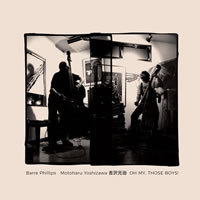 The fruitful collaboration between the Lithuanian NoBusiness and Japanese ChapChap labels continues in fine form with this live bass duo recording from Barre Phillips and Motoharu Yoshizawa. The set, recorded in April 1994 at Café Amores, Hofu, Yamaguchi, Japan, is a consummate matching of two bass masters. Both began recording and performing solos in the ‘60s and they bring that steadfast probing of their instruments to this spontaneous duo. They also bring a deep-seated sense of musical investigation and collective discovery. Clocking in at 1 hour and 15 minutes, it is remarkable that the two pieces on this disc capture only part of the performance. The opening 40-minute duo was released on ChapChap’s Live “Okidoki” and the entire performance went for over three hours!
The disc begins with “Oh My!,” an expansive 55-minute improvisation. Immediately, one hears the contrast between Phillips’ acoustic bass and Yoshizawa’s homemade electric vertical five-string instrument. The darker, amplified tone and electronic shadings of Yoshizawa’s instrument provide a perfect foil for Phillips’ warm resonance. The two adeptly mine the dusky attack and reverberant sustain of their instruments, patiently building an intertwined dialog of plucked lines, tawny arco, scuttling overtones, and percussive counterpoint. Initially, the pace is measured as they settle in, then about 9 minutes in the momentum starts to mount with a passage of shuddering, sonorous arco. That acrobatic balance continues throughout the piece, with sections of brooding stillness that give way to lithe dynamism. Midway through, their twinned arco, tinged by Yoshizawa’s electronic treatments, becomes orchestral in depth and the richness of timbres and layering. But then, like a changeable sky, they open things up again with a strappingly active section of crackling bowed interchange. During the final section, Yoshizawa introduces Theremin-like sliding sonorities and skittering electronic oscillations, providing apt contrast to Phillips’ rounded tone and more angular attack.
After the almost hour-long tour de force of the opener, the second improv, titled “Those Boys,” starts with more open, spiky interplay. Yoshizawa’s electronic treatments percolate against Phillips’ most spunky, forceful playing of the set. Over the course of 20 minutes, the improvisation has a more restless edge to it, shifting course with mercurial verve. Phrases whiz by with bristling abandon as the two spontaneously steer the arc of the piece. Midway through, Yoshizawa caroms sinuous arco lines off of Phillips’ burred, groaning bowing, which push things off on a spiky trajectory. The final section launches into a flurry of countervailing bowed lines which amass into dense swirls, gradually decelerating to a poised calm. While the playing in this piece is often more boisterous than the opening improvisation, it never lacks a sense of careful listening on the part of the two players. This one is another winner from the ChapChap vaults and is a worthy addition to Phillips’ incredible string of bass duos with musicians like Dave Holland, Peter Kowald, Joelle Leandre, and Barry Guy.
–Michael Rosenstein