Moment's Notice
Reviews of Recent Recordings
(continued)
Greg Saunier + Mary Halvorson + Ron Miles
New American Songbooks, Volume 1
Sound American SA004
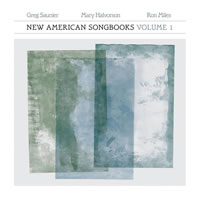 New American Songbooks, Volume 1, is the first recording in a new series produced by Sound American. This limited-edition LP features a one-time meeting between Greg Saunier, Mary Halvorson, and Ron Miles that redefines the concept of the Great American Songbook. Together, they update a time-honored tradition of adapting songs to the jazz idiom that were not expressly written for improvisers. Nate Wooley (producer for Sound American) asked Saunier, Halvorson, and Miles to pick some tunes as part of a new American canon. The result is a surprisingly egalitarian combination of lesser-known numbers culled from the worlds of pop, rock, jazz, and classical.
Saunier is best known as drummer for the eclectic post-punk band Deerhoof. Halvorson, the most creative guitarist of her generation, has worked with everyone from Anthony Braxton to John Zorn. Miles’ lyrical cornet has similarly graced numerous jazz ensembles, most notably those of Bill Frisell and Fred Hess. Collectively, their beguiling arrangements transcend their varied sources, reinventing populist themes as vehicles for spontaneous invention.
Most of the repertoire is contemporary, but obscure; John William’s “Luke and Leia” (from Return of The Jedi) is the exception, due to the current popularity of the Star Wars franchise. The rest of these under-appreciated gems include tracks by singer/songwriters like Fiona Apple and Elliot Smith, the Beach Boys, ‘70s pop from The Partridge Family, a ballad by Duke Ellington and Billy Strayhorn, and even a movement from classical composer Vincent Persichetti’s Symphony for Band.
Apple’s “Jonathan” opens the session in striking form; Halvorson’s bold attack and Saunier’s crashing cymbals underscore Miles’ clarion cries as the spirited take grows increasingly abstract. Miles often assumes the lead voice, as on “Luke and Leia,” where his tonally ambiguous variations are underscored by Halvorson’s echoing tremolos. The guitarist’s protean approach is particularly impressive in a medley of Smith’s “Everything Means Nothing To Me/Last Call” – kaleidoscopic on the former, anthemic on the latter. Conversely, her phantasmagoric glissandi throughout Ellington/Strayhorn’s “Day Dream” are appropriately quixotic.
The trio displays an uncanny rapport, despite this being the first time the three have played together. The unit tackles a wide range of genres and styles across the date’s 40-minute duration, delivering each adventurous interpretation with harmonious conviction. New American Songbooks, Volume 1 is a rousing success, accomplishing Wooley’s intended goal of expanding what qualifies as a modern songbook standard.
–Troy Collins
Stray
Into Darkness
Iluso Records CD09
 The group Stray brings together guitarist John Russell, saxophonist John Butcher, bassist Dominic Lash, and drummer Ståle Liavik Solberg for an extended 52-minute collective improvisation recorded live at Iklektik in London in December 2015. Russell has been a seminal part of the London free improvisation scene since the mid ‘70s and Butcher dove in during the early ‘80s, both working together for over three decades and individually in countless projects. Lash, has proved his mettle as a go-to bassist in a variety of settings: free jazz ensembles like The Convergence Quartet; collaborations with, among others, Alex Ward, Stefan Keune, and Tony Bevan; improvised settings with Mark Wastell’s The Seen or a trio with Axel Dörner and Roger Turner; performances of compositions by members of Wandelweiser or James Tenney to name just a few. Oslo-based Solberg has collaborated with both Russell and Butcher as well as players like Martin Küchen, Steve Beresford, and Joe McPhee. But these bona fides do little to prepare the listener for what happens when the quartet hits.
Things start out in familiar territory for those familiar with the members of the group. Russell’s dry guitar chords ring out against burred breathy tenor, rough-hewn arco, and spattered percussion. But at just a few minutes in, the energy starts to mount. Russell adds shades of distortion to his decidedly electric guitar tone, Butcher responds with long burly overtone-shaded notes, and Lash and Solberg stir things with clattering activity. Then Butcher digs in, with biting torrents of notes that recoil off of the guitarist’s feedback-tinged playing. From there, the four attack the improvisation with a feisty potency. These are all players well-versed in microscopic detail though, so they never get carried away with the brash energy of their playing. Instead, they probe and prod with carefully attuned collaboration.
This is some of Butcher’s brawniest playing in recent memory, drawing on his rough-hewn multiphonics and massive breath control to spill out vigorous lines on both tenor and soprano. Russell, a player mostly pegged for his acoustic playing, relishes the heft and coruscating blaze of electric guitar, leaning in with fuzz, grit, and abraded sustain. Lash digs in, his deep, full tone and propulsive momentum bounding across the spirited collective chemistry. Solberg is a canny participant, able to caterwaul along with lithe agility, darting around his kit with a keen ear for texture and timbral accent. The four build the improvisation around peaks of intensity that unfold into sections of more open interplay. When things drop to hushed detail about 35-minutes in, the subtle sonorities and granular detail each player brings to the proceedings is arresting. Then slowly, they layer on density, build dynamics, and charge to a shredding conclusion, rounding things off with minute kernels of breath, scraped strings, and percussive patter. Fine playing by all and a welcome glimpse at where the collective pushes each of these musicians.
–Michael Rosenstein
Third Coast Ensemble
Wrecks
Rogueart 077
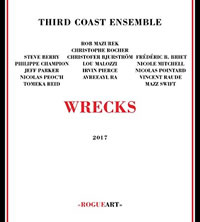 This record documents a fascinating summit of French and Chicago musicians, led by composer/director/cornetist Rob Mazurek. In much of his writings for large ensembles, Mazurek favors strong environments and atmospheres. It’s not so much that he does this at the expense of thematic materials or sub-groupings, but that he favors sonic immersion. The results are generally really compelling, and Wrecks is one the best things I’ve heard from him in the last few years.
Some gorgeous unisons for flautist Nicole Mitchell, guitarist Jeff Parker, and multiple horns open up “This is the Atoll” (included are Irvin Pierce on tenor, Christophe Rocher on clarinets, and Nicolas Peoc’h on alto and soprano; the brass section consists of trombonist Steve Berry and trumpeter Philippe Champion). In what are some of Mazurek’s signature compositional moves, these thematic materials are set in the midst of all kinds of swirling textures, creating just the right measure of tension (from horn overtones, or electronics, the latter courtesy of Lou Malozzi and Vincent Raude). The hour-long suite is made up of movements and compositions seguing gracefully, as when the fierce heat of “Drinkable Gold with Shadows’ Liquor” drifts apart suddenly to leave a lush section for piano (Christofer Bjuerstrom), strings (cellist Tomeka Reid, violinist Mazz Swift, and bassist Frederic B. Briet), and percussion (Avreeayl Ra and Nicolas Pointard). Smart sub-groupings and constant change keep things lively, and Mazurek impressive keeps the collective sound from blurring unproductively.
Highlights abound, and this listener was especially taken with the brightly melodic opening to “The Blue Oblivion,” which has a sterling Pierce solo set amid mid-tempo groove and chirping electronics. “The Saying Ship” is a brooding, ominous text piece (with Malozzi’s vocals), roiling flute and piano, and it’s got one of the most compelling aesthetics of the entire set: deep immersion into a particular space of reflection. “Cobalt of Chance” surges forth from there, riding on a gradually accelerating tutti riff that erupts into noise and fanfare. And this same piece contains what might be the most singular passage on the disc: Swift, Reid, and Bjuerstrom rocking it in between ensemble blasts. For all the excellent moments spotlighting individual voices (spare a moment for Parker’s righteous soloing on the churning “Wild Gale”), there are equally exhilarating passages for burning collective fire, like the modal work on “On the Trapeze of Minds Ferns.” Overall, it’s a record filled with depth and playfulness alike, realized by the musicians’ palpable conviction. And if you’re looking for evidence of that conviction, proceed to the final two tracks, the percolating “The Game Circle” and the riotous closer “The Island Beneath the Sea and Spirits’ Bean,” which has almost a rousing Brotherhood of Breath vibe. Terrific stuff overall.
–Jason Bivins