Moment's Notice
Recent CDs Briefly Reviewed
(continued)
Charles Lloyd
Rabo de Nube
ECM B0010663-02
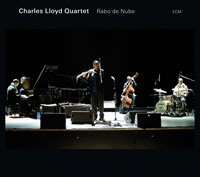 Charles Lloyd is 70 this year. What would you want to say about him? He's a survivor, for sure, though such an accolade is ambiguous, given that mere survival is hardly an honorific. An innovator? Perhaps in some degree, though this live recording from Basel finds him ever more securely encamped in Coltrane’s harmonic empire. A great composer? Possibly, though there isn’t anything from Lloyd’s now nearly twenty-year comeback period that jumps straight into the repertory, let alone the canon. The saxophone sound, these days mediated by a few spots on tarogato as well as alto flute, explains his affection for the obscure European horn. It’s mellow rather than hard-edged and it often takes that extra measure or two to pick up on Lloyd blindfold. He’s an unemphatic master.
It’s uncomfortable to admit it, but Stanley Crouch got it right when he said Lloyd’s genius lay in picking the exact musicians who could deliver the sound he was looking for. Such an observation doesn’t immediately rise out of the non-obvious -- Coltrane wasn’t inclined to take the first name in the phone book either -- but when one considers just how brilliant Lloyd’s recruitment has been over the years, it starts to make more sense. This, after all, is the man who recruited Keith Jarrett and Jack DeJohnette when they were still tyros and threw them onstage in the rock hangars he played at the time.
He’s done it again with pianist Jason Moran, bassist Reuben Rogers and drummer Eric Harland. Harland was the keystone of his last ECM disc Sangam and he delivers a tremendous performance here too, stretching out the time on even the most ostensibly clipped of meters. The opening “Prometheus” features one of the most exciting lines Lloyd has ever delivered, but the track then dissolves into a meet-the-band round of solos, which leave you wishing you were chained to a rock being pecked by an eagle, too. The reality is that, apart from Lloyd’s cadenzas and some of Moran’s features, this is a group that works most effectively when playing as a group. “Migration of the Spirit” is a lovely thing, with an enchanting coda. “Booker’s Garden” starts off on alto flute then hands over to Moran, who explores some quite unexpected intervals in a strangely edgy solo. Then, like most of these pieces, it changes tack entirely and comes on like a hard-bop swinger with an element of shuffle in the rhythm.
“Ramanujan” sees the tarogato come out, over more of Harland’s enigmatic percussion. It’s fairly orthodox snake-charming stuff, apart from the drummer’s role. Moran takes on “La Colline de Monk” for half its length before Lloyd sweeps back in Charlie Rouse mode to play it out as a thoughtful duo, punctuated with quotes. “Sweet Georgia Bright” is sinuous, elegant, almost sly in its use of altered changes, and not so very from the source material. Rogers does a fantastic job of a fast line. The only non-original is the Silvio Rodriguez title track, which sounds to these ears superfluous to a set that has already made a formidable mark. Shorn of it and “Ramanujan” and with an edited “Prometheus”, this would have made a terrific CD and a great telegram for Lloyd’s anniversary. As it is, it falls into that older man’s habit of carrying the conversation on just a little too long. But that’s what happens when you surround yourself with bright young guys who want to know how it was back in the day. It’s a great group, arguably his best.
–Brian Morton
Joe McPhee + Dominic Duval
The Open Door
CIMPoL 5003
Trio X
AIR: Above and Beyond
CIMPoL 5001
The Train & the River: A Musical Odyssey
CIMPVIEW 10001 DVD
 There’s bound to be an odd-ax out with multi-instrumentalists, an instrument that brings out the essence of his or her music as well as any, but for sundry reasons, is infrequently heard. For Joe McPhee, it is the alto saxophone. Prior to The Open Door, recorded at the 2006 Suoni Per Il Popolo festival in Montreal, McPhee had featured the alto on two recordings, which have now been somewhat triangulated by this duo set with bassist Dominic Duval. Old Eyes (1979; hat ART) and The Dream Book (1998; Cadence Jazz Records) were inspired by Ornette Coleman; recorded just a few months after Jackie Mac’s passing, The Open Door was named after the club where McLean first heard Charlie Parker. Yet, McPhee’s hauling out the alto does not simply signify homage; intriguingly, there are few passages where even an oblique connection to McLean can be made. What the two saxophonists share is a trenchant honesty, conveyed through a mastery of the edge and heart the horn can project. Particularly on the 25-minute opener, “Escape from the Shadows,” McPhee pivots nimbly between outbursts of guts-shredding intensity, passages of disarming lyricism, and seemingly everything in between. Unlike most who try, McPhee can infer the power of the tenor without straining his sound or the listener’s credulity. Arguably, Duval is McPhee’s perfect foil for the multi-instrumentalist regardless of what horn he is playing; but, here, the bassist’s darting phrases and serpentine lines are particularly well-suited to McPhee’s approach on alto.
In Jay Rosen, both McPhee and Duval have an acutely ensemble-minded drummer whose most pyrotechnic displays remain supportive of the overall direction of the music and never become superfluous or distracting. This is crucial to Trio X’s music, as McPhee can mull over pensive or even mournful lines for minutes at a time, maintaining delicate nuances and resisting easy resolution. At the other end of the spectrum, McPhee can unleash truly idiosyncratic torrents of sound, requiring equally close listening on the part of his colleagues. There’s a palpable mercurial quality to how Duval responds with everything from plump-toned vamps and sprints through the registers to garrulous arco effects and ethereal harmonics, which intensifies the charge of everything he does. On both AIR: Above and Beyond, recorded the day after the duo set, and The Train and The River, Dmitrij Veller’s documentary built around a 2006 Vilnius concert, Rosen emphasizes fundamentals without becoming simplistic or stereotypical. It may be an old-school role, but Rosen is the sturdy fulcrum between two heavy forces; still, he leverages more than enough room for himself on both performances.
Both concerts find Trio X slipping into jazz chestnuts – “Up Jumped Spring” and “Here’s That Rainy Day” on AIR… and “Lonely Woman” and “God Bless the Child” on the DVD – summoning ghosts like Albert Ayler’s, and delving into extended techniques to create gripping abstractions. The Vilnius footage reveals them to be noticeably relaxed performers, sufficiently secure in the moment to not rely on eye contact or gesture cues. This is also reflected in the interviews with all three members, clips from which are scattered through this very ambitious film. Veller is not satisfied with just the stock performance-interview formula, but introduces a separate narrative, inspired by the Jimmy Giuffre composition that gives the film its title. Comprised of exterior shots of trains and rivers, and shots of a woman on a train and then wondering the tracks, Veller creates some impressive sequences that mesh surprisingly well with the music. Principal camera operator and editor Evgeny Levin has a spot-on sense of composition, light and color in these sequences, and his multi-camera concert footage is consistently well-framed and has a crisp pace. While the film fulfills all of the requirements of a jazz documentary, it nevertheless feels like the Veller and Levin were constrained by the conventions. One wonders what they and musicians like Trio X would produce if creativity was the sole criterion of a collaboration. Still, this film fills a real documentary gap.
–Bill Shoemaker
Pauline Oliveros + Miya Masaoka
Accordion/ Koto
Deep Listening DL36-2007
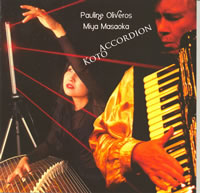 There’s something immediately strange and oddly compelling in this series of improvised duets for koto and accordion, an interactivity that seems to deconstruct the identity of the instruments at the same time that the two musicians exploit the instruments’ physical properties to the limits, the wire and wood of Masaoka’s koto, the bellows and reeds of Oliveros’s accordion. The four pieces are named for the segments of a day — “Daybreak,” “Forenoon,” “Afternoon,” and “Twilight” — and each is a distinct environment, the equivalent of a specific quality of light, mood arising as a condition of attentiveness to the auditory details of the space and the interaction. It’s improvisation so true to the instant that we become one with its unfolding, a gradual emergence of meaning that can take a listener’s breath away. The natural sounds that seem to enter (“Daybreak” is sub-titled “the sound of a crow”) and the affinities with other instruments (organ, harmonica, guitar) do not so much belong to the realm of the imitative but rather to the transformational. At times, the koto seems to assert its ethnicity with specific tonal content, while the accordion is as abstract as a distant Nebula, but by the conclusion, koto and accordion, silence and sound, seem to have fused.
–Stuart Broomer
Enrico Rava + Stefano Bollani
The Third Man
ECM 2020
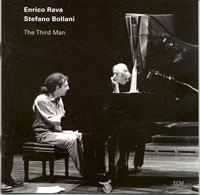 While ECM’s spacious, hyper-resonant sonic world is often associated with a Nordic aesthetic, it’s as well-suited to the lyric strain of Italian jazz and a group of musicians to whom rich timbre is virtually a birthright. Enrico Rava’s trumpet has a gorgeous, burnished metal sound and there are no cymbals to detract from it here, as he’s joined in close duets with Stefano Bollani, whose singing piano frames and enriches Rava’s every melodic flourish. The music turns readily to romance, but there’s substantially more than that here, the expressive range stretching to the sudden flashes into the upper register that mark the title track, or the sustained probing that takes place in Rava’s “Cumpari,” his lines bursting into chromatic flurries. It’s a virtuoso dialogue that’s as often marked by rambunctious spontaneity as gleaming timbre. Part of the brilliance of this work is revealed in the inclusion of three “covers,” Bruno Martino’s “Estate,” Antonio Carlos Jobim’s “Retrato Em Branco Y Prato” (heard in two contrasting versions), and Moacir Santos’ “Felipe.” The originals — like Rava’s luminous “Sun Bay” and the playful “In Search of Titina” and Bollani’s pensive “Santa Teresa” — seem just as melodically achieved.
–Stuart Broomer
Matana Roberts
The Chicago Project
Central Control 006
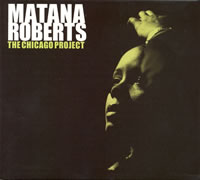 Saxophonist Matana Roberts had me hooked about one minute into “Exchange," the opening track of The Chicago Project. This is hard-edged, resolute fire music, with its roots absolutely in the new jazz of the '60s. One of the things it’s possible to dislike about it is that it doesn’t seem to trade in any way on developments over the last decade. How you respond to that will depend very largely on whether you think jazz improvisers should be toying with Radiohead tunes and Nick Drake songs or whether they should be strictly pentateuchal in their loyalties.
There’s nothing of the New Testament about Matana, and much of the old believer. When she brings on Fred Anderson for three “Birdhouse” improvisations, they sound very much like players of the same generation, except that there is a sliding, nurturing, warm-at-the-center quality to her saxophone tone that promotes an impression of yin-yang in the music. Apart from those pieces and “Nomra,” there’s not much surcease anywhere else on the album. It clips along, fuelled by Jeff Parker’s guitar, Josh Abrahams’ bass and Frank Rosaly’s drums.
“Love Call” sounds like Albert’s been revived, though again there’s something both steelier and more accommodating in the construction and delivery of the solo that leads you to think there’s a different spirit and a differently gendered idiom at work in there as well. As on “Exchange”, she’s wonderfully good at multi-tasking the group, getting different tempos and lines working in concert but working at sufficiently different angles to generate real dynamism rather than that all-too-frequent impression of an essentially simple idea and uncomplicated line roughened and distressed to suggest “freedom”.
After a couple of plays, one starts to recognize that the almost nostalgic cast of the record has a lot to do with a notably rough mix, which isn’t as bad as, say, a badly remastered ESP date from 1968, but with some of that present-tense roughness. There were probably difficulties with source performances for a couple of tracks fade our rather cravenly, which robs them of much of their power. This is the kind of music CIMP do very well (though of course they do other things not so well) and a little more audio vérité might perversely have done her favors. As it is, some of the production sounds like the aural equivalent of make-up applied in the dark. A more scrubbed sound might have been better, and given that Parker provides more than enough texture for the whole group, it wouldn’t have been so hard.
Still, you always quibble about the good ones. The year’s young, but this is the kind of thing you want to find in the post box in January. Makes you think it hasn’t all gone to hell. Matana Roberts will work – or continue to work – in challenging settings. She’ll probably have to resist a makeover of some sort.
–Brian Morton