Adam O’Farrill: In And Out Of The Frame
by Troy Collins
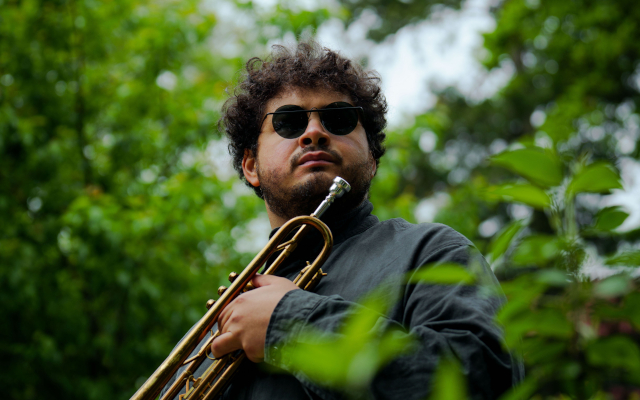
Adam O’Farrill © 2026 Alice Plati
Brooklyn-born trumpeter and composer Adam O’Farrill has recently emerged as one of the brightest new voices in contemporary jazz. Widely recognized as a rising star among the most in-demand trumpet players, over the past decade O’Farrill has earned acclaim from major outlets like The New York Times, The Wall Street Journal, NPR, as well as various international critics, while consistently appearing in DownBeat Critics Polls and year-end best-of lists.
O’Farrill comes from a distinguished musical lineage. His grandfather was the iconoclastic Afro-Cuban-Irish composer and arranger Chico O’Farrill; his father is jazz pianist and composer Arturo O’Farrill; his mother, Alison Deane, is a classical pianist and educator; and his brother, Zack O’Farrill, is a drummer, composer, and frequent collaborator. Adam is of Mexican, Cuban, and Irish heritage on his father’s side, and Eastern European Jewish and African-American heritage on his mother’s side. Growing up in the culturally diverse musical environment of New York City has informed both his artistry and a resistance to stylistic pigeonholing – an issue he addressed directly in a JazzTimes profile titled “Adam O’Farrill Does Not Play Latin Jazz.”
As a trumpeter, O’Farrill has performed and recorded with a wide variety of artists, including Mary Halvorson, Patricia Brennan, Stephan Crump, Rudresh Mahanthappa, Vijay Iyer, Tyshawn Sorey, Anna Webber, Hiromi, and many others. As a bandleader and composer, O’Farrill has developed a distinctive and deeply personal body of work that often encompasses themes of mixed-race identity, family history, and spirituality. His flagship ensemble is the long-running chord-less quartet Stranger Days, featuring saxophonist Xavier Del Castillo, bassist Walter Stinson, and drummer Zack O’Farrill. Stranger Days has released four albums in total, including its eponymous debut (Sunnyside, 2016), El Maquech (Biophilia, 2018), Visions of Your Other (Biophilia, 2021) and HUESO (Food, 2024).
In 2022 O’Farrill recorded his most ambitious large-ensemble statement to date, the expansive octet project For These Streets, a suite loosely inspired by the literature, culture, and music of the 1930s. In addition to his quartet and octet work, O’Farrill has led the electro-acoustic nonet Bird Blown Out of Latitude. He made his professional recording debut in 2013 on Chad Lefkowitz-Brown’s Imagery Manifesto and toured internationally from 2014 to 2017 with Rudresh Mahanthappa’s band. From 2022 to the present, O’Farrill has maintained an active international performance schedule, touring extensively throughout the U.S., Europe, and Asia with his own projects as well as with ensembles such as Mary Halvorson’s Amaryllis and Hiromi’s Sonicwonder.
O’Farrill has received numerous awards and honors for both his trumpet playing and composition. He won the DownBeat Critics Poll for Best Rising Star Trumpeter in 2019 and 2021, received the ASCAP Herb Alpert Young Jazz Composer Award, and has earned numerous commissions and grants from myriad organizations. He holds a Bachelor of Music degree in Jazz Performance from the Manhattan School of Music. I interviewed O’Farrill in the spring of 2026, just before the release of his new quartet recording ELEPHANT (Out Of Your Head) and an imminent European tour.
* * *
Troy Collins: You come from a long line of musicians. Some early biographical information might be of interest to readers unfamiliar with your background. How did you get your start playing music?
Adam O’Farrill: My mother, Alison Deane, is a classical pianist. She was born to an African American father and an Eastern European Jewish (primarily a mixture of Poland and Lithuania) mother, and grew up on the Upper West Side. From an early age, she was pretty ahead of the curve, having performed her first recital at Carnegie Hall at age 11, and graduated from high school when she was 15. Her father also was friends with several jazz musicians, including Randy Weston, who wrote a tune dedicated to my mom, “Little Susan,” featured on Weston’s 1959 album, Little Niles (Susan is my mom’s middle name). She went on to perform for years before becoming an integral member of the music faculty at the City College of New York for close to 30 years.
My father, Arturo O’Farrill, is a jazz pianist and composer. He was born to a Mexican mother and a Cuban-Irish father, happening to be Arturo “Chico” O’Farrill, one of the leading voices of mixing folkloric Cuban melody and rhythm with a plethora of musical styles, including big band and classical music. My grandfather worked with everyone from Charlie Parker to Machito, David Bowie to Count Basie, the last of whom my father remembers being a particularly funny character when he’d come over to the Upper West Side apartment for parties hosted by his parents. My dad grew up in the Upper West Side, but was born in Mexico City and moved with his family when he was age 4. His teenage years were filled with going to jam sessions and watching kung fu movies in Chinatown, and then being discovered by Carla Bley playing a gig in upstate NY at age 19, going on to tour with her for several years. Her stylistic boundlessness was a great inspiration for his own creative pursuit.
Fast forward to me being born, and being raised by two pianists who both grew up in the Upper West Side, and who both informed my own practice in very different, equally productive ways. Firstly, they both wanted to start with piano, which I did at age 6. Around that time, my dad took my brother and I to visit the late, great Dominican saxophonist, Mario Rivera, at his apartment on Columbus Ave, and he had one of Dizzy Gillespie’s old horns out, and let me try it. This was before I started learning trumpet, but I still remember the feeling of the brass on my lips, barely making a sound but smelling the years of tobacco on it. Then, when my brother, Zack, a drummer, percussionist, and composer, was in middle school, the concert band was playing, and I was enamored with the clarion presence of the instrument, even in that respectively shoddy context. So, at age 8, I began learning trumpet, taking years of lessons with the great Jim Seeley, who played in my grandfather’s band and still plays in my dad’s band. He was the best first trumpet teacher I could ask for, who managed to show me the fundamentals of the instrument simultaneously with learning how to improvise. From the beginning, I felt like the creative purpose of learning this instrument was so well illuminated. While that was happening, my dad would bring my brother and I down to the basement to play and learn tunes together. He was really adamant that I go for it, plunge into the dark and improvise, and it was definitely some tough love, but ultimately is a huge reason why I’m able to truly improvise as freely as I do today. My mom was crucial to instilling a sense of discipline in me. I would practice in my room, which was within visibility of the kitchen where she liked to relax and read, and if she saw me slouching while playing, she would tell me to sit up straight. She also made sure I practiced every day to begin with, so I would be nowhere without her. And my brother, Zack, was, and still is, essential to my musical growth and journey. He was listening to all of the coolest stuff before I did, from Art Blakey to Vijay Iyer, and continues to hip me to things that I don’t know. We also led a band together in high school that was almost solely responsible for me having motivation and a vehicle for which to write music.
TC: Did you have any other influential teachers or mentors early on that provided you with previously unknown creative avenues to explore?
AO: I already mentioned Jim, but the other thing I’ll say about him is that he was really great at making learning bebop language and tunes feel really fun. He just has such a pure love for the music and you could feel it in the way he demonstrated certain things to me. After Jim, I studied with a trumpet player named Nathan Warner, who taught in the pre-college program at Manhattan School of Music. He got me to open up my sound, and play much more broadly with more strength, volume, and range. I also took some lessons with Ambrose Akinmusire in high school, who really flipped my world upside down when I first saw him play (summer 2009, at The Jazz Standard, with Gerald Clayton’s band). The first lesson I took with him was definitely tough, as he basically said, “You can play all this language and licks. So what?,” and I think that really got me to ask myself why I play what I play, and what it is that I’m capable of communicating through my instrument. The second lesson, I definitely wanted to show him that I’d taken to heart what he’d said, and it felt a lot lighter, and I’ve always felt such love and support from him since then. And one of the biggest mentors I had early on was a teacher at LaGuardia High School named Robert Apostle. He taught a class sometimes called “New Music Singers,” sometimes “New Music Ensemble.” Basically, it was a class for students who made original music, whether they were coming from jazz, pop, rock, experimental, etc. He’d have us periodically show the class what we were working on, and he was not shy about letting us know when something felt half-baked or that we weren’t going deep enough with it. But it was always coming from a belief in everyone’s potential to express themselves in a unique and personal way, and taking that class really taught me a lot about putting more thought and consideration into my own music.
TC: As a dedicated trumpet player, I’m curious what you think of the horn’s nearest relatives, the cornet and flugelhorn? There are some cornetists for example that are really adamant about their love for that instrument.
AO: Well, when I hear Taylor Ho Bynum play cornet, what he’s doing is so tailored to the instrument that I can’t imagine it resonating the same way on trumpet. I feel similarly when I hear Roy Hargrove play flugelhorn. Because of the timbres of each instrument, you really have to adjust your technical and improvisational approach to each one. Personally speaking, I’ve had experience with each, but I am definitely a bit of a purist and stick to trumpet at all times, unless a gig is really calling for something else. Even if it can’t get quite as warm and fluffy as flugelhorn, or as light as cornet, I just think the trumpet has a wider range of possible colors, textures, and tones.
TC: What about composing? Do you write parts with specific players in mind, or do you embrace a more egalitarian approach, where tunes are open to interpretation by different groups of players?
AO: It kind of depends on the piece. When I’m writing for either of my quartets, I definitely am hearing how they might potentially approach the material. And I like to consider both their strengths and, instead of “weaknesses,” get them to try something that they might not have before, or at least not in this particular manner. Sometimes this entails specific parts for each person, but other times, everyone is reading from the same score. The latter is perhaps an example of the kind of piece that I’d write that could is a bit more open to interpretation by other performers I’m not as familiar with.
TC: How do personal and stylistic dynamics shape the inner workings of your various ensembles?
AO: In Stranger Days, my quartet with Xavier Del Castillo, Walter Stinson, and Zack O’Farrill, we have a pre-gig ritual of playing dominoes. Playing together really helps us lock in and focus, but in a very fun and light way – even though it gets competitive to the point where we’re throwing pieces onto the ground if we lose. But my general rule of thumb is that you have to be not just a kind and thoughtful person to play in my band, but you also have to be unafraid to be yourself and march to the beat of your own drum. Vulnerability and honesty makes the music better, always.
TC: The jazz bands of a previous era featured long-term personnel for extended tours, but that has largely changed, for various reasons. What advantages and challenges do you find in maintaining and/or playing in a number of different groups?
AO: Well, I’ve been very lucky to play in bands led by several people, particularly Hiromi and Mary Halvorson, for which the personnel has remained consistent from gig to gig. I think Hiromi’s band has played almost 200 gigs over the past 3 years, so that is a very intimate musical connection between the four of us, a level of trust that is really special and rocksteady. On the other side of the coin, when I played in Rudresh Mahanthappa’s band 10 years ago, the personnel would change a lot from gig to gig. But in a way it was refreshing, as playing that book of music – his album, Bird Calls – felt completely different, especially depending on who was playing drums, usually either Rudy Royston, Dan Weiss, or Jordan Perlson, all very unique drummers from each other. So I think both are valid for different reasons, and at the end of the day, you gotta do what you gotta do. I unfortunately had to pull out of a leg of a tour this past fall, with a band that I’ve made every gig with the past 4-5 years, and I think it was hard for the bandleader because of how much they invest into writing the music for each particular personality. But I heard recordings of the band with my sub, and I had this funny experience of learning that I’d been playing the wrong note in one of the pieces this whole time, because I had heard my sub play it correctly!
TC: Ha! I’d ask you to name the band, but if you haven’t already, then never mind. Thinking of adaptability, considering your ability to navigate multiple styles and genres, are there any aspects of the jazz tradition you currently find inspiring and/or any established practices you find creatively constraining?
AO: I appreciate the artists who put just as much thought into their compositional voice as they do into their improvisational voice. Of the people I’ve worked with, Anna Webber is a great example of this, and I love playing her music because the improvisation feels purposeful to the larger arc of the composition, or it’s situated within the framework in a way that creates a feeling of strong narrative tension and release. I’ve worked with many bandleaders who struggle to communicate how they want a piece to function, and revert to the traditional head-in/solo/head-out structure, as if by default. And granted, that can still be very effective, and sometimes that is what the piece is calling for, so it would be unwise to do something that is unnatural just for the sake of it. But I just wish more artists in jazz were more thoughtful about why, when, and how we improvise in a piece.
TC: Beyond composition, what are your thoughts regarding “pure” free improvisation compared to more traditional theme and variations-based strategies – and how do you negotiate the differences between the two in different settings?
AO: I try to approach “free” improvisation with the same care and consideration I apply towards improvising on a more predetermined framework. I think in playing “free,” there’s a greater responsibility to effect awareness and conversation, but there’s also the challenge of not playing too carefully, to the point where things feel overly mannered, delicate, and stiff. And when I’m playing on a more “traditional” form, I want to feel free within that, and not let it box me in a way where I feel like I’m trying to nail every chord change and not give into rigidly staying on the grid. But then there’s also this question of, what does it mean to play the song/to solo on the song? And where is the line between respecting the page, and taking it outside of that? These questions always bubble when I’m playing in any setting.
TC: What about “inside” versus “outside” playing? I suspect most musicians are comfortable playing across multiple genres, but not every musician is willing to play “out.” Do you ever encounter that, or is that not an issue with the artistic circle you most often find yourself in?
AO: When it comes to “inside” vs. “outside,” the first artist that comes to mind, that we should all aspire to, is honestly David Lynch. Because he completely dismantled the walls that we too often put up between those overstretched qualifiers. There is so much stark reality in his phantasmagorical imagery, in the way that he uses his visual imagination to communicate the joys and horrors of the real world. So, whenever I play a note that isn’t necessarily in the chord changes, I’m not thinking about being “out.” I’m doing it as an experiment to see how it can relate to the chord changes, even if it doesn’t immediately fit harmonically. I actually think a lot of people are comfortable playing “out,” but I often question how much that choice is rooted in a somewhat binary method of thinking, which feels a bit limiting to me.
TC: Continuing from the previous question, do you ever feel the need to keep your musical worlds separate? Or is there enough cross-over between your various engagements and skill set that you can do most anything in each setting?
AO: I do feel a responsibility to tailor my approach to every setting I’m in, but finding a way to remain true to myself and expression in the process. I would say Willem Dafoe is a big influence in this regard, where he can go from the unhinged Bobby Peru in Wild At Heart to the tender-hearted Bobby Hicks in The Florida Project, with the menace of the Green Goblin in between. All these hugely distinct characters, but it’s impossible to imagine anyone but Willem Dafoe portraying them. Especially when I’m inspired by a bandleader’s vision, I want to serve that vision the best I can, which really includes finding my personal and emotional entry point into the music. It doesn’t hurt to maintain a certain level of technical facility, making it easier to adapt to different settings, but thinking of it in terms of character/role is really key to my process, and trying to find the emotional, perhaps even psychological intent of the bandleader and composer.
TC: To delve into something more specific, earlier you mentioned touring extensively with both Mary Halvorson and Hiromi. How did each of those longstanding associations come about and what differences do you find in performing with each?
AO: I believe the first time I met Mary was when she came to a gig I was playing with Stephan Crump, at Cornelia Street Cafe in 2015 or 2016. A few years later, she had some release shows for Code Girl that Ambrose Akinmusire couldn’t make, so she asked me to sub for him. Then I officially joined that band in 2019, and recorded on the second album, Artlessly Falling. And since then, I’ve done three more albums, all with her Amaryllis project (Amaryllis, Cloudward, and About Ghosts). It’s kind of funny to look back on the first time I played with her, rehearsing for the Code Girl gigs, because I felt so shy, but now we’re friends, and it’s been beautiful to have that relationship in my life. Both in music and life, Mary is a deeply generous, sensitive, and funny person. As a bandleader, she places an uncommon level of trust in her players considering how specific her musical voice is. That taught me a lot about leading my own bands.
With Hiromi, there’s a funny occurrence that I only remembered recently. In 2015 I was playing at the Belgrade Jazz Festival with Rudresh Mahanthappa, and our band entered the dining area just as her band was leaving. In that moment, I’d briefly met her bandmates, Anthony Jackson and Simon Phillips, but not her. So it’s a bit wild that we’ve now spent as much time in a room together as we’ve had, and have also eaten a LOT of delicious food on the road, considering all the places we’ve traveled to. In terms of how I joined the band, I simply got an email out of the blue from her about the project. I was pretty shocked considering that we had both occupied pretty different musical scenes from each other prior to that point. But it’s very moving because she really was drawn to my sound and, in my mind, took a pretty big risk on me finding my way into her music. Like Mary, Hiromi is also deeply generous, sensitive, and funny! And playing with her has been one of the most transformative experiences I’ve had in music. She gives 150% on every gig, no matter how little sleep we got the night before, no matter what the venue is like ... and to learn how to keep up with and match that energy has made me such a stronger trumpet player and improviser than I ever thought I could be.
TC: I interviewed Jacob Garchik a few months ago, who compared genre-hopping (as a musician) to being like an actor, so your earlier Willem Dafoe reference is not lost on me. Speaking of cinematic efforts, For These Streets was one of my favorite albums from last year. I know you’ve talked at length about this record in previous interviews, but I’m still curious what brought about the focus on 1930s culture and if you see any parallels between then and now, especially as represented on the album?
AO: I’m very proud of For These Streets. Well, I made this interesting observation while watching One Battle After Another this past year. There’s the sequence where Bob Ferguson (played by Leonardo DiCaprio) first goes on the run from Steven J. Lockjaw (Sean Penn), and he emerges from this hole in the ground, bumbling around frantically. I felt that this was a very Charlie Chaplin-esque moment, and I know Paul Thomas Anderson has talked about the influence of Buster Keaton on his Thom Yorke music film, Anima. So, I think there are certain artistic currents and ideas that run from the 1930s all the way through now, in a variety of mediums.
But Chaplin in particular has always been an artist that I love and am amazed by, because his work is both flat-out entertaining and manages to be a commentary on heavy themes like industry and poverty. So, I would say Chaplin was one of my entry points into the 1930s, but the other was Henry Miller. It was fall 2021, I had just rewatched Chaplin’s City Lights, but was also reading Miller’s Tropic of Cancer at the same time. I was amazed at how different in tone and function these two works were, despite releasing at similar points in history (City Lights in 1931 and Tropic of Cancer in 1934), so that compelled me to try to find other – to repeat the word I used before – creative currents throughout that time. I would say one of the biggest influences on For These Streets was also Virginia Woolf’s The Waves (1931), in terms of being structured around six narrators, and wanting my music to be structured around giving each performer their own individualized moments to shine.
I also just really liked the creative challenge of making something of a “period piece,” but in music. Even though the resulting album probably sounds pretty modern, there were a lot of musical motifs from composers of the time like Ravel, Stravinsky, Chavez, Messiaen, etc. But also, for the recording setup in the studio, my producer, Spencer Murphy, and I wanted to somewhat emulate how a lot of the old Ellington records were made, with everyone in the same room together.
TC: You’ve made a number of striking comparisons between film and music thus far, so I’m curious how much influence the cinema has on your music, whether in terms of composition or improvisation?
AO: I am influenced by the color, framing, and lighting of visual composition. I also recall an actor telling me once that how an actor is lit has a huge impact on how you respond to them emotionally. There’s an attention to aesthetic detail in film that is very inspiring to me. I also am influenced by the character developments and narrative arcs that we see in cinema, and am often trying to figure out how to reflect that in my own music, with the ensemble I’m working with. I’m also thinking of a quote from Martin Scorsese: “Cinema is a matter of what’s in the frame and what’s out.” I think there are clear ways to apply that to music and sound, that whatever noise is heard within a performance and/or recording can be inherently musical. On my album, HUESO, there is the sound of Walter turning his pages on one of the tunes, and it was really important to me to leave that in, because it felt very natural and a part of the sonic world being formed. At the root of it, though, cinema is one of the most powerfully immersive art forms, especially when watching it in a theater and there are no distractions for two hours and change. I saw David Lynch’s Elephant Man at BAM a couple years ago, and I remember coming out of the theater and feeling like I was seeing the world differently. That’s what I want my music to do for people, to immerse them on that level.
TC: In reference to performing, how do you feel about studio recording compared to live performance and how does that affect your playing in each situation?
AO: I like that the processes of recording and playing live activate different sides of myself as a performer. There’s a safety net in recording, where you have the time and space to refine what you’re trying to communicate, but I think it’s also easy to become a perfectionist and go a bit crazy with that. With recording, there’s also the risk of closing off the channels of spontaneity that open more easily when it comes to performing live. I often don’t think about trying to recreate the “live” feeling in the studio, because they are such different worlds and sets of circumstances, but I like to think about how to incorporate elements of each into the other. Like, how I feel free and spontaneous while performing onstage, while also trying to match a certain level of clarity that is often thought to be only attainable in the studio. I’d like to think that they are not mutually exclusive.
TC: In the same line of thought, what are your thoughts on the state of the recording industry, especially regarding archival copies (CDs, LPs) versus more ephemeral formats (downloads, streaming)?
AO: When I buy an album on Bandcamp, I feel like I’ve bought a piece of candy. There’s the pleasure in enjoying the music itself, in supporting the artist, but perhaps most of all, there’s the joy of building my own personal collection and each album has increased value because I spent money on it. I’m aware that a lot of people either can’t or aren’t willing to spend that money, and choose to stream instead. There is definitely the economic fallout from that, which I believe we’ve already been bearing witness to for a while now. But perhaps my biggest fear is that because of streaming, the music becomes devalued, and that people take the music for granted, because they can hit play, skip, hit play, text while listening, hit shuffle and not even know or care what they’re listening to, etc. There is a part of me that is eager for my music to reach as many ears as possible, and if streaming is one of the avenues for that to happen, so be it. But I just hope that the ones who do decide to stream it also decide to cherish it, and it moves them to support the music in other ways, such as buying a ticket to one of my concerts, or letting it become a way to hear the music of other beloved colleagues of mine. I would hate for someone to stream my music, and for it to not mean anything to them, and it’s just another random stimulation in their day.
TC: You have a new album coming out, ELEPHANT. Care to talk about that? It features a different line-up than your usual chord-less quartet.
AO: In a way, ELEPHANT has been in the works since I was in high school. It was my senior year when I first started experimenting and playing with the trumpet quartet format for my music. And I’ve tried it at many points with all sorts of combinations of people, but it didn’t really feel right until this current incarnation of Yvonne, Walter, and Russell, with this book of music. But since those high school experiments (which included Russell), a lot of the musical tenets remained intact – stylistic fluidity, formal amorphousness, finding the melodic glue through off-kilter rhythm, etc. A couple of my own musical developments made it feel finally possible now, though. One of those was learning how to use electronic pedals, for which I have to thank the bassist, Eva Lawitts (also a close high school friend). In 2017 or so, she had me join her experimental rock band, Stimmerman, and set me up with a Digitech Whammy Pedal and the Earthquaker Avalanche Run. I didn’t have any technical understanding of how they worked, but Eva trusted my instinct, amazingly enough. Playing in this band was a game-changer for me as a trumpet player, having to understand how to translate my craft to such a starkly different environment, stylistically and sonically. And it definitely opened new doors for me, when people started to get wind of the fact that I was using pedals. In fact, I was in the middle of a recording session with Eva and Stimmerman when I got the email from Hiromi about potentially joining her new project. She said she wanted a trumpet player who used pedals, so I simply took a video of us listening to the playback during the recording session with Eva, and sent it to Hiromi. Which leads me to the other big development that happened for me to instigate the formation of ELEPHANT, which was the beginning of my role in Hiromi’s Sonicwonder. Hiromi has unstoppable energy as a performer, and it’s all done through such a powerful understanding of her instrument. And having to keep up with that energy made me develop such a deeper relationship with my instrument. Since her band is also a quartet, it really gave me the chops and the confidence I needed to front my own quartet, so I formed ELEPHANT in September 2023, not too long after my first performances with Hiromi in May 2023. In terms of figuring out the lineup, Walter was the first person I had called because of how much he has made the bass the fulcrum of my compositional output thus far, through my other band, Stranger Days. I wanted to explore his sound in a different context. He, Russell, and I had played a little bit of trio together a long time ago, so I wanted to get back in touch with that connection. As I mentioned before, Russell and I went to high school together, and have been close friends since, and I’ve learned a lot about music just from listening and sharing with each other what we’ve been getting into. And then I asked Walter if he had played with any pianists recently, at that time, that he liked, and he mentioned Yvonne. I had just met her, not too long before he recommended her, and had only heard a couple of clips of her playing, including with Ingrid Laubrock’s band. But I was also intrigued by her candid disposition as a person, and was curious to see what that would bring to the music and group dynamic.
TC: What other musical projects do you have planned for the immediate future?
AO: I have an upcoming project that I will be presenting at the Boulez-Saal in Berlin in February 2027, with some musicians that are a little older and more established than me, mostly based in Europe, and who I look up to very much. It will be an interesting combination of instruments and personalities, and I’m very excited to see how it pushes me to write differently. I also will be going into the studio soon to record the next ELEPHANT album, and I would like to do another Stranger Days album and a solo trumpet album as well, but those latter two don’t have a determined timeline yet.
© 2026 Troy Collins