Moment's Notice
Reviews of Recent Media
John Butcher
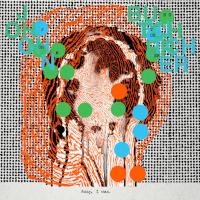
Away, I Was
Relative Pitch RPR1250
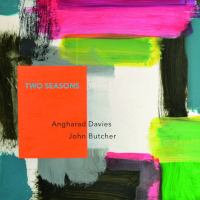
Angharad Davies & John Butcher
Two Seasons
Weight Of Wax WoW07
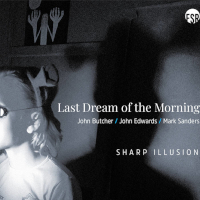
Last Dream Of The Morning
Sharp Illusion
Fundacja Słuchaj FSR24
Form anchors saxophonist John Butcher’s improvisations, whether he performs alone or in company. One gesture seeds the next, mutating through incremental decisions and abrupt pauses that redirect the argument. The logic reveals itself only in retrospect. In the moment, any plot twists arrive without warning. Circular breathing and microscopic control of harmonics and overblowing serve expressive ends rather than technical display. No matter the configuration, silence often emerges as a key component, framing sounds which invoke hybrids between circuitry, insects, birds, and industrial processes, while resisting accurate description. Belying his skill, in the three albums surveyed here, he makes it all seem natural.
One of Europe’s most exacting improvisers for over four decades, Butcher approaches the solo format as both laboratory and platform. Away, I Was presents eight pieces curated from a 17-year period from 2008 to 2025, an overview of gambits which Butcher programs for overall cohesion and variety. Some of the pieces, like “Brinks” with its terse title recalling Steve Lacy, which contrasts abrasive gnarly provocations with cooler layered overtones, would effortlessly translate into ensemble settings. Likewise, the emphatic trills, arpeggios, and silences of the concluding “After Chihuahuan” would grace any situation.
Between times however, Butcher conjures scenarios that might only arise from solitary practice. On “Mirror Foil,” he utilizes feedback, derived from rhythmic keypad manipulation that resembles a thumb piano or steel pans. On the compact “Frisklings,” he overdubs twittering sopranos and squawking staccato tenors in a miasma of opposition. His love of resonant spaces manifests itself obliquely only in the audience recording “Shaken Stains,” where ambient noise and clatter surround his distant soprano monologue, muffled, as if in an adjoining room.
He also mines the extremes. “Fujin’,” notable for the sinuous unfurling of susurrations and sibilance (appropriately recorded at Oslo’s Blow Out festival), evolves into yelps and judders alternating so rapidly they evoke two separate voices. At the opposite pole “Listening To DB Listening To JM,” contains unadorned notes tracing a zigzagging course in an unruffled progression. It approximates chamber music that could pass as through composed, but whatever its provenance, unfolds with disarming lyric clarity unusual in his work.
In long-running partnerships such as that with violinist Angharad Davies, the instrumentation dissolves into a charged encounter between temperaments. Two Seasons unites two fiercely individual improvisers who attain a heightened state of listening and responding. The album draws on two sessions, one a spring 2024 studio meeting in Nottingham, and the other a Berlin concert in autumn that same year. They rebut expectations, neither settling into contrast nor seeking easy agreement, instead often creating a delicious sonic and emotional ambivalence.
Of the ten pieces, the opener “Hydref I,” from the Berlin concert, clocks in at 24 minutes while the others span between one and six minutes. Their voices interlock with uncanny precision. “Hydref I” progresses through a series of striking combinations: a draggy violin motif repeats and fractures against saxophone splutters; high bowed whistles jostle against reedy whispers; violin scribbles over harrumphing saxophone. Reacting off one another they continually catalyze both development and movement through exchanges of abstract textures, often beyond their instruments’ conventional range, like a persistently recalibrating balance which never quite settles into equilibrium.
By necessity the shorter cuts are less episodic. Often the sounds have no emotional correlates, summoning eerie acoustic terrain, like the nerve-twanging drones of “Gwanwyn vii,” that recall a traffic jam of emergency vehicles. Occasionally they elicit clearer feelings: the braided long tones of “Gwanwyn ii” imply an elegiac flavor, while in “Gwanwyn v” the warped legato saxophone phrases and the slow-motion soaring violin take on a sense of repose.
Performing as Last Dream Of The Morning, Butcher, bassist John Edwards, and percussionist Mark Sanders, have a finely calibrating approach to triangulation. Sharp Illusion documents a 2024 concert in Lublin, Poland, and finds them venturing into less charted domains, often hinting at a brooding menace, despite decades of shared history. This is their fourth release under the moniker, though their musical interconnections run far deeper. As ever, direction stays a collective responsibility: any player can pivot the music, and the others react with instinctive, often unexpected adjustments. The result is an elastic continuity that thrives on risk.
Butcher steps in and out of the exchanges, re-entering to pursue altered strategies, or recast the ensemble’s hue by switching between tenor and soprano. He probes and reroutes the flow without grandstanding, deploying a vocabulary of multiphonics, split tones, and sudden clarion bursts as structural devices rather than decorative effects. His judicious use of a legit tone grounds the trio to a recognizable lineage even as the surface splinters.
Bass and drums maintain continuous finely detailed dialogue, with each other, themselves, and the saxophonist, to relentlessly transform the music. What distinguishes Edwards and Sanders is not simply virtuosity but their fluency. They seamlessly traverse free jazz, resonant of the African-American motherlode, and free improv, where instrumental roles evaporate into pure interaction. Indeed they often inhabit both realms simultaneously.
Edwards remains one of the instrument’s most dynamic practitioners. Elemental in attack, he constantly toggles between flinty pizzicato and grimy arco, percussive and propulsive in equal measure. Sanders similarly marshals timbre into momentum placing himself in a line that includes Tony Oxley and Paul Lovens, yet sounding unmistakably his own man.
The interplay unspools in a serrated succession of fits and starts, exemplified by episodes like that in “Roof Rattle” where an accelerating pulse shadowed by Butcher’s urgent exclamations collapses into a lull before the trio regroups in a more aerated conversation. While the overall trajectory is full of drama, the macro level comprises countless arresting moments – the almost human cries in “Turning The Soil,” summonsed by the confluence of Edwards’ abraded moans and Butcher’s piercing soprano, furnish just one example. The trio frequently darkens the timbral field; even the nursery-rhyme seesaw near the close of “Movable Bridge” turns murky under pressure. “Afterglow,” with its piping soprano, gritty bass figures and lurching rhythmic undertow, fleetingly suggests a deconstructed march before dissipating into a typically more textural close to what might be a pithy and well-merited encore.
–John Sharpe