The Book Cooks
Excerpt from
The Williamsburg Avant-Garde:
Experimental Music and Sound on the Brooklyn Waterfront
Cisco Bradley
(Duke University Press; Durham and London)
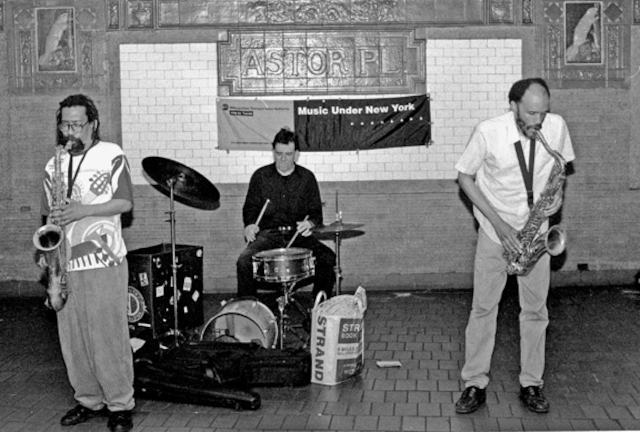
TEST: from left, Sabir Mateen, Tom Bruno, and Daniel Carter at Astor Place subway station, 1997 photo © Michael Wilderman
Legitimizing Brooklyn: Jump Arts Festivals
In 1999, however, conscious attempts were made to bring the East Village and Williamsburg artist communities together, in the form of a collective called Jump Arts, led by recent New School graduates bassist Tom Abbs and drummer David Brandt. The explicit goal was to get musicians from the East Village, some of whom had lived and worked there for decades without ever playing in Brooklyn, to attend or perform at events in Williamsburg. Jump Arts also organized events in Manhattan that featured musicians from both communities and at times organized tours for these musicians outside of New York City. Some of the demand for these connections came as the Knitting Factory was beginning to become less the center of the scene, first moving to Leonard Street on the Lower East Side in 2000 and then closing altogether two years later. Tonic would soon emerge as the new center, but for a time the community was searching for other venues and specifically for opportunities in Williamsburg.
Jump Arts put on a series of twelve festivals, drawing the downtown scene and the emerging Williamsburg scene together in 1999–2003. Abbs specifically aimed to bridge the two scenes, incorporating Gold Sparkle Band into much of what was happening in the downtown scene, and fuse them in Williamsburg. Abbs sensed that “there was nothing for emerging artists, very few opportunities for the up-and-coming generation to get gigs to play their own music, so I formed the Jump Arts collective nonprofit.”
One of the earliest events, Jump over the River: Liberation Music Festival, took place on July 2, 1999. The bill featured a number of bands, including the Triple Threat Sextet, which was essentially an expanded Gold Sparkle Band lineup with Abbs and others. The same evening, multi-instrumentalist Daniel Carter (b. 1945) and Williamsburg-based drummer Randy Peterson played in their first-ever duo performance. Carter had been a pivotal figure on the downtown scene since the 1970s. Peterson, a close associate of renowned saxophonist Joe Maneri (1927–2004), has remained more of an underground figure, despite appearing on a number of records. Carter’s involvement, though it was not his first time playing in Williamsburg, sparked a string of innovative performances by the multi-instrumentalist at free103point9 in the years that followed.
Butch Morris
The success of the event convinced the Jump Arts organizers to continue with a series of festivals through the following years that continued to build bridges between the communities. For example, in April 2001 the organization invited Lawrence “Butch” Morris to convene a big band called the Jump Festival Orchestra at the Brecht Forum (in Manhattan), which included a broad range of players from both sides of the river. It was an intergenerational ensemble, in addition to bridging geographies, including more established figures such as Steve Swell (trombone) and Assif Tsahar (bass clarinet) but filling out its ranks with many of the up-and-coming musicians of the time, such as Okkyung Lee and Shiau Shu Yu (cellos), Charles Waters (clarinet), Oscar Noriega (bass clarinet), Andrew Barker (drums), John Blum (piano), Chris Jonas and Brian Settles (saxophones), Reut Regev (trombone), Matt Lavelle (trumpet), Tom Abbs (tuba), and Jessica Pavone (viola), among many other performers.
Morris’s theories of “improvised duet for ensemble and conductor,” or “conduction,” as he termed it, were boldly innovative in that he aimed to improvise as a conductor with the ensemble in the moment. “I teach a vocabulary to the ensemble but we don’t rehearse the music we are going to perform. The conduction is an instant composition. I started doing this in the first place because I realized there was a great divide between what is notated and what is improvised.” By vocabulary, Morris meant a range of signals that indicated actions such as repeat and sustain, as well as graphic information and melodic directions, “but each musician was able to interpret” that vocabulary. Morris would return with slightly altered lineups of the big band at future Jump Arts events. Many of the figures in the Morris conduction projects would figure prominently in the development of the Brooklyn scene; for violist Jessica Pavone, it constituted one of her first gigs in the city and helped her connect with the community of artists at an early stage of her career.
The April 2001 bill included many other key encounters, such as pairing veterans Paul Flaherty (saxophone), Steve Swell, and Wilber Morris (bass) with the younger Brooklyn-based drummer Chris Corsano for a fully improvised set. Daniel Carter returned and played with the younger figures Tom Abbs, tenor saxophonist Brian Settles, and drummer Chad Taylor. As Abbs, the organizer, stated, the events were intergenerational, “to include our mentors on the stage next to us.”
The festivals were also multidisciplinary, with bills that included dance, poetry, live painting, or gallery shows, paired with or integrated into the musical performances. In 2003 the festival had reached a point of exhibiting interdisciplinary works such as saxophonist Patrick Brennan’s Transmedia Band. Brennan’s goal with the group was to form an ensemble “of disparate activities who would be able to interact with the intensity and intersubjective responsiveness of an improvising musical ensemble.” The strategy was to try “to make visually evident the internal dynamics of what was going on in dialogical music via the common kinetic-rhythmic potentials shared by gestural painting, dancing, and sounding.” The painter, in this case, was calligrapher Lan Ding Liu, from Beijing, whose images were projected onto a wall so that the audience could see them, while dancer Patricia Nicholson brought her many years of improvisational knowledge to dance, and Brennan coaxed the sounds of the piece out through his saxophone.
TEST
The festival also included TEST, which comprised members who lived on both sides of the river: Daniel Carter (many instruments), Matthew Heyner (bass), Sabir Mateen (reeds and woodwinds), and Tom Bruno (drums). The band was steeped in the free jazz tradition of groups like the 1970s loft band the Music Ensemble and the band Other Dimensions in Music, which was first convened by trumpeter Roy Campbell in 1989; both of these bands also included Carter. Mateen had grown up singing in church choirs before studying and playing saxophone and flute in the air force band. Before coming to New York, Mateen had lived in Los Angeles for more than a decade, where he played in Horace Tapscott’s Pan-Afrikan Peoples Arkestra, which expanded his understanding of the possibilities of an ensemble.
TEST was one of the great freely improvised bands of the period and had honed their craft playing in the streets and subways of New York City. Carter and Bruno had regularly been playing duo on the streets a few blocks away from where Mateen was playing solo; they eventually fused, and that was the beginning of TEST. Heyner joined later, having studied with bassist William Parker and developed as a player in the No-Neck Blues Band. Mateen explained that the name came from the idea that “everything we go through is a test—how we live, how we survive. What we are doing at the moment is a test.” Carter said, “It really surprises me that other musicians haven’t decided to do that, especially considering the economics of this music.” The band finally cast light on the considerable talents of Mateen, who until the late 1990s had been chronically underdocumented.
One critic described TEST’s music: “The group constructs a succession of peaks from its disparate elements, bridging all dynamic [possibilities] along the way. As it is created entirely of-the-moment, the music of TEST determines its own form—attesting to the individual and collective abilities of Bruno, Carter, Heyner, and Mateen.” With both Carter and Mateen as multi-instrumentalists, the timbral and textural possibilities of the group were vast. Their released live recordings capture the kind of music that they presented at Jump Arts.
Jump Arts Goes on the Road
Jump Arts also organized tours for the artists. After the 9/11 attacks, the organization was motivated to reinvigorate American culture and put together a tour that launched from Galapagos Art Space in Brooklyn; then swept through Tritone in Philadelphia, the University of North Carolina in Chapel Hill, and a restaurant gig in Winston-Salem, North Carolina; and climaxed at the two-night Jump to the Eyedrum improvisational music festival in Atlanta. The artists traveled together in a caravan of cars. They returned to Tonic in New York and were disappointed by low attendance after encountering enthusiastic crowds at most of the other tour stops.
Many of the featured groups on the tour shared members, allowing for different lineups and personnel within the larger group of touring artists. Gold Sparkle Band reunited with trumpeter Roger Ruzow, who had remained in Atlanta, and played at the Eyedrum. Afterward, Waters remarked about the show and the reunion with Ruzow, “The real missing part is his voice and understanding of how the group works. He is very responsible for Gold Sparkle Band’s aesthetic — and that’s what Barker and I miss most.”
The performance opportunities at the Eyedrum anchored the entire tour. Ruzow was the local organizer for the festival, which also included regional acts such as the Flakes, Konx, Chattanooga’s Shakin’ Ray Lewis, and the Erik Hinds Trio alongside the Jump Arts performers. Of the Jump Arts participants, Barker also played in a fiery free jazz trio with Daniel Carter and Sabir Mateen that was released on record. Poet Steve Dalachinsky often performed solo but also paired with Charles Waters in a duo. The Transcendentalists, a group comprising Carter, Abbs, Steve Swell, and percussionist David Brandt, performed with Mateen as a special guest, having recorded and released a record a few months prior. Carter and Brandt formed trios with Swell or Mateen on different nights. Cellist Okkyung Lee played duo with Abbs in a group called Dichotomy. Lee and Mateen both played solo on the bills as well. To conclude each night, all of the performers would appear onstage together for an improvised large ensemble. The concerts ended up lasting three to four hours each night. Jump Arts sold a CD-R compilation recording from the tour that contained work by each of the artists.
The music often incorporated nonsonic elements. Dancers Jessica Kjos, Heather Kravas, and Jessie Gold improvised with different groups on each of the bills. In a different vein, M. P. Landis did live painting, using primarily household latex paint and acrylics, either onstage, if there was room to accommodate him, or immediately offstage.91 He would paint through the entire evening of performances, with two wooden panels covered in paper on which to work. One panel was covered by one large piece of paper, while the other panel had multiple smaller pieces stapled to it. Landis described his process: “I painted the whole board, not thinking about where one piece of paper stopped or started. I liked how it gave the work a sense of being midstream, like capturing a sound in time.” He added, “The intensity of the music made the painting intense. It felt like I was doing months’ worth of painting within a few hours.”92 Poet Steve Dalachinsky presented his work every night, often with the Transcendentalists, while also working as the emcee for the events. Dalachinsky composed several poems during the tour that tell of their travels and of the people and places they encountered.
Abbs eventually got burned out organizing festivals and raising funds, after organizing a dozen of them over the span of four years. Some of the scene moved to the Pink Pony, on the Lower East Side, for a year or so afterward. The festivals and events had a lasting impact. For a time, Jump Arts forged a strong link between the established downtown scene and the burgeoning scene in Williamsburg and provided a stage for established, underground, and just-then-discovered figures who would have an impact in the years to come.
© 2023 Duke University Press