Moment's Notice
Reviews of Recent Recordings
(continued)
Marc Ribot
The Young Philadelphians: Live in Tokyo
Enja/Yellowbird 7760
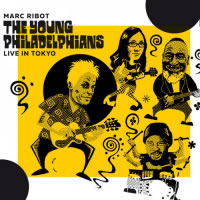 The Young Philadelphians: Live in Tokyo is Marc Ribot’s long-awaited dance with Sweet Philly Prime Time. That’s Ornette Coleman’s Prime Time, and the funky, lush Philly soul trademarked by Kenny Gamble and Leon Huff of Philadelphia International Records. It’s 1975 again (or thereabouts) for this sizzling summer night two years ago at Club Quattro. Ribot had been dabbling in harmolodic funk for the better part of a decade, chopping and changing his Young Philadelphians, before formalizing this enviable lineup. Ribot and Mary Halvorson spearhead the two-guitar frontline, alongside a pair who will forever carry a great man’s imprimatur, Jamaaledeen Tacuma (electric bass) and G. Calvin Weston (drums), original members of Prime Time. Ribot’s also added a string trio – violinists Takako Siba and Yoshie Kajiwara and cellist China Azuma – to double down on the Philadelphia International sound.
That authenticity (of a sort) is perhaps the most surprising thing about this disc. It’s a truism to say that Ribot likes to opens things up. But to me, the truly radical aspect of this date is how in it is: they really play these tunes. And you’ll know them all – a seven-song set that includes a whole lot of love, from a “Love Epidemic” to “Love TKO” and a “Love Rollercoaster.” It’s rough and raw, churning in this off-kilter groove – “The Hustle,” for one, is sweet and nerdy and just out of sync. But it’s still remarkably charted and controlled; Ribot even transcribed the strings parts. The tunes are terrific, and all the original repeats are intact.
Together, Tacuma and Weston are a force of nature. On “TSOP (The Sound of Philadelphia),” as Halvorson flies into a world of fractured, disjointed fuzz, Tacuma unpacks the original line, spinning things into an incantatory, electric counterpoint. Weston’s there, too – examine this man’s mean high-hat workout – as he takes basic funk convention into the mythic realm. Ribot’s immense power is often felt in one of the set’s grand rubato openings. Even after all these years, he can still make a single searing note sing in ways that seem to defy electronics.
The joy is in the details, which makes you want to revisit one of Ribot’s primary sources: Coleman’s Of Human Feelings (Antilles, 1979). Among the most extraordinary things about that extraordinary record – when harmolodics met electric funk, full-on, for the first time – is its absolute, unwavering clarity. Prime Time was a sextet, a terrific flurry of criss-crossing voices, and yet you still heard every line, all the time. OHF is a monument to musical clarity – a staggering example of how improvised music can move in this roiling, wondrous world of pinpoint polyphony.
The Young Philadelphians never quite gets there. There is improvisation, there are solos, but they never really throw out the scripts. The space it occupies is irresistible, and I suspect it will be a source of great success. Since the recording, Ribot has said they’ve started to open things up. Live in Tokyo is only the start.
–Greg Buium
Thumbscrew
Convallaria
Cuneiform Rune 415
 Convallaria, the second release from the all-star trio Thumbscrew, is the work of a true working collective, much like the group’s eponymous 2014 Cuneiform debut. Guitarist Mary Halvorson, bassist Michael Formanek and drummer Tomas Fujiwara spent two weeks honing new material at City of Asylum, an artist residency program in Pittsburgh, Pennsylvania, resulting in a highly cohesive set of pieces for their sophomore effort.
Although technically leaderless, the focal point of Thumbscrew is unquestionably Halvorson, who has done more to advance the creative potential of jazz guitar in the past decade than almost anyone else. Her singular approach is a bold amalgam of avant-garde techniques that recalls everything from Joe Morris’ spidery fretwork to Sonny Sharrock’s overdriven sheets of sound. Though her phrasing often invokes traditional antecedents, her use of feedback-laced distortion and non-tempered pitch manipulations bears a more identifiable relationship to the noise scene, which expands the trio’s sonic palette exponentially.
Formanek and Fujiwara, esteemed veterans on their own accord, easily avoid rhythm section clichés. Formanek’s robust basslines rarely maintain straight time as often as they provide harmonic counterpoint. Fujiwara is a nimble percussionist with an ability to sustain an engaging pulse in any meter. Together, they establish abstruse grooves with a near clairvoyant sensibility that can be attributed to the fact that Thumbscrew is regularly employed as a rhythm section by each of its members in vastly different lineups.
The album opens with Halvorson’s “Cleome,” an ominously paced theme that gradually builds in tension, highlighted by Fujiwara’s steely volleys, the author’s scorching runs and Formanek’s fleet musings. One of the date’s most dissonant numbers, “Screaming Piha,” is loosely based on the distinctive call of the namesake South American fowl. The composition’s shimmering psychedelia features Halvorson using delays to multitrack layers of fuzz into an intensifying screed of white noise, while the rhythm section gradually increases tempo, eventually blending into a cacophonous wall of sound.
Fujiwara’s “The Cardinal and the Weathervane” is among the set’s more elaborate tunes, a triadic structure that quickly shifts perspectives; sinewy unaccompanied bass introduces the piece before it transforms into prog-metal, climaxing with Sabbath-induced riffing from Halvorson. Conversely, it is Halvorson’s “Inevitable” that closes out the album on a lyrical note, imbued with some of her most melodically straightforward variations. Balancing sophisticated writing with adroit improvisational interplay, Convallaria is a captivating document of the harmonious chemistry shared by three master musicians.
–Troy Collins
Greg Ward & 10 Tongues
Touch My Beloved’s Thought
Greenleaf GRE-CD-1050
 Alto saxophonist-composer Greg Ward’s suite for big band is simply a masterpiece, one of the most exciting large ensemble compositions in recent memory. Ward took his inspiration from Charles Mingus’ Black Saint and the Sinner Lady, but in such a way that what you hear is purely Ward’s voice with a trace of a Mingus accent. Rather than make his own arrangements of Mingus’ themes, Ward picks up a rhythm or a chord voicing or a small part of a phrase and uses it as the foundation of his own writing. Ellington did much the same thing when he took something one of his band members played and wrote a piece based on it. Lacy, too, could borrow from a favorite improviser and make his own composition out of it. And Ward consciously uses signature Mingus techniques as well. He layers several melodies at once on “Daybreak” and “Round 3.” “The Menacing Lean” features another favorite device of Mingus, several simultaneous soloists working together with riffing from the rest of the band and Ward soaring over the whole tumultuous lot of them. And there are frequent tempo changes within a section, startling violent outbursts from the band, call and response, and unexpected outbreaks of heart-on-sleeve lyricism. It’s just a superb example of a historically informed original composer working at the top of his game.
A swaggering coterie of ten players from Chicago’s tightly knit community of forward-looking jazz musicians executes Ward’s composition with ruthlessly assertive exuberance. Everyone gets a chance to solo and there’s nary a wringer in the bunch. Several stand out, however. Pianist Dennis Luxion (a revelation to this writer) anchors the kick-ass rhythm section, proving himself to be an all-around keyboardist – a harmonically inventive, rhythmically astute accompanist, with a nuanced touch and a keen sense of melody as a soloist. A beautifully controlled instrumentalist, Ward is in full throat on “Daybreak” and “Gather Round, the Revolution Is at Hand,” playing with both passion and attention to form. Keefe Jackson’s gruff, post-bop baritone solo on “Grit” is in perfect keeping with the twisting, blues inflected melody. On “With All Your Sorrow, Sing a Song of Jubilance,” trombonist Norman Palm solos with a blues ache undergirding a lovely melodic sense. But it’s the orchestra’s all-in esprit de corps that makes the album. They play with urgency, biting off every riff and melody with relish, maintaining clarity even in the densest passages, and sound utterly committed to Ward’s vision. Great stuff.
–Ed Hazell
Matt Wilson’s Big Happy Family
Beginning of a Memory
Palmetto 2182
 Beginning of a Memory is drummer Matt Wilson’s first recording since his wife Felicia succumbed to leukemia in 2014. For this expansive session, Wilson convened all the members of his longest running groups (The Matt Wilson Quartet, Arts & Crafts, Christmas Tree-O) into a large ensemble he coined Matt Wilson’s Big Happy Family. Bigger than his usual small combos, this ad-hoc collective explores the different stylistic focuses of those individual projects with a rotating roster that features over a dozen musicians playing in various configurations.
The result is a heartfelt memorial, featuring new arrangements of many of Felicia’s favorite tunes from her husband’s songbook, performed by musicians she considered part of her extended family. The impromptu session was recorded without using charts, showcasing the camaraderie between Wilson and his sidemen. A carefree mood pervades the retrospective date, which includes seventeen tracks culled from Wilson’s entire career, including rousing up-tempo numbers, rambunctious improvisations, ecstatic swingers and a handful of romantic ballads. Wilson’s releases as a bandleader are typically characterized by an adventurous, eclectic sensibility tempered by a wry sense of humor – this set is no different.
The music is often joyous, occasionally sentimental. Larry Goldings’ solo prepared piano rendition of “How Ya Doin’” is a touching example of the latter, as is the languid “Getting Friendly,” which features cornetist Kirk Knuffke, alto saxophonist Andrew D’Angelo and tenor saxophonist Jeff Lederer at their most lyrical. The most poignant number is “Flowers for Felicia,” an intimate piece that combines the melodies of Wilson’s “Orchids,” written for his wife, and one of her favorite songs, the Carter Family classic “Wildwood Flower.”
But there’s also the zaniness of “Go Team Go!/Endless Love,” with a vocal cheering section that transforms into a bass-driven rendition of Lionel Ritchie’s saccharine pop tune, as well as a riotous take on “Schoolboy Thug.” The former medley is a salient example of Wilson’s sense of humor, featuring all four bassists (Yosuke Inoue, Chris Lightcap, Paul Sikivie and Martin Wind). “Schoolboy Thug” on the other hand, finds Wilson at his most unfettered, unleashing thunderous trap set tattoos in a thicket of funky, riffing horns.
The most striking arrangement appears last. “July Hymn” was originally performed as a ballad by legendary tenor saxophonist Dewey Redman on As Wave Follows Wave (Palmetto Records, 1996), Wilson’s leadership debut. Here it closes out the album, re-imagined as a lush contrapuntal horn chorale, perfectly ending a program that celebrates life, rather than mourning death.
–Troy Collins