Moment's Notice
Recent CDs Briefly Reviewed
(continued)
Harry Miller’s Isipingo
Which Way Now
Cuneiform Rune 233
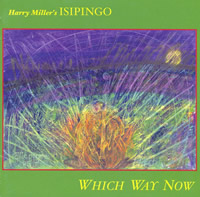 The standard narrative of exiled South African jazz musicians in the 1960s centers on Abdullah Ibrahim and The Blue Notes. Harry Miller is not relegated to the margin in this narrative, but close to it. Yet, when you fast-forward the saga into the mid and late ‘70s, Miler had become a real force. An in-demand bassist, Miller managed the seemingly impossible; refusing the back seat of a sideman, he constantly soloed on the bandstand; yet, he was a consummate ensemble player, who used his indefatigable drive to center improvisers whose approaches were predicated on enormous centrifugal forces. As a writer and a bandleader, Miller staked out a distinctive stylistic frontier between the sounds of Cape Town and progressive hubs of the London scene.
Miller also made a lasting contribution to an alternative infrastructure for the London jazz and improvised music scene by forming the Ogun label with his wife, Hazel Miller. In addition to playing on albums by Chris McGregor’s Brotherhood of Breath and Louis Moholo’s Octet, Miller also led several enduring Ogun LPs, which were reissued in 1999 as the limited edition box set, The Collection. One of Miller’s Oguns was Family Affair, the only previously issued recording by Isipingo. Given the energetic spirit of the 1977 studio session, the release of a concert recording by Isipingo is real news, all the more so since Which Way Now doesn’t merely flesh out the sextet’s history, but fundamentally alters our understanding of its evolution. Recorded by Radio Bremen in November 1975, a full 15 months before Family Affair, this set not only features a substantively different line-up than the LP, but also includes two Miller compositions heretofore not issued on any Miller group recording.
Three of Miller’s cohorts are on both dates: Moholo; alto saxophonist Mike Osborne, who ran a renowned late 70s trio with Miller and Moholo; and pianist Keith Tippett, who also performed on Miller’s other Ogun sextet project, In Conference. Still, the Bremen line-up included two distinctive players that did not perform on the studio album, Blue Notes trumpeter Mongezi Feza and trombonist Nick Evans, best known for his work with Soft Machine and Elton Dean. Feza died tragically before the making of Family Affair, and was replaced by Marc Charig, while Malcolm Griffiths stepped in for Evans.
Despite the equal number of South Africans and musicians associated with what jazz historian John Wickes calls the Tippett-Dean-Osborne axis of British free jazz, Miller did not forge a Fire Kwela hybrid with Isipingo. Instead, Which Way Now suggests Miller was refining an approach that not only reflected his South African roots, but also his affinity for both American jazz, crystallized through early ‘60s visits to New York when he worked in ocean liner bands, and his London environs. The melodic contours and harmonic features of the two pieces reprised for the ’77 studio date, “Family Affair” and “Eli’s Song,” are well within the parameters of contemporary British jazz.
Reported by annotator Francesco Martinelli, Tippett felt this was one of Isipingo’s best gigs, and the performances back the pianist up. Miller and Moholo’s grooves tended to be more urgent than effervescent; but, from the opening strains of “Family Affair,” they exacted a fine balance, one that sustained the 20 minutes generally allotted to each tune. This plays perfectly to the strengths of Tippett’s approach, a combination of powerful chords and sparkling right-hand filigrees, and the respective strengths of the horn players. “Family Affair” provides a good brief for Evans’ wail-punctuated lines, Feza’s double-edged lyricism, and Osborne’s blues-drenched rasp.
Released previously only on Miller’s solo bass album of the same name, “Children At Play” is built upon a pungent motive with a continental tinge. The head is crisply stated at a slightly faster tempo than the solo version, and it proves to be a sleek, yet fiery vehicle for the band. Though each of the horn players essay cogently, it is the almost phrase-by-phrase responsiveness of Tippett, Miller and Moholo that is particularly engaging. Osborne’s sinewy lines are met with finely detailed cymbal work; Tippett mirrors Feza’s dramatic sweep; and Evans’ growls and yelps are matched by mini seismic events in the rhythm section. Tippett and Miller then exploit the momentum in their own solos before the theme is reiterated.
“Eli’s Song” uses a vamp-based strolling feel and incisive thematic elements to create a strong rhythmic tension that propels the solos, even when the phrasing lopes over the bar lines, as is the case with Evans’. When Feza and Osborne seize upon the push and pull between the elements, the results are compelling. The title track ends the proceedings on a triumphant note. The antiphonal section writing is perhaps the clearest example of the influence of contemporary British jazz composers on Miller (after all, Miller worked with the best of them, starting with Mike Westbrook). The band simply soars through the solos, a fitting finale for this revelatory recording.
Jim Pepper + Amina Claudine Myers + Anthony Cox + Leopoldo Fleming
Afro Indian Blues
PAO 10330
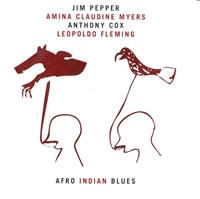 Few artists testify to the African American experience being the bedrock of American music like pianist/vocalist Amina Claudine Myers. And, nobody has channeled the spirituality of First Peoples into jazz like tenor saxophonist Jim Pepper. Myers’ nourishing blues and gospel and Pepper’s soulful, occasionally outbound playing proves to be a powerful combination on Afro Indian Blues. Even though Pepper and Myers first worked together in the edition of Charlie Haden’s Liberation Music Orchestra that recorded Dream Keeper for Blue Note in (date), the album did not hint at the potential realized on this ’92 concert recording with bassist Anthony Cox and percussionist Leopold Fleming. The set consists of a blues, a Myers original based on an elemental chord progression, and Pepper’s “Witchi Tai To” and “Comin And Goin,” each of which clock in between 10 and 15 minutes. Listeners familiar with Myers and Pepper will not find anything revelatory on the album, but they will marvel at the deep rapport between them, nonetheless.
Billy Stein
Hybrids
Barking Hoop BRH011
 Guitarist Billy Stein has been hidden in plain sight for almost 30 years, playing in New York with an impressively wide spectrum of players. Most probably, the main reason Stein has flown under the radar of both the press and record labels is that he is truly neither a straight ahead player or an outcat. If one was to place Stein on a flow chart of jazz guitar morphology, it’s all dotted lines from predecessors like pre-Eleventh House Coryell and Cobblestone-era Martino, and blank space separating him from contemporaries like Joe Morris and Bruce Eisenbiel.
On the aptly named Hybrids, Stein freely improvises through the idiom; the many quietly subversive ways he undermines the common criteria separating inside and outside playing demand acutely close listening, particularly on the part of his cohorts. Stein has a lyrical streak in his playing that could either be swamped by hyperactive avantists or overly sweetened by a mainstream rhythm section. Conversely, Stein’s more assertive threads are equally vulnerable to generic playing. And, then there are the passages where Stein borders on the minimal, letting his lines waft over a couple of beats, potentially deadly moments without the right players.
Luckily, Stein has bassist Reuben Radding and drummer Rashid Bakr on board. They bring the right measures of robust support and elastic interaction to the proceedings. Since Radding is responsible for some of the most provocative American improvised music over the past year (mainly through his own Pine Ear Music imprint) and Rashid Bakr is renowned for his work with such envelope-pushing units as Other Dimensions in Music, it is particularly gratifying that Stein brought out lesser known aspects of their playing. The rhythmic empathy within the trio is strong, as is their ability to anticipate and dovetail each other’s next move. They get so deep in the pocket that they end up somewhere else.
John Tchicai
John Tchicai with Strings
Treader trd005
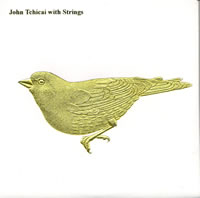 Though he will forever be associated with the Fire Music of the 1960s, John Tchicai’s compositional sensibility is largely rooted in folk music, including children’s songs. It is this aspect of Tchicai’s music that John Coxon and Ashley Wales (AKA Spring Heel Jack) highlight with their surreal palettes of samples, conventional instruments and found objects on John Tchicai with Strings. At first, Tchicai’s alto saxophone and bass clarinet melodies seem to be the determinative element, as they are, in turn, tender, forlorn, and piquant. Samples roll in like fog; Coxon and Wales then conjure apparitions largely through percussion (a deployment aided by Mark Sanders on three tracks), but also with dabs of electric guitar, piano, harpsichord, and trumpet. Tchicai only occasionally plays with palpable heat; when he does, Coxon and Wales adjust the textures in such a way to be both compatible with Tchicai in the moment, as well as the overall arc of the album. By the album’s concluding track, which features a recitation of a Steve Dalachinsky poem by Tchicai, his deep resonant voice made more benevolently spectral in the mix, it becomes clear that the album is one of Coxon and Wales most masterful constructions. They manage to let Tchicai be Tchicai, while placing his unique voice in a distinctive new light.
Randy Weston and his African Rhythms Trio
Zep Tepi
Random Chance RCD 27
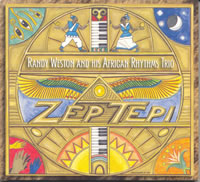 The great Randy Weston turns 80 this year, but you would never know it from his performances on Zep Tepi. Since most of the pianist’s compositions on this trio date with bassist Alex Blake and percussionist Neil Clarke are 30 to 50 years old, it is a pleasurable exercise to dig out earlier albums for comparison. To say that he’s playing better than ever would be a little misleading by suggesting technical issues that are moot. On that count, it’s simply amazing that he plays as well as on decades-old albums. It’s more to the point to say he’s playing more wisely than ever, and that shouldn’t suggest that he’s compensating for effects of age that aren’t in evidence, anyway. Weston’s wisdom is manifested in the elastic approach to form he has honed over the years. Certainly, this ability is partially repertoire-based, and speaks to his gifts for penning pieces that he can remold into any shape. For instance, he plays “High Fly” at a surprisingly languid pace with an usually soft touch, while he manages to stretch the structure of “Blue Moses” and give the tune new gravity at the same time. Whatever the issue at hand, Weston’s approach is ably supported by Blake, whose slap and strum-rooted style benefits from the brilliant recorded sound, and Clarke’s percolating cross rhythms. While great players at 80 are often mere shadows of their former selves, Randy Weston still overshadows practically every pianist on the international scene with his vigor and creativity.
