Moment's Notice
Reviews of Recent Recordings
(continued)
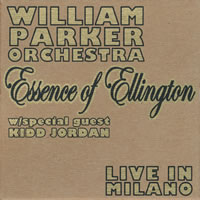
William Parker Orchestra
Essence of Ellington
Centering 1008/1009
 At this point in time one often experiences the historical works of creative composers with a strangely rarefied but rightly revered sensibility – see the Jazz at Lincoln Center Orchestra – rather than honest intensity and the ever-important “mistake.” Sure, it is thrilling to hear someone with technique to spare perform a composition perfectly, but it is often far more interesting to embrace difficulty as a performer works through a piece in which challenges are met with the intellectual and physical strain of immediate interpretation. I know that I, for one, would rather hear bass clarinetist Jason Stein work through Warne Marsh’s “Background Music” than codified jazz school perfectionists. That’s not to say one is more “talented” than the other, but that heart, soul, and struggle are values important to this music’s growth.
All this is to say that the recent two-disc set of bassist-composer William Parker’s Essence of Ellington captures an important wooliness in Ellington’s music that is often left by the wayside. That’s not to say that Ellingtonia cannot be realized slickly to remain valid – and as a sonic architect, some amount of precision is necessary – but Ellington’s range also encompasses a hefty amount of grit. The closest Ellington acolyte to really approach an understanding of the composer’s intentions and vision might have been Charles Mingus; the bassist-composer’s work was lofty as well as down-and-dirty, and embraced struggle on an equal footing with grace. Miles, Monk, Cecil Taylor and Bill Dixon also had similar sensibilities. All of these musician-composers also brought the music forth with an inherent trust in their ensembles to make the work happen. Importantly, the leader introduces the concert as an opportunity to place Ellington as someone whose work inspires artists toward individuality – being oneself through the music, whether it is performing Ellington’s pieces or one’s own.
Recorded live in Milan, Parker’s fourteen-piece band includes pianist Dave Burrell, drummer Hamid Drake, Swiss vocalist Ernie Odoom, trumpeters Roy Campbell Jr. and Matt Lavelle, trombonists Steve Swell and Willie Applewhite, and reedmen Sabir Mateen, Dave Sewelson, Ras Moshe, Rob Brown, Darius Jones and Kidd Jordan. In addition to five Ellington-associated compositions, Parker also contributes three original pieces to the two-disc set, including a rousing homage to the late trumpeter and educator Clyde Kerr, Jr. (1943-2010), “Portrait of Louisiana.” In a true Ellingtonian fashion, it is primarily a showcase for Kidd Jordan’s tenor, in a lengthy communicative exchange with Hamid Drake that segues into a strong brass-tenor dialogue.
“Essence of Sophisticated Lady” begins as a trio for Jordan, Swell and Burrell, slowly adding Parker’s words (sung by Odoom) and orchestral filaments, piano blocks clinking against Odoom’s voice, which elides between song and choppy recitation. As the tune emerges the orchestra enters with a sentimental lope, Parker and Drake evincing muscularity and gentle swing as brass and woodwinds toy with stately glide and embody a natural wandering tendency. Sewelson’s baritone is more closely aligned with Mingus’ Bluiett than Ellington’s Carney – he’s blustery and squeaky, but it’s a necessary injection of swaggering bar-walk into Parker’s bright and wistful arrangement. Following Campbell’s muted skitter, Burrell is probing and kaleidoscopic in duet with the leader’s thick pizzicato. “Take the Coltrane” is fierce with a hard push from the rhythm section, collective trills supplanting explosive tenor mouthfuls and brassy, chortling soli. While perhaps not as pandemonium-inducing as Paul Gonsalves during “Diminuendo in Blue and Crescendo in Blue” (Ellington at Newport, Columbia, 1956), the band is on fire here and if it wasn’t already clear by this point, the compositions have become attached to Parker’s orchestra.
Following an achingly beautiful “In a Sentimental Mood” from altoist Darius Jones and Burrell, the orchestra gives “Take the A Train” a muscular chug. Set in motion by a gritty staccato riff, Parker and Drake swing mightily against a series of colorful dialogues; rather than particulate statements, these do more to carry the tune’s energy, though the trombone exchanges are quite rollicking. As Moshe digs in his heels and Odoom’s voice carries over the ensemble, the group breaks off into fragments of punchy freedom, the central riff lapping at the edges of an emerging “Ebony Interlude.” The latter is a rather striking duet for clarinet and contrabass, Mateen approaching stark, poised delicacy with detours into raspy kinetics and cries that eclipse his conversational register. Terse, wiry and oblique, a keening Rob Brown introduces “Caravan” unaccompanied, unspooling knotty runs that evoke an audible “huh” from Parker. The altoist is tremendous here, athletic, funky and dry as the ensemble leaps into a storming version of Tizol’s signature piece. Burrell’s pointillist arpeggios are reminiscent of his stirring, brief statement at the close of Grachan Moncur III’s “When?” (New Africa, BYG, 1969) before telescoping outward into unsettled left-hand masses. A collectively improvised coda closes the piece and carries forward its energy, rather than obscuring its distinct and recognizable personality.
Perhaps ascribing opposition to concepts of perfection and looseness goes against the essence or nature of this music – improvisation and interpretation are essential facts of how creative music works, and yet some performances are certainly “cornerstones.” While time will reveal whether such cornerstones are present in Essence of Ellington, Parker and company have outlined their impressions of Ellingtonian architecture in a fascinating suite. Whether or not one knows the directions to the main building, these discs point out features along the way that one might otherwise miss, in addition to providing celebratory and captivating textures that are unique. Essence of Ellington is profoundly Ellingtonian by being completely its imperfect self.
–Clifford Allen
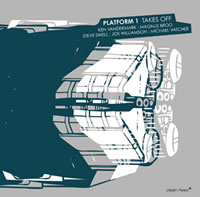
Platform 1
Takes Off
Clean Feed CF255CD
 The suggestively named ensemble Platform 1 is constituted by top drawer improvisers from several different scenes. Reeds player Ken Vandermark and trumpeter Magnus Broo have long experience together from various ensembles and shared friendships, and they’re joined on the front line by the superb trombonist Steve Swell. The group is rounded out by an engine room stoked by bassist Joe Williamson and drummer Michael Vatcher. Their music takes on a lot of different aspects, but it’s often rather rolling and rambunctious, with an energy and even some arrangements that recall mid-1960s Archie Shepp to some extent. No fear of derivative music here, though, as the compositional framework and the instrumental vocabularies are far more contemporary (even if Swell does owe an audible debt to Rudd, a fine thing that). For example, for every boisterous yawp and raggedly swinging passage, the band is as likely to move crisply into a clacking, Braxtonian pulse track to focus their energies differently.
But, possible influences aside, a lot of the pieces here are not only vehicles for terrific playing (the brass players in particular won me over) but are great expressions of these players’ personalities and backgrounds. Broo’s jaunty, swaggering “Portal #33” and uproarious “Dim Eyes” recalls the enthusiasms of his work in Atomic (and to a lesser extent those of a different, Broo-less band, Exploding Customer). Vandermark sounds really good throughout here: lusty and focused on “Dim Eyes” (which also boasts killer work from Vatcher), sweetly melancholy on his marvelously assured ballad “Stations” (for CF honcho Pedro Costa),” and funky as hell on his Rudd dedication “In Between Chairs.” Speaking of funk, Swell’s “Compromising Emanations” hits the sweet spot just after the nicely groaning textural piece “Deep Beige.” A smart, well-balanced set overall.
–Jason Bivins
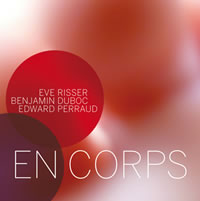
Eve Risser + Benjamin Duboc + Edward Perraud
En Corps
Dark Tree DT02
 Eve Risser plays piano, sometimes prepared, sometimes not, and she plays here in what looks like a traditional piano trio with bassist Benjamin Duboc and drummer Edward Perraud. It might look like it, but its conceptual architecture is utterly different. There are two tracks here – one long (“trans”: 34:51), one half as long (“chant d’entre”: 16:24) – and there is rarely a moment when the piano trio isn’t being reinvented as a wildly various drum. Risser uses preparation to reduce the piano to a fundamental identity: it’s not just a mirror of western tonality and an even tempered imitation of an orchestra. It’s a kind of string drum, or half string, half percussion instrument; at Risser’s hands, the piano becomes ambiguously one with drums and bass in a music that is devoted to the beat, the drone, the continuum.
On “trans” the music extends for a long stretch of time outward from the insistent polyrhythmic turmoil of Perraud’s drumming, absolutely detailed, acutely attuned to pitch, and in that web Duboc’s bass and Risser’s prepared piano seem like more drums, more insistent on a beat, a pulse so strong that it radiates outward, taking in every variation, every slapped bass string, every snare roll to itself. Risser’s genius consists in her willingness to match piano to drums and to bass, insisting on a uniform hammered cluster or interval or micro-figure. When Risser strips the piano of its temporary additions somewhere after the twenty-minute mark in “trans,” it’s to insist on a chord that differs from the preceding only in sounding unequivocally like a piano.
The same insistence characterizes “chant d’entre,” notable as well for its polyrhythmic density; until at the conclusion Risser’s repeated figures in the left and right hands demonstrate remarkable independence. It’s an insistence on trance and transformation, on “across” and “in between,” a focusing of consciousness that makes most music seem purposeless. This is a piano trio in which individual voices occasionally rise slightly to lead, but in which every convention from theme to solo has been erased in the unitary field of the beat.
–Stuart Broomer
Sam Rivers + Dave Holland + Barry Altschul
Reunion: Live in New York
Pi Recordings PI45
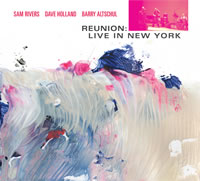 Considering the stature of Sam Rivers as musician, organizer, teacher, and leader, it is astonishing how few of his recordings as a leader are still in print. He was never that prolific when it came to documenting his work and many of his seminal recordings from the ‘70s never made it to CD. A few of his Blue Note recordings are still around, but even his Impulse recordings have disappeared. So those who were fortunate enough to tune in to the week-long Sam Rivers Festival broadcast on the Columbia Radio Station WKCR back in 2007 experienced a particular treat. The broadcasts dove in to his recorded output, unreleased concert tapes, and interviews, culminating in a sold-out reunion concert by Rivers, Dave Holland, and Barry Altschul. This trio was the core of Rivers’ music from 1972-‘78, playing frequently in the New York lofts as well as a few European tours.
Most listeners probably know this trio as participants, along with Anthony Braxton, in Dave Holland’s Conference of the Birds (ECM); and while that record is unimpeachable in its brilliance and importance, it caught the group at their start and just begins to capture the strategies toward free playing the three were to explore over the next six years. During that time, this trio – along with his tuba trio with Joe Daley and drummers like Thurman Barker and Warren Smith – charted out an approach to free improvisation that allowed for fiery explosion, tuneful churning energy, and loose grooves. Rivers moved between tenor, soprano, flute, and piano, orchestrating the flow of the music with the lithe, muscular, melodic drive of Holland’s bass and Altschul’s elastic, tumbling sense of time.
The stakes are always high for reunions like this one and this concert was met with particular anticipation. When the three hit the stage for the two sets captured here, they hadn’t played together in over twenty-five years. In the intervening years, their paths had diverged, particularly Holland who has turned increasingly toward more tightly arranged, post-bop settings. Wisely, they don’t come off like a group with something to prove. Instead, the first CD kicks off with Rivers teasing out a melody with throaty vigor over Holland’s bounding groove and Altschul’s simmering drumming. From there, the three kick in with open, energetic free interplay.
It is amazing to think that Rivers was 84 when this was recorded, as his tone and phrasing on tenor, soprano, and flute are a model of controlled intensity and still as distinctive as on his ‘60s recordings. His piano playing as always, maintains a less refined edge, his skittering runs deployed more as thematic counterpoint, and percussive and harmonic orchestration. Holland responds with a polished reverberant tone, providing harmonically rich counterpoint while propelling the music along. His solo spots serve as reminders of the stunning solo sets I caught of his during the late ‘80s. Altschul has recorded infrequently over the last decade and his balance of potent drive and coloristic invention provides an effective balance to the group.
The first set ranges in mood and dynamism over the course of fifty minutes, driven by Rivers’ shifts between instruments with solo interludes by both Holland and Altschul and at times, those shifts tend to break the focus of what had proceeded, taking a bit of time to ramp back up. There are plenty of high-points though, in particular, a jabbing soprano feature three quarters of the way through and a spirited flute finale to the set. The second set starts off at a spritely sprint with Rivers on flute again transitioning to a slow simmer with Holland’s groaning low end against Altschul’s dark rolling toms leading to a probing section driven by Rivers’ free tenor lyricism resolving in to an achingly plaintive theme. The three ramp things up again in the final section with a spry sprint to the finish.
The strategy of moving through shifting sections at times gives the improvisations a somewhat episodic feel. But there are strategically deployed peaks that hold things together. While it would be great to see some of this group’s music from the ‘70s back in print, this is a solid testament to their collective skills and serves as a fitting tribute to Rivers’ mastery.
–Michael Rosenstein