Moment's Notice
Reviews of Recent Recordings
(continued)
Steve Colson
The Untarnished Dream
Silver Sphinx SS12403
 By all rights, Adegoke Steve Colson’s discography as a leader should be pages long. As it is, it contains only a scant five titles, beginning with the Unity Troupe recordings of 1978-80 issued as Triumph! (on Colson’s Silver Sphinx imprint) and No Reservation (Black Saint). Those albums not only established Colson as a gifted pianist and composer, but a prescient leader whose synthesis of the populism and experimentalism of the AACM can be heard as a predicate for Nicole Mitchell and others. To a substantial degree, Colson achieved this through his writing for the voice of his wife, Iqua Colson, whose ability to swing is matched by the rarer skill of giving a human dimension to art song contours. This is confirmed on The Untarnished Dream, even though Iqua Colson sings on only four of Colson’s nine tracks with Reggie Workman and Andrew Cyrille. The Colsons’ reprise of “Triumph of the Outcasts, Coming” – the last piece on Triumph! -- is a fine example of both Colson’s demanding vocal parts and Iqua Colson’s projection of warmth and ease. Conversely, the title tune demonstrates Colson sure feel for a tune that turns a phrase every which way, and Iqua Colson’s ability to give it an uncontrived glow. Colson’s writing on the trio tracks is equally wide-ranging, spanning smart, swinging tunes like “Circumstantial” and elastically structured compositions like “Parallel Universe.” Cyrille and Workman are the consummate rhythm tandem on the more concisely scripted tunes, supplying pungent fills and turning the heat up a notch at precisely the right moments. They are frequently brilliant in more freely improvised spaces. Colson is adept in each of the idioms included in the set; but more importantly, he maintains a continuity of voice in each. His playing is occasionally reminiscent of Andrew Hill’s in the ‘70s for its use of abrupt silence, short churning phrases and large jabbing chords. He projects the same quiet sureness whether he is sprinting through an exacting set of changes or comping Iqua Colson; it’s the glue that holds all the facets together. Most importantly, The Untarnished Dream is a sorely needed reminder that the Colsons can rally folks, stoke their passions and their spirits.
–Bill Shoemaker
Dawn of Midi
First
Accretions 048
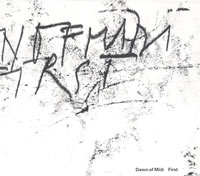 What’s in a name? With Dawn of Midi, it’s important to avoid any misconceptions by clarifying right off the bat that this is not a plugged-in retro-fusion band. (“Midi” may be a reference to the south of France, as the band apparently spends part of its time together in Paris – or maybe not.) Nor, for that matter, is it a World Music or “ethnic” jazz ensemble, despite the fact that its members – pianist Amino Belyamani, bassist Aakaash Israni, and percussionist Qasim Naqvi – are Moroccan, Indian, and Pakistani, respectively. Moreover, if you’re hung up on categories and willing to accept the distinction, I’d say they’re not a jazz band per se, but a devoutly acoustic improvisatory trio that draws upon occasional jazz, classical, and ethnic resources. And they do it well.
The group’s identity is defined by its acoustic properties – tonal nuances that vary from piece to piece according to touch and timbre. All three alter their sound to affect dramatic contrasts. Israni, for example, will rattle his strings percussively, let ripe bass notes resonate in the air, or serve as a harmonic fulcrum for the shifting modalities of the piano and drums. Naqvi’s patterns and accents – often faint echoes of wood, metal, or brush – are sparse, responsive, and unpredictable. Belyamani’s piano ranges from chiming bell tones to muted pin-pricks and feathery caresses. From these sonorities they construct environments and a narrative of engagement, rather than “tunes” – melodies blossom from insinuated motifs, then just as quickly dissolve, unresolved. Instead of conforming to symmetrical phrases, they re-design the space around their abstracted shapes with polyrhythms (some possibly derived from ethnic musics) and supple interplay. Though the energy level is frequently subdued, an inevitable drama builds from the audible tension between intuitive commitment and organizational impulse, reflecting their individual experiences in more rigid compositional forms. Dawn of Midi are storytellers, though unconventional ones, creating their own plots out of wisps of smoke and the musical substance at hand, in the moment.
–Art Lange
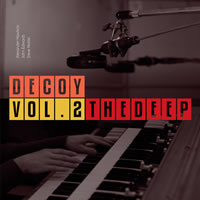
Decoy
Vol.1 Spirit
Bo’ Weavil weavil40CD
Vol. 2 The Deep
Bo’ Weavil sidra02lp

 Alexander Hawkins is one of the faster-rising figures in the UK, his projects as leader and co-leader yielding some of the better recordings of the past four years. While his bona fides as an improvising pianist were established on Barkingside (Emanem) with bassist Dominic Lash, percussionist Paul May and clarinetist Alex Ward, it was The Convergence Quartet’s Live in Oxford (FMR) where Hawkins – and Lash, for that matter – proved to have composer’s chops as refined as those of his more acclaimed cohorts, cornetist Taylor Ho Bynum and drummer Harris Eisenstadt. Hawkins’ work employed an appealing elastic approach to materials derived in part from Andrew Hill. Hawkins hit full stride with last year’s No Now is So (FMR), the brilliant debut of his sextet with Lash, percussionist Javier Carmona, electric guitarist Otto Fischer, cellist Hannah Marshall and Orphy Robinson on steel pans. With a program of original compositions, collective improvisations and insightful covers of pieces by Wadada Leo Smith and Sun Ra, Hawkins drew an elegant arc from Hill to Henry Threadgill’s brand of elasticity, achieved through jolting, high-contrast timbres.
That line, however, jumps into another dimension with the debut of Decoy, a trio with bassist John Edwards and drummer Steve Noble that features Hawkins on Hammond C3. Rhythm yields elasticity on Vol. 1 Spirit, released on CD, and Vol.2 The Deep, issued as an Lp; the trio can pivot from a thrashing two-beat to bebop overdrive, and from roadhouse stomps to shambling swing. But, then, so does texture; Hawkins’ stop-pulling on the C3 (which differs from the monster B primarily as furniture, not as an instrument) is arguably the primary source for this, but Edwards does not take a back seat, frequently triggering a squall with a brusque scrape of the strings or high-pitched bowing. This latter aspect of elasticity is crucial because it also points up Decoy’s moorings in improvised music, a point easily lost given the music’s susceptibility to comparisons to Sun Ra, Lifetime-era Larry Young, and others. Granted, Hawkins’ Leslie-spewed clouds of cosmic dust and his racing, razor-sharp lines do much to support the connections, but he also undermines them just as frequently, albeit with less obvious means. The real measure of the trio’s commitment to improvisation is their propensity to end a piece far afield from where they began, and taking unexpected routes along the way. This is where Noble is particularly effective, as his timing for kicking the trio in and out of gear is impeccable.
Decoy already has their next album in the pipeline, a meeting with multi-instrumentalist Joe McPhee, an exciting prospect. It’s early yet, but this may be their year.
–Bill Shoemaker
Hamid Drake & Bindu
Reggaeology
RogueArt ROG-0021
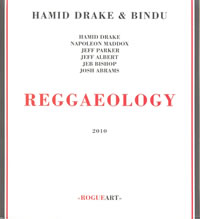 For the third time, drummer Hamid Drake assembles yet another group to perform music with yet another concept under the Bindu umbrella. On his latest RogueArt release, he’s brought together vocalist Napoleon Maddox, trombonists Jeff Albert and Jeb Bishop, guitarist Jeff Parker, and bassist Josh Abrams to play free jazz heavily infused with Jamaican reggae. The main interest lies not it how well they play reggae (although Drake is a master of it), but how they transform elements of reggae into something new.
Drake’s experience in reggae bands is fairly well known and if this album is any indication, he clearly loves the genre, knows a lot about it, and plays it with passion and conviction. Reggae has variations and different styles, and Drake, rather than play a generic “reggae” beat, differentiates among them and uses them in different tunes. For instance, he sets “Kali’s Children No Cry” in motion over a one-drop beat. “Take Us Home” is based on a Rastafarian nyabinghi drum pattern. Since the 1970s, regions of reggae producers made use of studio effects, and there is a bit of dub-style echo heard on “Togetherness,” and some use of the studio for overdubbing and reassembling the music. Albert doubles on Hammond organ on “Meeting and Parting,” injecting a little Upsetters vibe into the mix.
He also makes connections other traditions. Indian tablas and reggae blend on “The Taste of Radha’s Love,” a fusion that was popular in the some of the reggae coming out of London, with its large Indian and Caribbean expat communities. Abrams’ guimbri expands the music’s connections back to Mother Africa, reminding us also of the debt owed to Don Cherry’s world music-jazz fusions.
Like roots reggae and nyabinghi ceremonial music, the words and lyrics on the album are devotional. In fact, “Kali’s Children No Cry” is basically “Jah Jah Children No Cry,” with the substitution of Kali for Jah. Drake’s songs and poems in praise of Kali are not as sternly moralizing or Old Testament in their sentiments as a lot of Rastafarian music, but it shares the same devotional impulse, even if it takes a slightly different form. Maddox is equal parts actor-poet, sound source, and singer, so the tunes rarely come off as conventional songs, although there are song-like passages in many of them. On “Meeting and Parting” the ardor of Maddox’s recitation is both spiritual and sexual; it’s performed not spoken. In the ensembles and collective improvisations, his repertoire of gasps, shushes, whispers, pffts, and percussion imitations make him an equal with the horns.
All the allusions and borrowings from reggae form a platform for free jazz explorations. On “Kali’s Children No Cry” interludes of out of tempo sound manipulations appear between extended improvisations over Drake’s thunder clap fills and accents. “Kali Dub” is a collective improvisation that interweaves Bishop’s rougher, more highly textured sound; Albert’s sleeker, airier timbre; and the recitations and vocalizations of Maddox. Parker moves with impressive ease among the rhythm section, the ensemble collective, and his role as soloist on “Hymn of Solidarity” and “Meeting and Parting.”
The common point between jazz and reggae that Drake preserves is the ecstasy of rhythm. He understands the ability of a strongly stated beat to make us feel free, irrationally happy, and closer to something greater than ourselves. Out of these feelings, grows everything else on the album – the words of devotion and praise, the jubilant improvisations, the collective shouts. Even if you don’t share in Drake’s specific spiritual beliefs, you can still feel the joy in – as the lyrics to “Kali’s Children No Cry” put it—his “drum of great fearlessness.”
–Ed Hazell
Scott DuBois
Black Hawk Dance
Sunnyside SSC 1252
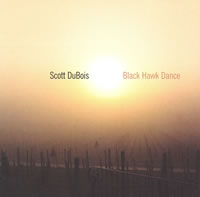 Guitarist Scott DuBois has made an impressive mark on the New York jazz scene since his 2005 Soul Note debut, Monsoon. His fourth session as a leader, Black Hawk Dance is his second for Sunnyside Records, following 2008's Banshees. Featuring the same personnel as his previous effort, DuBois is joined by German multi-instrumentalist Gebhard Ullmann, longstanding bassist Thomas Morgan and Danish drummer Kresten Osgood. On their sophomore effort, DuBois and company balance episodes of bristling furor with mellifluous lyricism, exuding a dynamic emotional resonance that stretches beyond the fervid intensity of their Sunnyside debut.
Reminiscent of Keith Jarrett's soulful writing for his 1970s-vintage American Quartet, DuBois' multifaceted compositions pivot between freedom and form with graceful alacrity, embracing moods that veer from wistful to acerbic. Such expansiveness is paralleled by his incisive virtuosity, a breathtaking technique that ranges from jagged, staccato phrases recalling John McLaughlin and Pat Martino's seminal work, to gauzy excursions that invoke the pastoral vistas of Pat Metheny's more agreeable efforts.
DuBois' bassist of choice since his 2005 debut, Morgan keenly interprets these often abstruse themes, lending a natural feel to even the most oblique angles. Osgood matches Morgan's exacting contributions with enthusiastic precision, fueling Ullmann's verbose expressionism, which in turn makes a perfect foil for the leader's blistering fretwork.
Inspired by Native American ceremonial traditions, the episodic title track opens the album, undulating between spare, unabashed lyricism and dense, coruscating fervor. Morgan and Osgood's vacillating undercurrent shifts through numerous tempos, fluctuating from ethereal accents and loping modal grooves to pneumatic swing. DuBois' prismatic articulation and Ullmann's vocalized bass clarinet ruminations are conveyed with rapturous conviction, infusing the folksy piece with a strange poignancy.
The introspective rubato ballads "Souls" and "Isolate" showcase the quartet's impressionistic reserve, while "Illinois Procession Rain" highlights their straightforward musicality. Accompanied by Osgood's sensitive brush work and Morgan's supple bass accents, the sanguine unisons of Ullmann's sonorous bass clarinet and DuBois' Frisellian filigrees yield a bittersweet heartland melody.
The quartet's most unfettered performances are found in the Ornettish angularity of "Dust Celebration" and the jaunty roadhouse vibe of "River Life." DuBois' rapid-fire arpeggios and Ullmann's gruff tenor testimonials inspire Morgan and Osgood to stellar heights on these excursions, with the closer, "Louis Frederic" upping the ante. Unleashing a torrent of overdriven note clusters in tandem with Ullmann's probing soprano cries, DuBois' sole use of distortion on the date sounds slightly out of place, but ends the set on an emotional high note. Gradually fading away, the tune evokes the spiritual heights attained by the New Thing's most zealous practitioners.
More conventionally melodic than their previous release, DuBois' quartet infuses this session with a muscular tunefulness that balances ferocity with tenderness. Both cathartic and uplifting, Black Hawk Dance is a stellar record, highly recommended.
–Troy Collins