Moment's Notice
Reviews of Recent Media
(continued)
Cecil Taylor Unit
Fragments: The Complete Salle Pleyel Concerts
Elemental Music 5990455
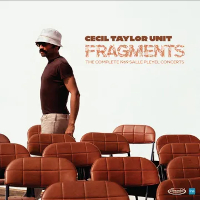 In 1969, Sam Rivers joined the Cecil Taylor Unit, which at that time consisted of Taylor, Jimmy Lyons, and Andrew Cyrille. The foursome traveled to France in June and stayed at the private arts institution Fondation Maeght, where in July they recorded The Great Concert of Cecil Taylor. In October and November, the Unit began a fifteen-date tour of Europe where they joined the Duke Ellington Orchestra and Miles Davis Quintet as a miniature Newport Jazz Festival. On November 3, 1969, the Unit recorded two sets at the Paris Jazz Festival, heard here officially for the first time (part of the concerts have been available on YouTube). Each set consisted of a performance of “Fragments of a Dedication to Duke Ellington” – a 90-minute afternoon rendition and a slimmer 49-minute evening presentation. Each set is gargantuan, and when considered together, almost unwieldy in scope. This of course, shouldn’t be surprising. Any reader of this publication should have a good idea that a live Taylor performance is likely to consist of a single high energy marathon piece. That’s exactly what is on offer here.
The afternoon set begins with the band outlining and elaborating on a short theme. For someone who had only been with the group for less than a year, Rivers sounds right at home. As a quartet or in duos, trios, and solos of various configurations, the Unit plays with an unflagging force and energy. They take their listeners through various stories and episodes with changes in texture, dynamics, mood, and volume. The rush of ideas, along with the added power of Rivers blowing the pads off his tenor, is exciting. Midway through, as the band reaches fever pitch and the intensity level is seemingly maxed out, a wild, guttural wailing emanates from the quartet. Taylor’s or Cyrille’s yell – it could not be Lyons or Rivers, as their saxophones are each at full cry – is disturbing and almost too much to take. The Unit found its way into my bone marrow. This is double black diamond level music.
The evening presentation has fewer plot points and episodes than the afternoon offering, but it is no less enticing. An opening group conversation is followed by a solo by Lyons (many of whose lines, which if put in another context, wouldn’t be that far out) and then one by Taylor. The quartet comes together for a spirited yet relatively brief group session. As in the earlier performance vocalizations sound out, but they are less pronounced, surprising, and affecting than before. The group recedes and Taylor solos. As he plays there are hints of another sound and layer of overtones on top of the piano. It takes some time, but it becomes clear it is Rivers on flute, embellishing Taylor. Together they are as if turbo charged sprites, dancing in the ether. The music’s intricate delicacy is all the more powerful given the visceral charge heard earlier in the day.
Like many of Taylor’s recorded live performances – from the Taylor/Lyons/Cyrille trio’s 1973 Japan shows to the slightly larger Units of the late 1970s and early 1980s to the Feel Trio’s week-long run at Ronnie Scott’s in 1990 to Taylor’s duets with Tony Oxley in 2002 – the music on Fragments feels not only like it could, but that it should go on and on. Taylor and company have much more to say and many ways to say it. The demands of the jazz festival format dictated that the music must stop. Miles Davis’s band needed to go on next, the audience would go home, and the next city beckoned.
On its own, Fragments is a stunning, monumental recording that all Taylor fans – especially those who particularly enjoy the Unit built around Lyons and Cyrille – should seek out. It is not, however, what coproducer Zev Feldman calls an album of “Biblical importance.” It does not represent a shift in Taylor’s approach and that incarnation of the Unit was not a catalyst for a realignment of the avant garde. Given its monumentality but not necessarily its artistic uniqueness in this period of Taylor’s work, how do we think of Fragments in relation to Taylor’s oeuvre? With freshly unearthed historical/archival releases I often ask myself – as I did while writing my review of the recent Rahsaan Roland Kirk releases in this publication’s last issue – “do we need this?” This question is usually followed up by, “is this worth releasing, or is this a money grab?” Here, I’m shifting from that somewhat cynical approach to one that is more concerned with Fragments’ place in Taylor’s work.
Usually, I tend to think of an album or a concert as its own discrete entity – related to the other discrete albums in an artist’s career, surely, but still existing as a single bounded item. I cannot do that here. The massive scale of Fragments as well as that of so much of Taylor’s work, prompts me to reconsider the collected recordings of Taylor’s career as akin to a single epic novel or poem. Each show, studio album, and live recording is one chapter or one stanza among countless others in that epic that cannot be broken off from the others. Fragments then, is small part of the story that features one of the few recorded appearances of an important character whose time in the narrative is short-lived. In this case the character is Rivers, who was only with the Unit for a year. Within the context of Taylor’s decades-long project, Rivers is a minor but important character who added a distinct voice to the Unit and helped it burn with phosphorescent heat. Fragments – the title itself speaks to this idea of a piece of a whole. This is not a singular performance to be bracketed off from what came before and what was to come later; it is one sublime moment among countless others in the continuous music of Cecil Taylor.
–Chris Robinson
Mike Westbrook
The Piano in the Room and the Blues
thingamajig 2503
 This collection of intimate piano solos was issued on Mike Westbrook’s 90th birthday, just prior to his passing, giving the eleven pieces an aura of famous last words, even though they were uttered twenty years ago. Additionally, solo playing was tertiary to Westbrook’s legacy, overshadowed by 60 years of breakthrough long-form works like Marching Song and The Cortège, the community outreach of the Brass Band, and a slew of durable recordings by mid-sized and large ensembles. However, there is something essential about Westbrook that is conveyed through this set of blues-inspired compositions – he subordinated his mastery of form to direct, emotive statements.
The timing of the album’s release makes the opening four variations of “Carillion Blues,” an eight-bar blues inspired by Jimmy Yancey’s “Death Letter Blues” all the more haunting. There is a kinship to Ran Blake in Westbrook’s use of slow-as-molasses tempi, sparse phrases, and acute blues feeling; but there is a basic difference in temperament as Westbrook shares little of Blake’s noirish sensibility and quasi-cubist approach to materials. Westbrook’s is blues distilled, not deconstructed.
The conceptual spine of the album is that each of the five batches of variations are blues of different bar lengths. The two versions of “Blues Changes” has the only traditional twelve-bar form, but instead of the standard chord changes, Westbrook opts for a knottier harmonic sequence and expands the voicings. On the two Bessie Smith-inspired variations – both of which receive a pair of treatments – the structure is stretched to 16 bars on “Empress Blues” and “Runaround Blues” to a remarkably organic-sounding 48. The concluding, single take of “Sunday Morning” is listed as a “no bar blues,” a liberal description of a serene, delicately developed motive.
The decaying notes and silences of “Carillion Blues” continue to play critical roles throughout the album, but there are also spurts of jaunty stride, fulsome chords, and spidery runs. Westbrook always played substantially more than “arranger’s piano,” yet he valued economy, and he judiciously picked the moments when he wore his heart on his keys. Still, for an artist whose music could exude broad theatricality, The Piano in the Room with the Blues seems to have been made for an audience of one – himself – a partial explanation of why it resonates long after it is played.
–Bill Shoemaker
Western Grey
After Hours I
Room40
Western Grey
After Hours II
Room40

 Australian percussionist Sean Baxter hit my radar when I read a number of tributes after his untimely death at the age of 50 back in 2020. A few recordings and videos of his intensely structural non-idiomatic approach to drum kit, percussion, and everyday objects revealed a resourceful, thoughtful mind at play. So, my interest was immediately piqued when I saw the announcement this year of After Hours I and After Hours II by the Australian electro-acoustic trio Western Grey on the Room40 label. The trio of Baxter (percussion, room acoustics, and found objects), David Brown (electro-acoustic guitar) and Philip Samartzis (electronics, field recordings, records, and microphones) had previously only released a single recording on a small Australian label in 2003 which never got much notice.
That has been rectified by Samartzis’ decision to revisit recordings the trio made in 2006 at the Melbourne artist-run West Space. Samartzis explains, "With the gallery empty and silent, we spent two evenings exploring its acoustic and spatial dimensions through a series of improvised performances. Using percussion, electro-acoustic guitar, electronics, field recordings, and found objects, we responded directly to the material qualities of the space – its concrete floors and walls, reverberant surfaces, and the presence of an elevator shaft that acted like a resonant chamber ... [The recordings] captures a fleeting moment when Western Grey tuned into West Space – and allowed it to speak back.” The improvisations on the two volumes, ranging from 11 minutes to 25 minutes, are studies in attuned listening and the collective development of structure.
Over the course of two hours, Baxter, Brown, and Samartzis probe the quiet interactions of their respective instruments and the space itself. This is a music built from shifting skeins of finely wrought detail. There is an intrinsic ambiguity in both the sources of sound and specific roles of the players. Fluttering oscillations, metallic clangs, pattering percussion, hissing electronics, dark sustained groans, and field recordings coalesce in the reverberant space. Bird calls, crowd murmurs, and snippets of urban soundscapes waft in and out of dissonance, microtonality, and the fragmentation of trajectory constructed from hanging tones, resounding gong decay, brittle clatter, and sputtering static.
This is music of patient, parallel activity as each of the members incisively allow their sounds to sit within the mutably evolving sonic whole. And, as Samartzis notes, the acoustic elements of the large gallery where they recorded is an integral element. As a result of his mixing and mastering, one can hear the way that the sounds diffused within the space, inhabiting and activating the site. While it is worth searching out Glacial Eratic, the group’s debut recording, After Hours I and After Hours II display how much the group developed their collective approach, still sounding startlingly innovative and revelatory even two decades after the recordings were made.
–Michael Rosenstein
Kenny Wheeler Sextet
What Was
False Walls fw19
 Evan Parker’s psi label reflected the totality of his advocacy. Sessions led by forward-thinking modernists like Gerd Dudek, Ray Warleigh, and Kenny Wheeler, reflected a set of decades-old associations as important to Parker as any others. Representative of the wealth of material recorded for the label, What Was, Wheeler’s 1995 session with Warleigh, Stan Sulzman, John Paracelli, Chris Laurence, and Tony Levin, suggests there is more that has yet to see the light of day, as the bulk of the tracks are only now being issued for the first time – the exception being the leader’s closer, “Kind Folk,” previously included on 2003’s Dream Sequence.
Unlike most Wheeler dates, only two of the album’s eight compositions were penned by the leader, and are saved until last. The saxophonists each pitched in a pair of pieces; “Subconscious-Lee” is stitched onto the title composition; and Mick Pyne’s “Masbro” is tucked into the middle of the program. There is a wide variety of melodic contours and rhythmic feels, spanning Warleigh’s “Blue Nile,” a punchy blues variant that would be a fine vehicle for Woody Shaw or Billy Harper, the hard bop message of “Masbro,” and Wheeler’s patented blend of melancholy and soaring aspiration on “Kind Folks;” but the stylistic differences are overwritten by the sextet’s ensemble presence. The horns are seamlessly blended in the ensembles, the rhythm section constantly provides the rhythmic and timbral touches that boosts the swing at the optimum moments, and the solos are consistently rousing. Despite its multiple authors and diversity of compositional approaches, the album flows as effortlessly as one where Wheeler penned the entire set.
In addition to being a very welcomed addition to Wheeler’s discography, What Was begs the delicious question of what else lies deep in the psi vaults. With False Walls and mastering engineer Felipe Gomes close at hand, Parker has a solid team when he unearths more gems.
–Bill Shoemaker