Moment's Notice
Recent CDs Briefly Reviewed
(continued)
Peter King Quartet + The Lyric Quartet
Janus
Miles Music MMCD088
 Terms like “third stream music” and “chamber jazz” are wanting in describing the integration of jazz and string quartet on Peter King’s five-movement “Janus,” the centerpiece of this concert recording. The approaches best represented by these labels entail a dampening of the fiery, bop-derived swing the alto saxophonist champions and they imply a post-serial compositional aesthetic to be central to the work, which is certainly not the case here. Instead, King’s inspiration from the string quartet tip is Bartok, to whom methods like the rippling of motives through each voice of the quartet, and the use of an arch-like structure, keystoned by a mirror-like third movement are easily traced. Additionally, King intimately understands Bartok’s affinity for folk music-derived rhythms and attack, and extrapolates it to his own ends.
Comparisons with current strains of chamber jazz and third stream music are further strained by King’s writing for the strings in passages where they are close to comping King’s quartet with pianist Gordon Beck, bassist Jeremy Brown and drummer Steve Keogh. Yet, it is not jazz-with-strings writing, either, even when fulfilling yeoman’s tasks like add grit to a Adderley-like work song, or a breeze to a waltz. The juxtaposition of passages featuring only the Lyric Quartet (Patricia Calnan, Harriet Davies, violins; Nick Barr, viola; Dave Daniels, cello), where the writing is often simultaneously elegant and knotty, and the full ensemble passages stymies the use of current labels for this type of project.
The other vital parts of the chemistry are King and his quartet, who exemplifies the fluid interplay that is a hallmark of modern jazz. Brown and Keogh maintain a rigorous back and forth, fueling the music as much with well-placed details as with sheer strength. In an idiom now widely perceived as formulaic, Beck remains a palpably risk-taking pianist. That they incite King to set solos stuffed with intricately constructed lines afire with blues-drenched fervor is an everyday proposition for them. However, in compositions where the tightly scripted string quartet parts preclude extra choruses, King’s quartet’s ability to trace an arc from nimble navigation of harmonic markers to flat-out exaltation within rigid parameters is exceptional, even for this sterling unit.
“Janus” is not the only piece on the album that has roots in Bartok. “Ronnie’s Sorrow,” a dedication to Ronnie Scott joining a soul-plumbing Bartok violin duo with a stirring mid-tempo, Coltrane-tinged vehicle for King’s soprano, has a ember-like quality, coming on the heels of the furious last movement of the title piece.
Joe McPhee + Paul Hession
A Parallax View
Slam SLAMCD 268
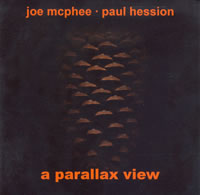 Though there’s nothing disjointed about saxophonist Joe McPhee and drummer Paul Hession’s exchanges that would support the album’s title, they are regularly jarring in their intensity. Though they have a short history together – the short 2003 tour that yielded these half-dozen improvisations was only their second – McPhee and Hession have developed a provocative and exciting rapport. In these wide open spaces, McPhee, who is heard here on both soprano and tenor, frequently changes the focal plane of the music, employing everything from spirituals to non-idiomatic materials. Not only can he slam the 1 as hard as anyone since Coltrane and sound a reveille as rapturously as anyone since Ayler; McPhee can also create a sense of purpose with recondite textures and wobbly intonation where other saxophonists can only muster a looming sense of the indeterminate. This requires a drummer who can commit, not dither around the edges. Hession does. There is nothing attenuated or wane about Hession’s approach, whether he is shadowing McPhee or colliding with him head-on. Instead, there is a refreshing willfulness to this music. Evolution frequently entails a discontinuation of functionality; in improvised music, adamant will has too often become something of an appendix, a flap that used to do something we now longer need. McPhee and Hession demonstrate it remains vital to the blood supply of improvised music.
Sonic Liberation Front
Change Over Time
High Two HT009
 Philadelphia’s Sonic Liberation Front is well on its way to becoming one of the more important American ensembles of the decade. Their mix of post-Coleman jazz, Afro-Cuban folkloric music and electronica manages to be immediately accessible without diluting any of its constituent parts. As was the case on their two previous albums, the writing of percussionist Kevin Diehl, alto saxophonist Dan Scofield and bassist Matt Engle on Change Over Time conveys not simply a smart distillation of composers spanning Joe Henderson and Roscoe Mitchell, but a keen ear for how jagged phrases and unusual structural devices will be buoyed by their drum corps. The drummers also have the right touch in supporting soloists like Engle, Scofield and trumpeter Bart Miltenberger; individual rhythms are well-defined, and the resulting polyrhythms have plenty of heat, but they keep the soloist front and center. One benefit of this restraint, if it can be characterized as such, is that when the percussionists (a contingent rounded out by Ira Bond, Rich Robinson and Chuckie Joseph, whose singing and guitar supply a tranquil mid-album aside) really let loose, there is a discernable spike. There is a similar modesty to Diehl’s use of electronics, which is particularly effective when resembling throat-sung drones. All of these elements fit together so easily that their on-paper disparity is inaudible, which goes a long way to explaining how Sonic Liberation Front gets you moving before you understand why.
Charles Tolliver
With Love
Blue Note
 It’s been 32 years since Charles Tolliver recorded his last big band date, Impact, for his Strata East. To place that timeframe in perspective, consider that several of jazz’s greatest trumpeters – including Clifford Brown, Booker Little and Fats Navarro – didn’t live to 30, and Lee Morgan died at 33. Within the relatively small sample of important trumpeters whose careers stretch that long, there are some scary examples of the ravages of 32 years, Sketches Of Spain to Doo-Bop being the case in point.
Perhaps, to some degree, a career with dormant periods is required for the odds to be beaten, allowing an artist to bridge the decades with albums as exceptional as Impact and With Love. Certainly, laying off the scene for extended periods gets you noticed if you return with a strong showing, the way Tolliver did in 2006 on Andrew Hill’s Time Lines. However, as well as Tolliver navigated Hill’s oblong themes and tricky shifts in rhythmic feel, Hill’s music did not require the unique combination of sustained power and fluidity Tolliver patented on his Strata Easts, a very high bar to clear significantly later in life. Listen to the trumpet solos on tracks like brawny, briskly paced “Rejoicin’” without referring to the solo credits, and it sounds like a youngblood who’s nailed Tolliver’s pungent sound and lacerating lines; when it turns out to be Tolliver himself, it’s safe to say he passes that test.
The bar for present-day jazz orchestra composers has risen precipitously since the 1970s. In 2007, a big band chart has to deliver more than a burst of excitement or a moving theme; it has to provide contextual markers to sharpen both a narrative and the composer’s place in a historical continuum. Tolliver achieves this on “Mournin’ Variations,” which commences with a yearning, spiritual-infused theme delicately scored for clarinets and flutes. After some striking orchestral flourishes, Tolliver shifts gears with a mid-tempo Coltrane-like blues feel, a tailor-made vehicle for both himself and tenor saxophonist Billy Harper, Tolliver’s Strata East label mate. He then reprises the material for woodwinds before ending the 11-minute piece with exclamation points with blasts from the brass and the explosive drumming of Victor Lewis.
In assembling this 19-piece ensemble, Tolliver made some interesting choices. He tends towards younger brass players including trumpeters David Weiss and James Zollar and trombonist Joe Fiedler. In addition to Harper, veterans like Craig Handy, Howard Johnson and Bill Saxton round out the sax section. The rhythm section includes Music Inc. bassist Cecil McBee and pianist Stanley Cowell, who shares duties with the impressive Robert Glasper. Intriguingly, the young player who makes the biggest impact is guitarist Ched Tolliver, whose walk-on solo on the driving “Suspicion” is deep in the pocket yet daringly off-center.
After With Love, it’s going to be tough to wait even 32 weeks for a follow-up.
