Moment's Notice
Reviews of Recent Media
(continued)
Angelica Sanchez + Chad Taylor
A Monster is Just an Animal You Haven’t Met Yet
Intakt CD 413
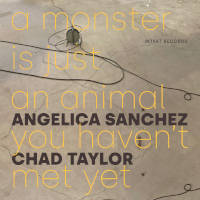 A Monster is Just an Animal You Haven’t Met Yet is the first duo album by pianist Angelica Sanchez and drummer Chad Taylor. This meeting seems inevitable, considering their long friendship, which has been documented over the years in various configurations. As virtuoso improvisers and diverse stylists, Sanchez and Taylor are two of the most protean personalities currently working in creative improvised music. Sanchez’s melodic progressions and harmonic contributions recall the endeavors of past masters, and are mirrored by Taylor’s equally multistylistic inclinations.
Unlike a solo performance, where narrative flow is unencumbered by the burden of shared responsibility, a duet tasks a pair with having the patience and commitment to follow whatever direction is mutually undertaken, while maintaining a congenial sense of cohesiveness. Sanchez and Taylor’s deft correspondence is uncannily balanced, their near telepathic bond yielding an unpredictable soundscape that is attained in tandem. Sanchez’s confident pianism guides the way, while Taylor’s percussive accompaniment provides momentum. The duo’s efforts are frequently intricate and occasionally serene, but always compelling.
The opener, “Liminal,” is spacious and lush with Taylor gracefully accompanying on mallets before rhythmically interweaving with Sanchez in a series of harmonious variations. “Holding Presence in Time” is similarly opulent, but suspenseful and restrained. On the other hand, “Myopic Seer,” takes off for the stratosphere, as both musicians orbit in close proximity around one another, slowly building in simmering intensity, playing together as one. “Animistic,” a sonic interpretation of animism (the belief that all things have a spiritual essence) is even more primal.
The title track offers exotic tonal variety; starting with a hypnotic riff on thumb piano, the groove continues while Sanchez rubs and strikes the strings inside the piano in sonic solidarity. Emulating natural phenomena, Sanchez’s piano ebbs and flows like water on “Alluvial,” her phrasing modulating from gently meandering to forcefully rushing; Taylor matches her fluidity with shimmering waves of percussion. On the closer, “All Alone, Together,” Sanchez is unrelenting, while Taylor’s pan-textural rhythms escalate in turn, his clattering cadences elevating the tune.
Sanchez rarely gets the recognition she deserves. Her playing is consistently surprising, and Taylor makes a perfect musical partner. Together they conjure a melodious dialogue that brims with endless possibility – expressive one minute, introspective the next. A tribute to the spontaneity of two artists creating in the moment, and a celebration of conversational interplay, the album title A Monster is Just an Animal You Haven’t Met Yet is also an apt metaphor; each excursion sounds unfamiliar at first, but eventually reveals an inner beauty that only close listening can provide.
–Troy Collins
Wadada Leo Smith + Amina Claudine Myers
Central Park’s mosaics of reservoir, lake, paths and gardens
Red Hook RH1005
 Wadada Leo Smith, Amina Claudine Myers, and Charles Ives, are generally not names mentioned in the same breath or sentence. However, they share a source of inspiration that led to some of their most profound music – Central Park. Although “Central Park After Dark” has a riotous midsection, it begins and ends with much the same tranquility that pervades Central Park’s mosaics of reservoir, lake, paths and gardens. Conveying tranquility through music is a trickier proposition than generally assumed; the music can slip into the soporific and, instead of entering a revelatory dream-state, one simply nods off. Perhaps Ives was on to that, prompting him to launch “Rag Time Gal,” replete with a piercing trumpet. Smith and Myers avoid this as well, though their approach is markedly different than Ives’. They double down on the elements that, in lesser hands, become tired gambits: the crystalline phrase; the resonant voicings; the evocative silences. Their mastery creates an experience where the listener is drawn deeper and deeper into verdant soundscapes, but remains alert to every petal, each drop of dew, and the dance of light and shadow created by foliage in a gentle breeze. This is no ordinary walk in the park.
Smith first demonstrated his ability to transmit the beauty of contemplation within a group context on Reflectativity, the 1975 debut of New Dalta Ahkri. In later major works like Ten Freedom Summers, Smith has used the gentle long tones and bright ascending phrases that characterize this facet of his work to offset more probative materials; here, these hues predominate. Building on Myers’ space-soaking piano arpeggios, Smith unfurls one of his more affective melodies on the opening “Conservatory Gardens” – there is a balm in Manhattan. This establishes a through line, not of materials but of tone. It is buoyed by wafting trumpet phrases and organ chords on the brief “Jacqueline Kennedy Onassis Reservoir,” a piece that exemplifies how a second track can provide an immediate contrast in palette while steering the arc of the album. Myers’ role in this regard cannot be overstated, her mix of single bass register notes, chiming chords, and lines that suggest the muffled rumbling of distant thunder, delicately shading Smith’s playing on “Central Park at Sunset.”
The midpoint placement of Myers’ piano solo “When Was” was brilliant. Initially sparse, it deliberately introduces the figurations, chordal heft, and harmonic contours that reflect the unique mix of church and conservatoire Myers brings to creative music. While it leaves the listener wanting more, the solo’s role is to pivot the album to its conclusion, which it does elegantly. An equally inspired stroke was Smith’s unaccompanied introduction on the subsequent “The Harlem Meer.” As original a player as he is, Smith nevertheless reveals his connection to Miles Davis when he employs a mute, an association reinforced by strategically placed blue notes and piquant piano voicings. The atmosphere continues to linger when Smith removes the mute for “Albert Ayler, a meditation in light,” even when Myers uses chromatic chords and cresting tremolo to dramatic effect. The most somber of the pieces, “Imagine, a mosaic for John Lennon” ends the album with a dusk-like image of the waning warmth of daylight and cool encroaching shadows.
Central Park’s mosaics of reservoir, lake, paths, and gardens is a masterpiece, pure and simple.
–Bill Shoemaker
Cecil Taylor Unit
Live At Fat Tuesday’s, February 9, 1980 – First Visit
ezz-thetics 101
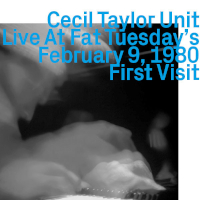 With Live At Fat Tuesday’s, the ezz-thetics label launches First Visit, Archives, a new series that offers “previously unreleased recordings of historic and musical importance.” In February 1980, the Cecil Taylor Unit held a two-night run at Fat Tuesday’s in NYC. Producer Werner Uehlinger recorded all four sets and the second set of the first night was released as It Is in the Brewing Luminous. Here, the first set of the second night is presented, filling out a picture of a short-lived version of the group. For his run at Fat Tuesday’s Taylor convened a sextet with Jimmy Lyons on alto sax and Ramsey Ameen on violin, both of whom had been part of Taylor’s working group over the previous few years, adding in bassist and cellist Alan Silva and drummer Sunny Murray who he hadn’t worked with since the late 1960s, and drummer Jerome Cooper who had appeared sporadically the year before. The group played the February dates and a short run in France later that fall but don’t appear to have performed together other than that.
Art Lange’s liner notes to the release talk about Taylor’s use of architecture as a metaphor for his music and that’s an apt description of the music of this version of his ensemble. Murray’s churning polyrhythms and Cooper’s more voluble tuned-percussion playing provide the underpinnings for the group’s labyrinthine flights driven by Taylor’s lissome torrents. One does wish that Silva was a bit less muffled in the mix, but his coursing lines come through, spurring the surging flow. Ameen’s violin is an effective textural element in the roiling intensity of the group, particularly in the final third or the set, weaving in and out of the propulsive energy. But it is Taylors’ long-term collaborator Jimmy Lyons who provides the most adroit foil to the pianist’s strapping intensity, his stabbing free-flight angularities bounding across the careening ebbs and flows of energy.
The hour-long set is emblematic of the ensemble approach that Taylor was charting at the time. While the trajectory of the piece wells and subsides, the energy never flags. Taylor’s playing provides a commanding center, guiding the structure through his use of repeated, motivic kernels, thundering clusters, and caterwauling rhythmic potency. The group is sparked by the shifting densities, delivering resolute performances that play off of each other with a keen sense of impelling ensemble furor. They can muster a collective clamor or open up, as they do in the last section of the piece, where Taylor and Cooper’s wild vocalizations call back and forth across the mix. In the final minutes, Taylor’s vocal cries and free lyricism masterfully guide the piece to an eloquent close. Kudo’s to Uehlinger for digging into his archives and adding to the scant recordings of this version of Taylor’s musical journey.
–Michael Rosenstein
Fay Victor Herbie Nichols SUNG
Life is Funny That Way
Tao Forms TAO 15
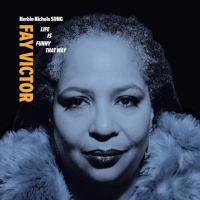 “Adaption” is the arguably wanting term Fay Victor uses to describe her approach to the compositions of Herbie Nichols on Life is Funny That Way. The singer gives canonic compositions like “House Party Starting” and “2300 Skidoo” new facets through lyrics that tell a little story as succinctly as a Lester Young solo. Her arrangements swing easily between spirited, straightforward readings and daring abstractions, reflecting an affinity for the jazzist’s articulation of modernity, and revealing the daring to take licenses with it. Both Victor and her ensemble have the stylistic range and expressive flexibility to create something way beyond the usual parameters of a repertoire project. This is not Herbie Nichols adapted nor even reengineered, but reimagined.
It is Nichols’ conveyance of indignation, insouciance, and vulnerability that makes his music fertile ground for Victor, who connects those qualities with those of great singers like Billie Holiday and Abby Lincoln. This is how she and her ensemble transform materials into realities. In the process, Nichols occasionally recedes somewhat to the midground during their off-road explorations. He can never be erased completely no matter how compositions like “The Spinning Song” or “Step Tempest” are altered, but Victor and her colleagues succeed in placing their own voices in the foreground to an impressive extent. Michaël Attias does so with chortling baritone solos; Anthony Coleman with glints of the pre-bop stylists that informed Nichols; Ratzo Harris and Tom Rainey with incisive anachronistic asides.
Victor’s Herbie Nichols SUNG not only keeps Nichols’ legacy alive, but acutely relevant. Now that the first generation of flame keepers – Roswell Rudd, Misha Mengelberg, and Buell Neidlinger – have left the scene, there needs to be musicians connecting Nichols and 21st Century jazz sensibilities; otherwise, such endeavors are master classes in cookie cutting. Victor and her cohorts do not simply take Nichols to the proverbial next level, but to their level.
–Bill Shoemaker
Mark Wastell
Vibra Trilogy
Confront (digital release)
 In 2004 and 2005, Mark Wastell documented a series of compositions for solo tam-tam dedicated to artist, writer, and musician Roger Sutherland, a participant in Cornelius Cardew’s Scratch Orchestra, member of the electro-acoustic group Morphogenesis, and author of New perspectives in music, a survey of 20th century electronic music. Over the course of the previous decade, Wastell had been delving into an exploration of sonic textures in groups like IST, The Sealed Knot, Assumed Possibilities, Chris Burn Ensemble, and + Minus, initially on cello then introducing what he termed “amplified textures” as well as percussion. Utilizing a hand-crafted instrument from Sutherland’s collection, across a series of releases, Wastell probed the shimmering non-pitched resonances and sustain of the tam-tam in pieces that range from eight minutes to a half hour in length. The pieces were originally released on three limited edition CD-Rs on small labels and quickly went out of print. Vibra Trilogy collects the releases, presenting an hour and forty minutes of immersive listening.
The metallic overtones of “Vibra #1” emerge in pulsing waves like transmissions from a distant galaxy. Wastell’s control of the overlaps and gradations of overtones, with attack subsumed into the coursing, unfolding waves of reverberation. Over the course of 24-minutes, the densities of the resonances gather and release with measured, focused deliberation through to the final moments of pensive, waning peals. The 34-minute “Vibra #2” begins with the intersection of discrete sonorous tremors, placing the percussive pulsations against a ground of hanging, metallic decay. That ebb and flow from density to spare events and Wastell’s consideration of the hushed, subtle timbres of the instrument defines the piece and the spaciousness provides an effective complement to “Vibra #1.”
The final three pieces are from the final release of the trilogy, Come Crimson Rays, presenting shorter explorations. “Come” dives into the lower depths of the range of the 32” tam-tam, mining the low-end rumble in contrast to the brighter shimmers of the previous two pieces, each of which was performed on a 24” tam-tam. Here, there is a physicality to the resonant shudders and Wastell rides the engulfing bass-heavy waves with purposeful patience. “Crimson” builds off of the layered gradations of “Vibra #1” and the overtones excite each other with radiant vibrancy. The 8-minute “Rays” closes out the recording, revisiting the resounding groans of “Come,” again letting the overtones accrue with keen control of the resultant subtle shadings. Wastell last performed “Vibra” on a short tour of the UK he did with Burkhard Beins in 2006, one recording of which was released as Vibra: Trent (not included here), but has not returned to the project since. The decision to assemble the studio recordings for digital release is welcome and provides a wider audience to experience these enthralling documents.
–Michael Rosenstein
Dan Weiss
Even Odds
Cygnus CD 104
 On Even Odds Weiss debuts a new trio featuring longtime collaborators alto saxophonist Miguel Zenón and pianist Matt Mitchell, who expertly navigate Weiss’ intricate compositions and an unorthodox recording process. The album comprises two distinct approaches to composition and improvisation, both offering unique challenges to these innovative musicians. Six of the twenty pieces are pre-written compositions that the trio interpreted together. The remaining pieces originated as brief drum exercises that Weiss recorded solo. He then presented those fragments to Zenón and Mitchell to improvise on. These knotty miniatures (many clocking in under a minute or two), require the players to issue fully formed statements in brief durations.
The miniatures are presented in pairs. Compare the swinging “Recover the Mindset” with the starkness of “M and M,” the poker-inspired “Too Many Outs” with “Runner Runner,” or “Bribes and Ultimatums” with “Royal Beatings” – the former in each case being Weiss’ unaccompanied drum track, the latter a response with Zenón and Mitchell interpreting the original. “Horizontal Lifestyle” and “Vertical Lifestyle” invert the drum-based process; “Vertical Lifestyle” features the full trio, while “Horizontal Lifestyle” spotlights the austere saxophone and piano duo it inspired. The mesmerizing “Conversing with Stillness” adopts a similar approach, beginning with the full trio before Weiss drops out, leaving behind a free-floating ballad.
These concise experiments are interspersed with a half-dozen of Weiss’ new compositions. They include the feverish opener, “It Is What It Is,” where claustrophobic tension contrasts with the lax tone suggested by its title. In contrast, “The Children of Uvalde” is a mournful tribute written in the aftermath of the 2022 school shooting, while the tender “Fathers and Daughters” evokes cheerful aspects of parenthood. The locomotive energy of “Five to Nine” and the elastic tempo that drives the lurching “Nineteen to the Dozen,” play on the complex meters of the respective tunes.
Paying homage to Weiss’ inspirations, the melodious “Nusrat” (named for the Pakistani Qawwali singer Nusrat Fateh Ali Khan), transfers a tabla rhythm to the drum set. “Max Roach” and “Bu” (Art Blakey’s nickname), both build on rhythmic ideas learned from the legendary drummers. The former elaborates on Roach’s contribution to Charlie Parker’s “Klactoveedsedstene,” while the latter reimagines an isolated Blakey pattern in the form of a traditional tabla composition. The impressionistic “Ititrefen” is “Nefertiti” spelled backwards and was written in homage to Wayne Shorter’s composition.
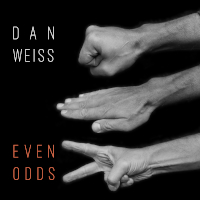
The album title reflects gamesmanship and the game of rock, paper, and scissors depicted on the cover is an apt representation of the trio’s playfulness. Even with three different ideas expressed simultaneously, the resulting music is rarely discordant, more often harmonious, but always fascinating. Finding a balance between unfettered freedom and traditional structure, the fervently episodic Even Odds has vivacious appeal.
–Troy Collins