Pandemic Odyssey
continued
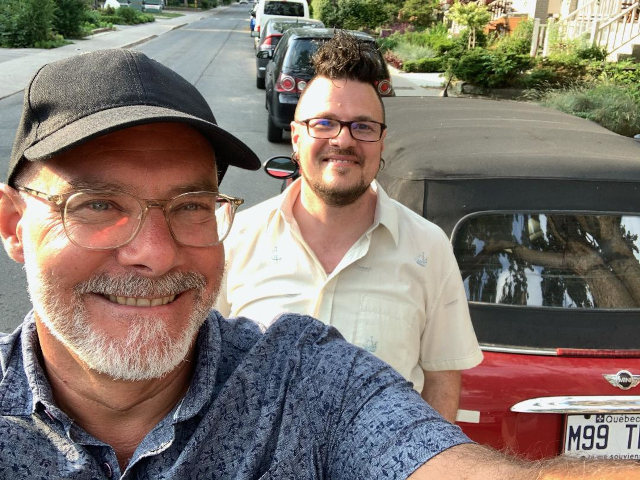
François Houle + Joe Sorbara, © 2021 François Houle
With all the elements having come together – dates, locations, the campaign, the financing – I set out on an 18 concert, 21-day trip across Canada.
Concert 1; Châteauguay, Quebec; June 13:
The first concert was at my brother’s backyard in Châteauguay, the town we grew up in on Southwest of Montreal Island, across the St-Lawrence River. I took the opportunity to announce my travel plans and the fundraising campaign I put together for cancer research, which came as a pleasant surprise to my family.
Concert 2; Montréal; June 14:
Before hitting the road, I tested out my set up for outdoor concerts with my good friend Hamin Honari, a world music master percussionist. Recently relocated from Vancouver to Montréal, where his wife Shirin is a research professor at McGill University, Hamin and I have been collaborating and working together on a number of projects over the years, notably with guitarist/pianist/composer Itamar Erez, Juno-Award winner Gordon Grdina, and now with the second incarnation of SAFA, my Persian music trio with him and Amir Koushkani. He is the artistic director of Vashan Society, and performs, presents, organizes world music concerts in BC and around the world. He performs regularly with the Vashan Persian Music Ensemble, Qualandar, Itamar Erez, Gordon Grdina’s The Marrows (with Hank Roberts and Mark Helias), as well as supporting young musicians with masterclasses and special clinics. Hamin comes from the most amazingly talented musical family.
Living on St-Denis Street in March and April, during the first lockdown, what would normally be a busy street turned into one where a car only drove by every half hour or so. This concert was the first since the lockdown for Hamin, and we performed in his backyard in the Mile End part of Montréal, near Jarry Park. A typical Montréal “balconville” thing, the neighbors pulled out chairs in their gardens and balconies to eavesdrop on the music making. It was a heartwarming occasion since it was my first opportunity to play with another musician in nearly four months. Attended mostly by friends of Shirin’s, some of whom specialize in Statistics, and Epidemiology researchers, the conversation hovered around the pandemic, and was quite animated as to what extent measures would have to be taken to counter the effects of the pandemic on society, and the economy. We all feared a second wave, which seemed inevitable at that point in June. Little did we know that things were about to get a lot worse come fall and winter.
Concert 3; Ottawa, Ontario; June 17:
My first official stop on the road was at flutist and scholar Ellen Waterman’s home in Ottawa. I first got to know this extraordinary woman as a participant of the Vancouver Creative Music Intensive, for which I was artistic director for six years. Ellen went on to graduate with a PhD and has focused her academic activities on improvisation and community, publishing fascinating papers and is the co-editor of the book Negotiated Moments: Improvisation, Sound, and Subjectivity (Duke University Press). An accomplished flutist, we improvised a series of duets following a solo set with my electronics. Musicians and colleagues Kathy Armstrong (new music flutist) and Shannon Peet (bassoonist and retired officer at The Canada Council for the Arts) were part of a small audience seated in Ellen and husband Michael’s beautiful garden in Nepean, on the outskirts of Ottawa. The post-concert conversation hovered around the shift in the arts brought on by the suspension of live performance and sudden surge in online performances.
Ellen Waterman: In academia, “innovation” is this buzzword, which is to say “Do something new. Do Something New!”. All the time. There’s only been the next new shiny thing that’s...that’s important. And here, actually, it is adaptation and reinvention, and working with what you’ve got. Trying to reconnect with people and figure out how to do it.
Shannon Peet: Reconnect. Re-imagine. Re-engage
EW: We’re trying to get back ...
SP: Re-engage! ... Some of the stuff that, I think ... deep in these rabbit holes about what the difference of the literatures, environmental scan, and reviews of what people are talking about, including webinars, and everything from social media to, you know, very specialized art magazines in all disciplines, and everything. And there seems to be a couple of camps; the large institutions, especially if they’re tied to a venue, are kind of, like, in the “return to normal, let’s wait it out twelve to twenty-four months. Keep the subscriber base engaged.” They let go of all the artistic staff, but they’ve kept their development staff and their marketing staff, because it’s all about just waiting it out until we can return. And then there’s the rest of it, and everybody’s going “are you kidding? We knew there were problems with the old model. Why would we rebuild the old model? You think we’re going to rebuild the European, white, colonial old model again, when we have a chance to rethink everything?” I don’t think we’re going to do that! And I see this tension between people who are wanting to drift towards more community and local and social value, and “who is art for?” and “who says who it is for?”, and who gets to create? Who gets access? and all of that. Between the old model, of this subscription base, and it’s just going to ... that model is going to die, very hard, against the sweep to build something different.
EW: Well, the exciting thing is that that swing to build something different that is community based, that is more local, more sustainable in all kinds of different ways. The opportunity right now is that you don’t have to have that opposition that is in front of you all the time that says “well, if you go that route, then it won’t be quality”. So we’ll lose the excellence. We’ll lose the high artistry that we would have with our current model. Now, people have to figure it out! They have to figure out how to do the things that sustains them, that satisfies them, that artistically is what they want to do. But they have to do it in a different social way.
Michael Waterman: The one component that involves taking my work to festivals completely disappeared, or put on hold. The other part of my practice which is online weekly improvisation, which has just kinda blossomed in this context. I’ve been doing this for close to 20 years. Since the start of the pandemic lot of past contributors have come to us, so that the participation has doubled.
EW: We’ve also been playing together over the course of our decades-long “association”. We just formalized a band name for our duo, Pa & Ma. Some of our collaboration with local dance company got postponed or put on hold, so we did an album, and a video for the Guelph Online Improv Festival.
EW: It’s artists who are doing this. The same artists who always have the smallest means to spare, but can affect so much. I say this sitting in a position of immense privilege, having a university professorship. I kept my job. Our day to day hasn’t changed that much, except for working at home. What I responded to was to develop a research project at Carleton University to look at how one can make meaningful experiences online for our students. We’re doing lots of background research right now. Lots of people have been gathering resources for both synchronized and synchronized activities. How to level latency. What do you do with your choir or your Jazz ensemble, to help the directors and students to use improvisation to overcome this latency. Changing our ideas of what pedagogy means ... people are doing an enormous amount of exciting work to kind of rethink their teaching online. How do you make people feel that sense of ensemble? That sense of community? That’s our research question. Not just how do we responsibly teach people to improvise.
Concert 4; Living Brightly Farm, Havelock, Ontario; June 18.
Making new friends and visiting new places are the spices of life. With a connection to the west coast, Susan Woollam agreed to welcome me to her farm roughly halfway between Ottawa and Toronto. The drive to Havelock was dedicated to listening to Hugh Fraser’s music with the Vancouver Ensemble of Jazz Improvisation (VEJI). With my heart full of gratitude for the time I shared with the wonderful musician and friend Hugh Fraser, his passing yesterday marked his return to spirit. He was one of the most dynamic and energetic jazz musicians I had the pleasure of hearing and working with.
Hugh was a true legend, leader, bigger than life all around beautiful person. Judging by the many tributes on Facebook and the press, he had an incredible ease with people, always supportive and encouraging. He fought his battle with cancer valiantly and with great courage, playing on despite his body being ravaged by this terrible disease. Today I dedicate my performance to his memory. Long live HUGE FRASER!
Interview with Susan Woolham: Living Brightly Farm:
Susan Woolham: Like almost 85% of farmers in Canada, I support my farm with off-farming income. I am a math and science teacher, and I was poised to start working in film on March 15. I had gone into my training in Toronto, and boom! COVID happens and I lose my tutoring job and my film job. And here I am with this very large 137 acres farm, going “Now what do I do? How do I pay my bills?”. And I really applied for money in all different places. So, I wasn’t able to get government funding, and I’ve tried for weeks. And amazingly, my community totally rallied and made it possible for me to stay. My roommate and I built a new greenhouse. And my neighbor Jordan lent us his back hoes so we could put hay in the ground. Bales of hay so if we got a frost bite it would be a 12-month greenhouse. And I had other neighbors come and help me put in the foundation, and someone else frame it. And so, the whole community rallied to make this possible. And my plant sales went fantastic. I loved COVID costumers because I got to have them one at a time. Normally there’d be 50 people in the yard. But with COVID it was one person at a time in the greenhouse, and I’d say “hi”, “Who are you?” and “How can I help you with your garden?”. And I could spend so much time with each customer, and everybody was so patient. And what a difference it was for me. The biggest thing for me was the community rally. I had help come from everywhere. I ended selling enough plants to pay my bills this month and I have a little bit set aside for next month. I am able to just focus on the farm. I am not running off to do teaching or working on films. It’s so much easier and slower. I am working 12 hours a day, but I’m in one place. For me, it means that everything is much slower, and it’s been a real blessing.
Concert 5; Niagara Falls, Ontario; June 19
Concert 6; Hamilton, Ontario; June 19.
This was my first time ever seeing Niagara Falls. On this trip, I hoped to take the time to stop and see iconic Canadian places such as this, to remind me of what it’s like to be living in such an amazingly beautiful country. The sound of the falls created a powerful backdrop for a simple melody that popped into my head, as I was thinking about my family, my brother, and all the friends I’ve seen so far on this trip. My spirits were high on account of all that.
I was happily surprised to hear from Cem Zafir early in the morning to invite me to perform in his backyard that very evening! I trust this man implicitly. He’s always been so supportive of musicians, and generous with his energy and hard work. With Zula Presents and the Something Else! Festival, he organizes concerts in Hamilton, and for years presented musicians from all over the world at various venues in Vancouver (he made Rime, a restaurant on Commercial Drive, one of the best live music venues in town for years!). Thanks to him and his wife Donna Akrey (a great visual artist) for having me play that night and organize food and a great bunch of friends and neighbors
Concert 7; Guelph, Ontario; June 20, 2020
The first time I met Ajay Heble, Artistic Director of the Guelph Jazz Festival at the time, I knew I had found a kindred spirit, a sonic adventurer, a scholar, and super lovely person to hang with. Him and his wife Sheila are the kindest people you’ll ever meet. Just ask their dog Braxton and he’ll tell you all about them just by the look in his canine eyes! I got to know Ajay more and more over the years, including working in Gaspé with him as part of the Coin-du-Banc En Folie Summer Improvisation Camp. Ajay is also the founder of the International institute for Critical Studies in Improvisation, an amazing resource and think tank for everything concerning improvisation and communities. If that wasn’t enough, Ajay spearheaded the development of the first ever improvised music PhD program at the University of Guelph. Thanks to IISCI and Ajay, I get to visit Guelph to perform at the University of Guelph’s Arboretum. After the solo concert I conducted interviews with them and a few other friends who attended.
Sheila O’Reilly: About the lockdown: I found it much easier than I thought it would be. To be inside, to be reading, to reconnecting with myself. We have a dog, so I have the advantage or going out with the dog every day. As far as where this is going, I am very optimistic. To use the time we have right now to learn that the path we are currently on is so detrimental to our existence, and use this time as a portal to get to our next world where we’ll be so much more respectful to the environment and to each other.
Ajay Heble: As someone who has health issues and is compromised in terms of health, I’m being very careful. This is the first time that I am out, except for walks with our dog Braxton, this is really the first time that I’ve been around more than one person. So, it’s great to be out, great to see you and great to be with friends, at a safe distance. I’ve been thinking a lot about this is has meant and what it’s going to mean for artists, for arts presenters. And one of the things is to try and provide opportunities for artists while things are being cancelled and a time for audiences when live performance opportunities are non-existent. I’ve decided to launch an online improvised music festival. I’ve been thinking about watching an improvised music festival for a while, since retiring from the [Guelph] Jazz Festival. So, after speaking to colleagues at IISCI [International Institute for Critical Studies in Improvisation], it occurred to us that this was actually maybe a really good time to launch such an event, because people want the music. They want the art. They want the opportunity to listen to people reading. To listen to music. And there’s something ... I’ve been watching some really interesting and inspiring events online. Two that you may know about, one we were both involved in, PENSODIA (nusica.org), a 24-hour event by our friends at the University of Padua in Italy. It is very inspiring to see what they were able to pull together, you know? This country that was in a lockdown, they managed to pull together this incredible event with probably over a hundred artists. It was also really inspired by what colleagues in Toronto who put together a program of events called URGNT. So, they’ve been live-streaming events pretty much since the beginning of the pandemic. Initially they started by live-streaming events from empty well-known venues. It was beautiful. Absolutely amazing to watch. Now they’ve started to do people from their homes. They’ve been doing these mini-festivals as well ... With these two models in mind, we thought why not do something of our own. We’ve pulled together about 150 artists from around the world. 24 hours of unique programming. Nothing will be repeated. So, it’s been a difficult time, but I think Sheila already quoted the author and activist Arundhati Roy, who says that “pandemics are like a portal that enables us to imagine a world anew”. So, there is an opportunity here to imagine the world anew. And I think it’s been difficult for many of us, of course. I’m actually doing ok. I can’t really complain. I think it’s been really difficult for others. But I try to imagine what the opportunity is ... and to improvise.
Justine Richardson (Director, Guelph Arboretum): I started here in February. In retrospect COVID had already started but we had a little bit of time before things really shut down. I’m talking to you now towards the end of June, and things are starting to open up. So, I’m working very hard to figure out what that means for us in this space. I’ve been really grateful that the trails have been open the whole time, and people have been using them. Families with small kids. To use them to get around. If been grateful that that’s been a possibility. But then how that looks going forward for a longer term. We don’t know. We’re planning to allow for some outdoor weddings and memorials in the space which has brought so much solace to people during this time. Serving as a place for mental health for a lot of people. [The arboretum] is a special place, and over 50 years. This is the 50th anniversary of the U of Guelph Arboretum. It started in 1970 in the spring. It really was a bare farm field. And through time and collections and planting trees, and reforestation between full growth forest at one end to old growth forest at the other end. This long-term caring project, that’s much bigger and longer than any of our lives, actually, has been a place to be grateful for.
Moving forward? That’s an interesting question. I don’t know. Hopefully we’ll all move forward with more care and respect for one another. A realization of really big systemic problems have not been solved by the pandemic. Actually, they’re made worse. Especially for Black people, people of color. I hope that we will find systemic ways to address these problems and move forward in a better way.
Concert 8; Toronto, Ontario; June 21.
For Toronto, I decided to connect with my great friend, wonderful human being, and killer musician, percussionist Joe Sorbara. It was a tough choice as there are so many amazing musicians in the Toronto area I would have loved to connect and play with, including Jean Martin, Nick Fraser, Kevin Turcotte, Tim Posgate, Lina Allemano, Rob Clutton, to name a few. Based on its rich musical history, I would say that the scene there has blossomed at an incredible pace towards more open forms of music, while retaining an incredibly inventive jazz and world music scene.
Happy Father’s Day to all the dads out there! Today, as part of my fundraising campaign, I pay tribute to my dad. He passed away from cancer at the young age of 51. Ever since I turned 51 myself, there is not a day when I don’t think of him, how he would have loved to see his sons find their places into the world. So, I imagine his spirit witnessing all that we do, he enjoys watching our children grow. I have conversations with him still. I ask him for advice. Every time I get dressed in the morning, I think of the rituals he had, shaving, combing his hair, putting on a tie, always looking sharp. It’s the sum of all these little memories that keeps him present in my life. His battle with cancer was short, just over 6 months. But he never gave up. He kept saying “I’ll beat this thing”. In a way he has, because today his memory and spirit are honored. About Joe; I got to play with Joe when he and his family moved to Vancouver a few years ago. We put together a trio with James Meger, with a few tunes recorded and ready for release in July on Bandcamp (Afterday Audio). Immediate chemistry. I would consider Joe one of the most sensitive drummers I know, always looking to lift the bandstand while keeping time and textures as a focal point of his playing. Please visit his website to witness the sheer scope of his activities: www.ovalwindowmusic.org
We also had some fun with a video session at Vancouver’s The Gold Saucer space in 2018.
The concert in Toronto at Joe Sorbara’s place was so much fun! Thanks to Joe’s efforts we had a nice audience, including some fine musicians who came to listen (shout out to Nick Fraser and Bea Labikova for coming out!). We live-streamed the concert on Facebook!
Travel Days; June 22 and 23.
Before heading out, I met with this extraordinary man, Sean van Sluys, director of Musagetes Foundation, who regaled me with stories of his recent trip to the Brazilian Amazon, and his take on what the Pandemic could potentially trigger some societal changes for the better.
Shawn Van Sluys: I’m the Executive Director of Musagetes, a foundation based here in Guelph. Our mandate is to make the arts more central and meaningful to peoples’ lives. More broadly, the mandate, in relation to that, is to look at how does artistic thinking, artistic practice, artistic exploration show us different ways of seeing, understanding, and relating to the world. Recently, I would say in the last few years, four five years, we’ve been working with more indigenous communities as well. And I think a lot of the way that I would see possibilities for a different world are in many ways informed by the work we’ve been doing with indigenous communities. One of those, that I hope that our relationship to the earth, to how we want to be present in relation to the planet is also informed more by more of a collective imaginary, a collective way, of being. The coronavirus has shown us how a sort of individualistic, consumerist ... When the coronavirus became a reality, I was much more resisting this idea that we should already start to think about how this was going to change the world around us, because I felt we needed to sit with the virus and understand how it’s present before we could really start to project, out to a year or two years, 10 years or two decades, where we’re going to be or how we want to be in the world. I think the window to then start to really test out some different ways of being is now. As we understand that the virus is going to be here for a while, and there will be future viruses, and more science, and more broader observations that’s showing us that this virus is largely a result of yet an ecological damage that we’ve done to the planet. These viruses ... Western scientists are showing this, indigenous scientists and in stories are showing us that these viruses are coming out of the earth because of the higher increased temperature, cutting down the trees. I saw [Canadian poet and Sto:lō author] Lea Maracle post something on Facebook a while ago where she talked about how Trees had come together ... because viruses were plentiful across the earth ... the trees came together and said “let’s be the keepers of the virus. Let’s hold them in our roots to protect the earth. But then when the trees got cut down ... the trees had to release those [viruses]. I think it’s a beautiful image. It’s just a very simple one. But it speaks deeply to the very human focused way in which we think about earth, as if we’re the only species that matters. As if we’re at that apex or something. I hope that this period of slowing down with the virus, where we have to be more isolated from each other, from our daily routines and so on, actually give people more time to contemplate. The relationship that we’re feeling towards other creatures in the world around us, like, I see more birds in my garden ... there is a certain soul-filling aspect to that that opens us up. And I think it opens our hearts. It opens our whole bodies to be more receptive to something that is not about money, it’s not about plastic [credit cards], it’s not about the consumption of an experience or the consumption of something else. I also hope that it sort of slows down ... there’s a searching that happens amongst certain people, a searching that amounts to a spiritual tourism, a sort of a dabbling into this spiritual tradition or in that spiritual tradition, and such. And this could be a moment for us to anchor ourselves in a form of spirituality, or even find spirituality.
People are starting to treat social change “thing” less as an industry and more as a way to relating to each other. I think that’s really important, because we have really turned this whole thing of changing the world into an industry. Companies are branding themselves that way. Organizations, foundations, social organizations are perpetuating the same models, or even continuing to work with models as if models they can be applied in any kind of scenario and can be fully comprehended. As Ellwood Jimmy, who works with us at Musagetes, always says, there’s a lot of value, and really a lot of importance in not knowing. And being comfortable with not knowing, and sitting with that, you know! I think that’s really wise. *
After a few days of back-to-back concerts, I hit the road to work my way from Guelph all the way to Saskatoon. I had two and a half days to make it there for my concert with Helen Pridmore. That day my drive took me up Highway 69 and Highway 17, probably the most scenic stretch of road in Canada, besides the Canadian Rockies. By mid-afternoon I ended up at The Big Nickel site in Sudbury (Canada is famous for giant sculptures and tourist attractions, perhaps not as ambitious as Mount Rushmore, but nonetheless impressive and a bit kitschy in some cases), where I had to stop for a short break to nap and stretch my legs after several hours of driving on little sleep. Just north of Sault Ste-Marie I made a stop at the stunning Kakabeka Falls, which Ajay and Sheila highly recommended. Looking at the map, and knowing I’d have to do really good time along the longest stretch of roads between concerts, I decided to make it as far north as I could that day, so that I’d have a chance to get to Saskatoon in time without killing myself. Initially, I had planned to make a stop for a concert in Winnipeg, the next big city along the way. Unfortunately, that concert had to be cancelled due to the province of Manitoba’s strict rules forbidding travelers to make any stops except for essential needs, such as fuel and food. This meant no campgrounds, no visits, nothing. Reshuffling my itinerary, it never occurred to me to measure the additional distance I would have to cover in a couple of days.
At sunset I came to the sudden realization that there were no gas stations on Highway 17 (“Highway” is a very exaggerated term for this two-lane meandering road along the shores of Lake Superior) until Wawa, several hundreds of kilometers up the road. After a very rough mental calculation, I figured I’d make it – barely. To complicate matters, a massive thunderstorm hit near Lake Superior Provincial Park, rendering visibility to zero and making road conditions very hazardous on the dark, narrow winding road. Somehow, I managed not to kill myself.
Once in Wawa, however, I couldn’t find a motel, and camping was out of the question as the thunderstorm was still raging. So, I had no choice but to sleep in my Mini Cooper in the parking lot of a closed gas station, as the empty fuel flashing light had been threatening impending doom for several kilometers already! As it turns out, it was quite comfortable, if I didn’t move too much and made sure the hand break didn’t kill my hips! Surprisingly, a young Mennonite couple with an infant suffered the same fate as me. We mutually agreed that whoever woke up first would alert the other vehicle as soon as the station opened at 6am in the morning. All in all, I had driven 12 hours straight for a total of a thousand kilometers (over 600 miles!).
The morning after, once refueled and broken fast on a stale bagel, I headed north along Lake Superior all the way to Kenora, insuring that I would make it in good time to Saskatoon the following day. Along the way I took in the breathtaking beauty of Sleeping Giant Park, and made a short pilgrimage to the Terry Fox monument just before Thunder Bay. After that long stretch of road, I decided to book a motel in Kenora, the last large town before the Manitoba border.
Concert 9; Saskatoon, Saskatchewan; June 24, 2020
As I was working my way through Manitoba and Saskatoon, I couldn’t help but reminisce about the last week, at how wonderful it was to see old friends, play and share music with folks who have not heard anything “live” in weeks.
I was looking forward to performing duos with the ever so creative singer Helen Pridmore in evening in the park with sculptures and statues just off a walking trail on the University of Saskatoon campus, behind the Education building. A small but knowledgeable crowd gathered to hear us improvise along with a cacophony of whistling groundhogs.
Paul Zuchan, composer, University of Saskatoon: It’s symbolic that you are playing here because this is a place that the city and the University and the symphony have been talking about a concert hall for long time, maybe 60 years. And it’s never come to fruition, obviously, for one reason or another.
FH: Has anyone ever come here to play, improvise, or dance?
PZ: Not that I know of.
Naomi Piggott-Zuchan, pianist: Not that I am aware ...
Helen Pridmore: I was an undergrad student here, and when I was a student this was all undeveloped. And there was a path that went down by the river. It was called the Devil’s Dip. It was actually pretty scary, like, people got assaulted down there and so. It’s all been, I don’t know what you want to call it ... gentrified?
PZ: Covid has affected me, but less than I would have initially thought. Maybe because I’m a composer. It’s one of the things I do. And composers naturally self-isolate a little bit. In some respects, it’s been nice to have more time to write. Bu t on the other hand I am an organizer, and some of things I have to organize have been cancelled. Things I put a lot of work into. So that’s a bit of a drag. Going forward, I don’t know. It’s hard to say. I hear big groups are the ones most affected, obviously. I see how much they want to get back to normal, and how hard that’s going to be. They’re trying very hard to come up with very creative strategies, such as fewer audience members, among other things. So, I’m glad I’m not someone with a large group because this would be absolute hell right now. To try and figure out, especially if you’re a group that has to be recruiting. Such as a university group, where you’re always in recruiting mode. And you’re always a bit worried that the next year there might not be students to replace those leaving. So, you’re walking into a situation like this where, for most years it is difficult, that this might make it worse.
NPZ: How did covid affected my life? It’s slowed it down a lot, for better or for worse, I guess. There has been more betters than I expected. There’s been time to really practice. As a musician, I spend so much time getting ready for the next gig that I can’t remember the last time I played something just because I wanted to. These last four months I have played whatever I wanted, not just the thing that’s coming next. I’ve been able to spend more time with my family.
PZ: Maybe too much time with family. (laughter)
NPZ: Our kids are small still, so they’ve been home for a long time. It’s been wonderful, and awful at the same time. How I think things are going to move forward? I agree with Paul that it’s a difficult time to be in the arts right now. I think that one of the ways that we will move forward is prioritize ourselves and our work in a way that I don’t think society does, because I see all these reopening plans that are business related, lots of things that are sports and entertainment related, and restaurant related. And their parameters don’t seem to be that much different than ours if we were considered worth prioritizing. No one will advocate for us except us. As we do reopen, I think that a lot of my colleagues and associates are finding that, unless we are very loud, we will be forgotten.
FH: Unless we are very loud, or we just do our thing, like I’m doing right now. I organized an 18-concert tour, playing to whoever is going to show up. There are no parameters. It’s sort of groundbreaking in the sense that there IS an audience, somehow, that materializes out of these conditions. Just by using social media and connecting with friends and a community, and friends, to just get a word out. For me, the experience is that there is a way. There are all kinds of ways we can survive as artists. That we can do something that is worth putting a lot of efforts into. It might not be lucrative in the traditional sense. But the way it is feeding me, my soul, after two weeks of isolation, and weeks, months of fretting about how I was so-call going to reinvent myself. It’s kind of bogus because we’re always inventing as musicians. It’s something we’re doing already. So, there’s a whole discourse going on right now about how do we change the context within which we create.
NPZ: I also think that when we talk about reinvention, there’s going to be a bedrock in most of us that says “no. This is what I am, and this is what I do. And I ‘ll find a new way to do it.” Maybe.
FH: We are not isolated, in the sense that we’re surrounded by a community that is living the same thing.
PZ: I’m hopefully that we’ll have some lasting effects. That people will remember what it was like without anything. I am so sick of doing everything online, and to do anything in person is just so much more rewarding. Now that we’ve done that in society. Hopefully, collectively, we can remember that. And we won’t take these things for granted anymore. There’s never been a period, at least in my lifetime ... in Saskatchewan, its history, where everything stopped for that amount of time. I don’t know if it ever did happen. So hopefully our culture can remember that collectively, and not take anything for granted.
Brian Garbet, composer: I’m kinda new to Saskatoon. I came a bit before anything happened [with COVID], so I’ve been stalled a bit, as there hasn’t been events to go to and meet people. Building on what people have said, I think it’s important to reconnect with a community, reconnect with other people and not give in to the fear of things. And resist not doing that. Being away from things for so long has shown people the importance of that; connecting with people and a community. I’m looking forward to when things relax a bit and getting to know people and find the music scene here in Saskatoon. Going out and doing stuff. It is something that perhaps, when coming here, I took for granted. It has made me reflect on things a bit. Thinking differently about things. The positive thing that came out of COVID was to teach people to be resilient and find other ways to do things. If we can bring that together with a sense of community, and not letting fear stop of from doing events, doing projects, like people have before. I think it’ll be perhaps even better.
HP: First of all, I want to thank you for doing this tour. I think it’s a brilliant idea. You see what a great space this is for performing. We’re socially distanced. We’re still able to feel a sense of community. My life has changed pretty much completely since this pandemic started. I was going to be on sabbatical, and almost all my plans have been cancelled. I have to reconstruct what I want to do. Part of it is now becoming a full-time caregiver. It’s something completely different than what I’m accustomed to do as an active performer and professor at university. That’s been very abrupt and, I have to say, disturbing. It has disturbed my entire way of life. Everything is pretty much different. My partner and I moved to Saskatoon to take care of aging parents. That’s the focus of our life now instead of doing gigs and creating music. I think the music will still continue. I’m looking forward to doing some projects on my sabbatical. It’s been an interesting time for that sudden switch. I have to thank COVID-19 for making me switch gears.
FH: There’s a silver lining to everything ...
Concert 10; Edmonton, Alberta; June 25.
As I was making my way through Saskatchewan and Alberta, the breathtaking view had a very calming effect on me. I was simply blown away by the serene beauty of the prairies, the stillness and solitude. After a week on the road, playing and meeting with friends after 3 months in Quebec, I couldn’t help but think how hopeful and positive everyone was, and that ultimately, we will have learned a lot from this current pandemic situation.
I met Chenoa Anderson when I began my involvement with the Vancouver new music scene in the early 90s. We hired Chenoa, a brilliant flutist, several times to perform really difficult music with my new music ensemble Standing Wave, which I co-founded with cellist Peggy Lee, pianist Laytuan Tan, and percussionist Laurie Lyster. We went on to collaborate on several occasions until she had the great idea to fall in love with composer Ian Crutchley and move to Edmonton. Since then, the two of them have been reenergizing the Edmonton new music scene and organizing concerts and festivals.
She booked me to present a streaming concert at the Yardbird Suite Club. The performance that evening was going to be to an empty club, but the video streamed on the internet at a later date in July. I was so thankful to her and Ian and everyone at New Music Edmonton, and a special shout out to Nico Anáez, who helped with connecting the two organizations to host me and plan the live streaming of this concert.
Concert 11; Jasper, Alberta; June 27.
On my way to Banff to play on Tunnel Mountain the following morning, Kyle Brenders, whom I planned on playing with that day, informed me that he had gone camping with his family and wouldn’t be back in time to join me, which was too bad because I was so looking forward to a rowdy duo at this location. Kyle was another graduate of the VCMI and ended up moving from Ontario to Banff where he got a position at the famed Centre for the Arts.
An engine warning light turned on as I arrived in Jasper, Alberta. The closest mechanic was way back in Hinton, where I had left from that morning. First car trouble of the trip after more than 3500 kms of driving. Dennis Mazur, expert mechanic, fixed Lazio (faulty distribution wires). As this took most of the morning and afternoon, I decided to drive through the Columbia Icefields and to play my clarinet at the foot of the glacier, rather than going directly to Banff as initially planned. The first time I drove the Columbia Icefield highway was in 1984, during my first summer residency at the Banff Centre for the Arts. Since then, the glacier has receded by many meters since that first visit. From the 1982 marker, it is hidden by mounds of sediment accumulated from years of erosion. The rate of melting has increased by several meters per decade since the 80’s, as indicated by the ever-widening distance between 10-year markers. It makes a strong case that indeed global warming is occurring. Somehow, the majesty of the glacier, in contrast to its receding rate, offered a wonderful metaphor for my brother’s disease; he was compelled to reason with the passing of time, to take stock of who he is and how he wanted to be remembered. It is not unlike the way the pandemic has forced me to face my own relevance to the world.
Concert 12; Banff, Alberta; June 28, 2020
Having lived in Banff for most of two years, in 1984-95 and 1987-88, this place holds so many fond memories. My first time there was the first year away from my native Quebec. I found myself surrounded by mountains, wilderness, and lots of fantastic musicians! The friendships built over my time there are still alive today, with the likes of extraordinary people such as Jean-David Coen, Bryan Pezzone, David Travers-Smith, Sue Gould, Brenda Fedoruk, and Don Ross, to name but a few who have helped me find my voice as a musician. And then the incredible winter sessions at The Banff Centre, organized by the Rolston family (Tom and Isobel) and Robert Aitken. Thanks to them I got to meet and work with a who’s who of the music world; Iannis Xenakis, Toru Takemitsu, George Crumb, Mauricio Kagel, Menahem Pressler, Alan Hacker, Mario Bernardi, and many more. The first summer there, I discovered that the center ran a jazz workshop lead by a who’s who of that scene. The artistic director was Dave Holland, with whom I inadvertently had a masterclass on the blues (up to that point I had been focusing on classical music). His kindness and generosity opened my eyes to the power of that music and planted a seed in me to eventually consider that career path. That summer I was surrounded by the music of young budding musicians such as Simon Nabatov and Ralph Alessi. They were heard in the Blue Room concerts rubbing shoulders with Dave Liebman and Steve Coleman, amongst other nobility.
Since that summer I went back several times, almost on a yearly basis, to do residencies at The Leighton Artist Colony, the various music programs, as an artist and also as faculty. More recently, Kyle Brenders was responsible for having me there working with composer Linda Bouchard and my trio with Gordon Grdina and Kenton Loewen.
Heading out of Banff, I made an extra stop at Moraine Lake, one of the most iconic places in Canada. If you look at an old Canadian $20 bill, you’ll know what I’m talking about! This was the location for R. Murray Schaffer’s Princess of the Star, and where the whole of Alan Hacker’s clarinet class played Mesomedes of Crete’s Hymn to the Sun, in the summer of 1984. I revisited with that memory so fresh in my mind. That day I played for a bunch of tourists from Iran, China, Japan, and other Canadian provinces.
Concert 13; Slocan Park, British Columbia; June 29, 2020
When driving back to Toronto after two years living in Vancouver, Joe Sorbara stopped by Slocan Park to visit his old friend and inventive trumpetist Emily Denison, who relocated there from Toronto with her husband to run the family-owned house. Joe was so blown away by the beauty of the place that he told me to contact Emily to see if I could make a stop there on my way to Vancouver. Emily responded enthusiastically to me visiting them. On my way there I made a stop near Nakusp for a cold night of camping, before heading south to Nelson to visit this lovely town. Not only did I have the pleasure of travelling through the Kootenays to visit, I got to play with Emily for the very first time.
Concert 14; Kelowna, British Columbia; June 30, 2020
The concert in Kelowna was dedicated to a few individuals who were in the midst of dealing with the harsh realities of cancer: Jason Hall, Christopher Langer and his beautiful and courageous wife. I also wanted to salute the indomitable Charles Barber, who succeeded twice to beat this terrible disease.
I get to perform with Darren Williams, who is kind of a high priest of extended techniques on the tenor saxophone and bassoon, often using circular breathing and multiphonics to devastating effect. Darren has worked with many world-renowned musicians including Eugene Chadbourne, Chad van Gaalen, Mats Gustafsson, and has performed at the Vancouver International Jazz Festival, the Casse-Tête Festival of Experimental Music, and the Fake Jazz Festival. He is based in Kelowna, BC, where he and Michael Woodworth operate the Skin and Bones Music Series dedicated to the presentation of experimental music in the Okanagan by performers both local and from abroad. We performed duos, with a helicopter hovering nearby. It reminded me of Stockhausen’s Helicopter Quartet performed by Arditti String Quartet. Birds got into it as well once the helicopter ran out of fuel. We didn’t.
Concert 15 - Bowen Island, British Columbia; July 12, 2020
The last concert of my tour took place on Bowen Island, where I performed a set for 20-some people at the house that Christine Fedina and Ken Pickering built. Ken’s spirit has been with me during my long journey across Canada, and I feel blessed to have had such a wonderful mentor and friend. Ken was well known in the jazz world for his astute programming skills, encyclopedic knowledge of the history of creative music, from its inception to the present. The yearly festival he co-founded was and still is the model template for what a truly great celebration of creative music should be. Yet another friend who passed away from cancer, his spirit was strongly felt inside of me as I negotiated a set of music by musicians he admired most: Jimmy Giuffre, Steve Lacy, John Carter, Duke Ellington.
An arts lover and supporter, but also a real person’s person, Christine plans to open her home more regularly for musicians to visit and perform. This last concert of the tour was the first one for her series, of what she hopes will eventually become a hub for visiting colleagues from all over the world.
As the jazz festival was cancelled in 2020 due to COVID, this performance was symbolic of what the artistic community means to all of us, that our lives are enriched by the arts and the people who make it possible for artists like me to do follow and share our passion. Thank you, Ken. Thank you, Christine for having me play at your beautiful home.
Concert 16; Vancouver, BC; July 28
This performance at Mount Pleasant Cemetery was more a video shoot than an actual concert. I performed a series of solo clarinet improvisations next to a huge tree near a stunning bronze statue of an angel. It was a fitting location as it reminded me of the passing of time, the ephemerality of life, and the unanswerable mysteries of death. Having listened to stories from friends and audience across the country on my journey, I wanted to create a piece that would look at death from a poetic lens, as death seems to underline what is so magnificent about life; when confronted with death, we reminisce about the past. We look at what’s been accomplished in our lives, and smile at all the “what ifs”, the great expectations of youth, the trials and tribulations of successes and failures, happiness and tragedy. As Kahlil Gibran wrote in The Prophet, “Joy is your sorrow unmasked.” When thinking of my brother’s passing, these words resonate in me, as he managed to reconcile himself with his situation, after a courageous fight. Despite the sadness and deep grief, what remains is memories of a happy human being, who really tried his best to define his happiness, not only for himself but also to share with his family and friends. He touched so many people with his energy, easy going personality, and simplicity. That day in the cemetery Charles Ives’ beautiful song “Serenity” resonated in my head along with Gibran’s words. Somehow, its haunting and beautiful melody emerged in my improvisation. I knew that I would build an arrangement of it as a soundtrack to the footage I recorded. The video was commissioned by my dear friends Carol Yaple and Richard Klasa for the Isolation Commission Series put together by bassist Mark Hainey, artistic director of The Little Chamber Music Society in Vancouver. Carol and Richard were instrumental in connecting me with the amazing folks at The BC Cancer Agency. With their assistance I was able to organize the fundraising campaign in honor of my brother. Yvon Houle succumbed to cancer in December 2020, just over a year after his diagnosis. The tour raised several thousand dollars for brain cancer research.
This trip opened my eyes yet again to how amazing it is to be a musician, to have so many friends and colleagues who really care about each other and the music. The human factor that emerged from meeting and playing across the country was so reaffirming.
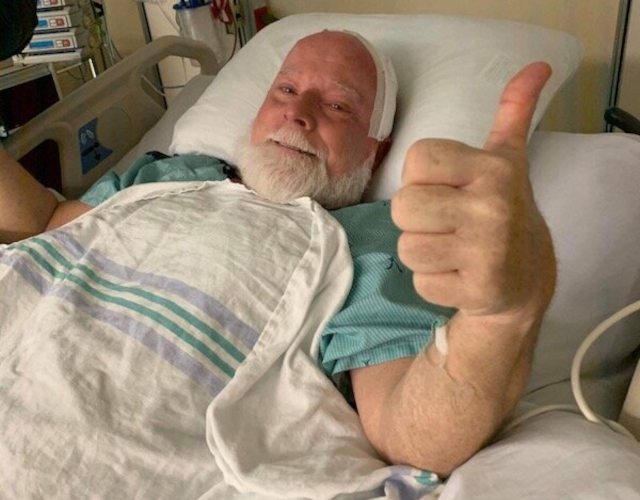
RIP Yvon Houle (1959-2020)
Thanks to Laurence Svirchev for encouraging and supporting this project.
© 2021 François Houle