Moment's Notice
Reviews of Recent Recordings
(continued)
Evan Parker ElectroAcoustic Septet
Seven
Victo 127
 Year by year Evan Parker’s electro-acoustic ensemble – a project he initiated more than two decades ago – seems to take on a more powerful place in his body of work. It is among improvised music’s irreplaceable groups – as ICP still is or as Albert Ayler’s trio once was. Parker’s ensemble has forever altered the way we hear music. Once documented exclusively by ECM – five groundbreaking discs from 1996 to 2007 – Parker’s psi label released Hasselt in 2010, and, now, Victo produces Seven, a live recording (and debut) of the ElectroAcoustic Septet at the 2014 Festival International de Musique Actuelle de Victoriaville.
If the group’s configuration has shifted over the years, growing to 18 pieces at Lisbon’s Jazz em Agosto in 2010 – a performance that, for many, ranks among the high-water marks of early 21st century creative music – Seven readjusts things once again. On the acoustic side, Ned Rothenberg (clarinets, shakuhachi) and Peter Evans (trumpets) remain; Ikue Mori returns on electronics. Now Sam Pluta (electronics) is added, along with Okkyung Lee (cello), and George Lewis (trombone and electronics). Remarkably, it was back in 1980 that Parker and Lewis first worked together, on a series of European dates captured by Incus Records.
Apart from Parker himself, this is an American band – a lovely artifact from the Englishman’s recent New York residencies at the Stone. Here, in small-town Quebec, he reconstitutes the electro-acoustic project for the first time without bass and percussion (Paul Lytton had been ever present until now). Yet the group’s moorings remain: the mirroring, of acoustic instruments and their electronic counterparts; the intricate network of voices, where collective improvisation is tied to line and timbre, where a profound sense of each player’s sound (tone, attack, breath, etc.) echoes, refracts, and ignites another’s.
Still, Seven stands apart. It is by turns searing and savage, hypnotic and contemplative. It is a supremely realized set of music – two brave, meticulous, and wonderfully alive improvisations. The record demands repeated, and varied, listening: on headphones, or filling up the room. The disc brings different delights every time; the balance – the performance itself and Victo’s exquisite production – is ideal. You might spend time, say, zeroing in on Rothenberg’s role on “Seven-1.” His work outlines the spine of this 46-minute event, tagging its beginning, middle, and end – on shakuhachi, the Japanese bamboo flute, with these gorgeous, airy, poised declarations, or on bass clarinet, down low, boring out the bottom end. Parker’s entrance comes when you’re already acclimated to the date. Lee’s pizzicato lines meander, then these terrific sweeps of sound, an electronic cascade, measured, hushed, Evans’s color. In “Seven-2” the trumpeter’s role is more prominent: he jumps in and out of the ensemble in a series of wildly controlled acrobatics.
But the overarching spirit is always Evan Parker’s: in parceled spirals, the drama of circular breathing, waves (gyres?) turning and pushing and cycling, bird calls, long tones, fantastic effects that, together, give you the sense of seven souls breathing. That, to me, is the most extraordinary aspect of this disc: the importance of space, of something beyond simple notation. At its very highest peaks, Seven is absolute music of the rarest kind. Whether the instruments are blown, bowed, plucked, or processed, you feel the essence of these sounds – as you might register a wisp of wind, or the pulse of a human breath.
–Greg Buium
The Renga Ensemble
The Room Is
Allos Documents 010
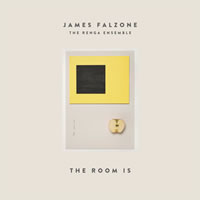 This CD is the most pleasure you can get legally in 2015. It’s wonderful music from one of our most ingenious composers: James Falzone’s settings for a clarinet sextet, restless music full of creative energy. It’s always moving. Textures keep changing; dynamics and register contrasts are mobile; usually at least two or three lines, in different momentums, are simultaneous; improvisations are sometimes free, sometimes follow simple outlines. Although most of the pieces include wholly composed passages, far and away the majority of the music on this CD sounds improvised – by Ben Goldberg (West Coast), Ned Rothenberg (East Coast), and Falzone, Keefe Jackson, Jason Stein, and Ken Vandermark (Chicago, the middle).
Falzone is a subtle composer. Without the weights of harmony or program, each of the longer pieces has its unique shape and character. The title piece especially has BANG! random chords BANG! shocking blasts stopping lines that almost develop BANG!, the BANG! chords making the work’s surface illogicality into a logical form. “Not Seeing” is contrasts of movement and stasis: a 4-note bass clarinet vamp at bottom, held clarinet chords in the middle, a fine lyrical Rothenberg alto solo atop. “White” has a birdhouse of clarinets around held chords; “Until” has spacy tones gathering, a moto perpetuo, then a high clarinet duetting with Jackson’s heavy contrabass clarinet; “That Red Apple” is an exhilarating clarinet chase. I’ve just mentioned the formal centers. Each piece is also full of details: chords, interjections, counterpoint, inspired babbling. Remember Mad Comics’ eyeball kicks? These are eardrum kicks.
The ludes, pre-, inter-, and post-, are held improvised chords. Each improviser has his solo piece called “Renga.” Vandermark’s is especially clever: chattering, nattering clarinets drive his baritone sax to frenzied mockery. Jackson’s is spacy staccato tenor sax notes (he makes me think of Maurice McIntyre here), Falzone’s clarinet is triumphant, and Stein’s bass clarinet contrasts with a growly, twittery contrabass clarinet underline. (Notice that three of these clarinetists cheat a bit with solos on other horns.)
An obvious ancestor of The Room Is is Douglas Ewart’s Clarinet Choirs of his Angles of Entrance CD – the Renga Ensemble, too, is liberated, exhilarating, the players are top musicians. Keefe Jackson’s saxophone ensemble Likely So is the Renga Ensemble’s contemporary, and like Jackson’s composing, Falzone’s presents mastery and a refined sense of form. The delightful nervous energy, the clarinet obsession, the love of detail are uniquely Falzone’s. You can hear that energy in his other groups, and he does create in other groups – he’s an adventurer (and not an experimenter). He’s not as well-known as he should be outside of Chicago, so I hope he’ll now become properly honored.
–John Litweiler
Gebhard Ullmann Basement Research
Hat And Shoes
Between the Lines BTLCHR 71238
 Gebhard Ullmann’s Basement Research issued its first self-titled recording twenty years ago on the venerable Soul Note label. Numerous personnel changes have transpired in the intervening years, with saxophonists Ellery Eskelin and Tony Malaby, bassists Drew Gress and John Hebert, and drummer Phil Haynes all former members. The current lineup features the German multi-instrumentalist (alternating between tenor saxophone and bass clarinet) joined by baritone saxophonist Julian Arguelles and trombonist Steve Swell on the frontline, with new bassist Pascal Niggenkemper and drummer Gerald Cleaver manning the rhythm section.
Hat And Shoes is the group’s 7th record and Ullmann’s 50th release as a leader or co-leader. The album bookends favorites culled from Ullmann’s songbook with three new pieces: the set opens with “Trinidad Walk” and “Wo bitte geht’s zu den Hackeschen Hofen,” closing with “Gulf of Berlin.” Unsurprising for an artist with such a vast oeuvre, Ullmann regularly revisits past repertoire, rearranging old compositions for different configurations.
One of Ullmann’s key strengths as a bandleader is his ability to arrange prewritten charts with unscripted passages that complement his intricate notation, effectively blurring the line between the composed and improvised. The opener, “Trinidad Walk,” is exemplary; Niggenkemper and Cleaver gradually thread conversational exchanges into a simmering Caribbean-inflected groove before the horns deviate from the main theme, launching into a brief but ecstatic a Capella soliloquy that galvanizes the tune’s harmonious melody, lifting the bandstand.
“Five” is a characteristically dynamic offering. Spurred by locomotive horn riffs, Ullmann takes the lead with a barrage of turbulent multiphonic variations before the band suddenly pauses, shifting into a regal processional. Swell’s lyrical variations gracefully conclude the number as it soulfully modulates from opulent horn chorale to a feverish recapitulation of the original melody. The manic “Wo bitte geht’s zu den Hackeschen Hofen” presents Ullmann’s aesthetic at its most anarchic, while the Ellingtonian lushness of “Flutist With Hat And Shoe” is the inverse, underscored by Swell’s dulcet muted brass. The delicate “Blue Trees And Related Objects” offers a similarly striking showcase for Arguelles harmonious extrapolations, while “Don’t Touch My Music” plumbs the furthest depths of his baritone.
The swinging closer, “Gulf of Berlin,” keenly encapsulates the leader’s episodic approach. Building from a spirited duet between Ullmann and Swell to interludes spotlighting Arguelles’ intrepid dexterity and Niggenkemper’s ruminative restraint, it succinctly demonstrates that even after two decades and multiple personnel changes, Ullmann’s Basement Research has lost none of its creative vitality.
–Troy Collins