Moment's Notice
Recent CDs Briefly Reviewed
(continued)
Splinters
Split the Difference
Reel Recordings RR13
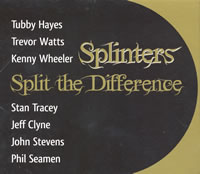 Economic downturns have played into the evolution of British jazz at critical points. Although this usually leads to bands just folding, musicians occasionally respond by seeking new formats and collaborations. That’s the case with Splinters, a short-lived early ‘70s improvising septet that joined three icons of British modern jazz – tenor saxophonist Tubby Hayes, drummer Phil Seaman and pianist Stan Tracey – with three lionized figures of London’s improvised music scene – drummer John Stevens, alto saxophonist Trevor Watts and trumpeter Kenny Wheeler – and bassist Jeff Clyne, who History has unfairly pushed into the background, despite strong work with everyone from the Jazz Couriers to Spontaneous Music Ensemble. Tracey has been quite plain in stating that his first forays into free improvisation were largely prompted by the bottom falling out of the market for his projects; one can assume something of the same was then occurring to Hayes and Seaman. Splinters had a spirited, if brief run in part because of the support of venues like the 100 Club, where this ’71 session was taped.
Splinters used the open-ended blow to coalesce around emerging semi-tangibles of pulse and phraseology, creating form on the fly. This allowed the older players to be remarkably true to their own voices. Hayes is very much his irrepressible self, barreling through the uncharted terrain as confidently as any of the players for whom free improvisation was the staple of their work, not a rare garnish. He and Watts are a surprisingly compatible tandem; while Watts mentions in his informative sleeve note that the group cleared the runway when Hayes would rev up for a solo, Watts is frequently soaring on a complementary course. Seaman and Stevens have a tight bond in creating interlocking, constantly percolating rhythms. Unfortunately, Tracey only plays on the longer of the two pieces on Split the Difference; this may be due to Tracey’s unease with free improvisation, or by being swamped in full-bore ensembles. Still, there’s enough of Tracey’s stinging comping and his Duke-Monk distillates to establish that his rhythmic and harmonic signatures flourished in this setting.
The buzz-worthy presence of Hayes, Seaman and Tracey overshadows the fact that such shuttling between camps was an everyday thing for Wheeler. The trumpeter’s decades-long affiliation with free improvisation diffuses the facts that he was ensconced in the London mainstream and studio scenes and that he’s just a few years younger than Tracey (Wheeler turns 80 in January). As the lone brass player in Splinters, Wheeler often shoots rapid-fire lines over the top of the ensembles and ricochets phrases off the other horns. The session includes some prime examples of how Wheeler combined blistering speed and precise articulation to bring old-school jazz excitement to freely improvised music. Much the same can be said of Clyne’s work, even though his plump tone is distended by an amp. Reportedly active in his early ‘80s, Clyne is one of a small number of British jazz musicians who played a significant role just not in the UK’s hard bop and free music movements, but in fusion as well. Split the Difference confirms that he is the peer of his more famous cohorts.
–Bill Shoemaker
Sun Ra
Featuring Pharoah Sanders and Black Harold
ESP 4054
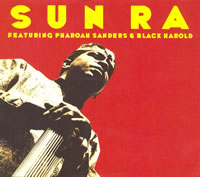 This much talked about 1964 Sun Ra concert is finally available on CD, with correct information about the event, excellent extended notes by Russ Musto, and five previously unissued stereo tracks. Saturn LPs never were in the audiophile range of quality, and since the original tracks seem to be have transfered from a vinyl copy there's some expectable distortion in the more dynamic piano parts (around 3:20 in “Dawn Over Israel”). We learned to live with that; I personally find the original hiss and crackle less bothering to the ear than the swishy background sounds left in this remastering by digital denoising. Pity that the original tapes could not be used for the original tracks, because the unissued first five tunes have a substantially better sound which obviously required less work.
This particular edition of the Arkestra features a line-up light in the winds (trumpet, trombone, flute and three saxophones) but heavy in the rhythms, with two drummers and two bassists. The sound of flute is a focus of the album; but, instead of Marshall Allen doubling; the main flutist on this recording is Black Harold (Murray), who is prominently featured on the album’s title. His contributions on the three last tracks – “The Voice of Pan”, “Dawn Over Israel” and “Space Mates” – are intriguingly impressionistic, with bluesy vocal effects and chirping overtones reminiscent of Rahsaan Roland Kirk and Eric Dolphy, but with a distinct personality. Variously described as “mysterious” and “rarely heard,” Murray has been in reality active in Chicago for the past 35 years, especially with Khalil El Zabar's Ethnic Heritage Ensemble, under the name of Harold Atu Murray. Here's a quote from a message by Ed Hazell on the Saturn list, kindly pointed out to me by Michael Fitzgerald: “So at the end of the night, I asked him if he was the Black Harold who plays flute on Featuring Pharoah Sanders and Black Harold. He laughed and broke into a very credible version of ‘The Satellites Are Spinning’! He not only played on that record and on other occasions with Ra in New York; he also said that he played with Ra in Chicago in the 1950s. Baritone sax, flute, 'and sometimes I would bring along my conga drum.'" In “The Now Tomorrow” Murray duets in fact with another flutist, most probably an uncredited Allen, where several instruments are added to the indicated line-up: according to the reviews quoted in the notes, musicians “played traditional instruments, whistles, shakes pipes, conch shells” and “instruments that Sun Ra had invented and others that he found and converted, a conch, for example, and a tuned bull horn.” Aurally one can hear some double reed zurna-like instrument and something that sounds like the yet-to-be-invented EVI.
It seems that not all the facts have been precisely determined yet, since also in “Dawn Over Israel” Robert Northern's bass clarinet seems to be present, as suggested by Robert Campbell and Christopher Trent in The Earthly Recordings of Sun Ra (Cadence Jazz Books).
The other soloist mentioned in the title and featured in the record is of course Pharoah Sanders: while Allen, Pat Patrick and other early Ra regulars like Clifford Jarvis and Ronnie Boykins are in the band, John Gilmore is not. According to the liner notes, playing outside the Orchestra with the Jazz Messengers in order to gain that personal recognition that Sonny himself would not concede him. According to other sources, Gilmore’s gigs outside the Arkestra with Blakey and others were accepted to provide much needed support for the band, and, when he took his place in the ranks again, he was an even more quiet presence than before. Pharoah, at 24, recently arrived in New York and yet to join Coltrane's band, joins the fireworks in the unissued “The Other World”, but seems equally at ease providing quiet support to the flutes and try to find, as it were, his place.
This is a rather subdued, dreamy set similar to the hypnotic Lanquidity (Philly Jazz; Evidence) of the following decade. The tone seems set by the tinkling celesta at the beginning, above the bowing of the basses; the emphasis on flutes and small instruments also prompted volume control.
The indexing of tracks is somewht arbitrary because the music is played without interruptions, creating three different long suites. The highlights are the unissued long tracks. “The Other World,” a 20 minute quasi blueprint for “The Magic City” featuring 10 minutes of a percussion duo by Clifford Jarvis and Jihmmi Johnson, and the 11+ minutes version of “We Travel The Spaceways” (here titled “Discipline 9” probably because it opens with a textural prelude similar to the “Discipline” series). Taken at a languid tempo that is so slow that even singing along with it has its psychotropic effects, it is an essential track for anyone interested in Sun Ra's music, and worth the price of admission.
–Francesco Martinelli
Lucky Thompson
New York City, 1964-65
Uptown 27.57/27.58
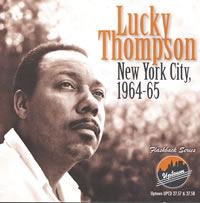 The saga of Eli “Lucky” Thompson is one of jazz’s most perplexing conundrums. Extremely talented, if emotional troubled, he never received the critical or public acclaim during his 30-year career that the ear-catching quality of his music deserved. When he disappeared from the scene in the 1970s, no one knew he was experiencing the gradual decline into dementia that would lead to his death in 2005. And his posthumous reputation continues to be damaged by a discography in shambles – important European sessions with Martial Solal, Hans Koller, Kenny Clarke and others unreleased or out-of-print; noteworthy domestic dates, like his unusual 1956 (!) trio for tenor saxophone, guitar, and bass, ignored or lost in the shuffle. Even his exceptional sideman appearances – extensive recordings with Count Basie, alongside Charlie Parker for Dial, with Monk on Blue Note, and Miles Davis’ “Walkin’” reclamation project for Prestige, to mention just a few – never seemed to elevate him to the recognition level of peers like Zoot Sims or Dexter Gordon.
Providing another revealing piece to the puzzle that was Thompson’s curious career, this new release of two live performances is a rewarding example of the special, and uncategorizable, nature of his playing. The first is from a short-lived “Jazz on Broadway” concert series produced by Dan Morgenstern and David Himmelstein; Thompson’s charts for octet are tantalizingly brief but memorable. The opening and closing “Theme” is suavely Dameronesque, with his soprano saxophone adding a sharp tang to the voicing. “Minuet in Blues,” though not strictly a minuet, does feature exquisite melodic episodes framing the blues blowing. The band stretches out only on “Firebug,” a modern swing chart with Latin underbeat a la Shorty Rogers or Gerry Mulligan – Cecil Payne’s baritone sax is boisterous, Benny Powell’s trombone gruff and blustery, Dave Burns’ trumpet boppish, but Thompson’s tenor sax solo, a delicious emulation of Coleman Hawkins, is the topper. The remaining pair of tunes are limited to Thompson and the rhythm section – “The World Awakes,” a frequently recorded showcase for his soprano sax, and the ballad “‘Twas Yesterday,” caressed by Thompson’s tenor and Hank Jones’ patrician piano.
The second CD offers a radio broadcast from the Half Note nightclub emceed by deejay Alan Grant, whose introductions and banter may lend period flavor, but are annoying as hell. The quartet stretches out on four tunes – another take on “The World Awakes,” a soprano rendition of “What’s New,” Tadd Dameron’s “Lady Bird” intensified by Thompson’s double-time tenor sax interjections and register shifting (is this the direction Wayne Shorter was heading in around the same time?), and a relentless, remarkably fluid “Strike Up the Band” similar to Thompson’s live 1960 Paris performance released by Vogue. Pianist Paul Neves, a rarely encountered member of the ‘50s Boston scene, is a keen foil, exploiting a soulful groove in “The World Awakes” and alternating accents on “What’s New.” But it’s Thompson’s show. His soprano saxophone was still an oddity in the ‘60s, and his phrasing resembled neither Bechet nor Coltrane (much less Lacy); personally, I wish he had favored the more flexible and multi-hued clarinet instead. But on tenor, his brushed suede tone and chameleonic demeanor is simultaneously comforting and convoluted. Whitney Balliett called it his “tightrope style” – an adroit blending of swing and post-bop attitudes, carried off with insouciant aplomb. As it turned out, there was an elusive irony to both his music and his nickname.
–Art Lange
Keith Tippett Septet
A Loose Kite Floating in a Gentle Breeze with just my Will as an Anchor
Ogun OGCD 030
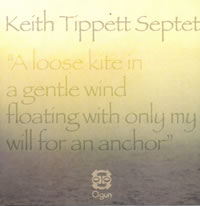 Pianist Tippett always works well on a large canvas. His large ensemble pieces can be enormous – Centipede’s Septober Energy (RCA/Neon, 1971) famously employed nearly every jazz musician in Britain in a suite that covered four album sides when it was released, as did Ark’s Frames (Ogun, 1978), Tapestry Orchestra’s Live at Le Mans (1998; newly reissued on Editions), is comparably proportioned. The more modestly scaled septet on this reissue of a 1984 Ogun LP plays an extended piece as well, a suite nearly as long as its title. Tippett writes catchy melodies and loves a good South African groove or a swinging beat; he can also bring order and balance to more rhythmically abstract passages. These virtues and a sense of pacing and contrast prevent interest from lagging over the course of a composition. Tippett is also an expert conductor from the keyboard, livening up rhythms, shading tone colors, providing harmonic nuance, and countermelodies.
This suite, which takes its title from a sentence from Maya Angelou’s I Know Why the Caged Bird Sings, was recorded live by a band that includes Larry Stabbins and Elton Dean on saxophones, trumpeter Mark Charig, trombonist Nick Evans, bassist Paul Rogers, and drummer Tony Levin. It was a great night for Stabbins, whose solos on the first and third (unnamed) parts of the suite reach very high pinnacles of rage and exultation. While no one else quite measures up to Stabbins on this night, there are nevertheless some marvelous moments by the others. Charig and Tippett are extraordinarily tight during the trumpeter’s solo on the first section. Bassist Rogers has a virtuoso turn on the encore, “Dedicated to Mingus,” a noirish Ellingtonian tribute to the late bassist. Evans’s blissful, hymn like solo towards the end of the third section eases the considerable tension built up by Stabbins and gently sends the band into the South African-tinged final theme. Tippett is a presence throughout, active but never in the way, a guiding hand that acts as the will anchoring a loose-kite septet in a maelstrom.
– Ed Hazell
Salim Washington
Strings
Cadence Jazz Records CJR 1212
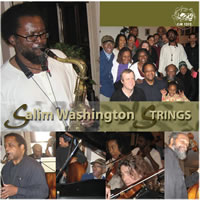 This album proves the old adage that where there is a will there is a way. The current odds against projects like Salim Washington’s Strings from being realized are staggering. The resources required for assembling and rehearsing a 19-piece ensemble, copying parts and recording the music simply knock most artists operating at a community level – distinct from corporate or cartel-controlled arenas – out of the box. So, to twist the phrase, thinking outside the box is the only way to make it happen. Beyond the commitment of musicians like violinist Charles Burnham, cellist Akua Dixon and multi-instrumentalist Howard Johnson – as well as Warren Smith, who expertly handled the conducting chores – Washington was fortunate to have a home whose front room was large enough to accommodate the musicians and yield a recorded sound that serves the ennobling spirit of the tenor saxophonist’s music.
Washington’s scores often evoke the sweep that RoMas, the tandem of Romulus Franceschini and Cal Massey, brought to Archie Shepp’s early 70s Impulse milestones, Attica Blues and The Cry of My People. One element of this is the conveyance of struggle, which Washington front loads with his arrangement of “Go Down Moses,” replete with whip crack-like percussion effects and the poignant voice of Washington’s 8 year-old daughter, Memphis (Remember Massey’s then 7 year-old daughter Waheeda on “Quiet Dawn” on Attica Blues?). Washington breaks down what made the strings on Shepp’s “Steam” so memorable: On “Elegy for Vikki Lou Washington/May Your Beautiful Soul Rest in Joy,” Washington evokes a smoky dead of night stillness; he brings a gliding lyrical elegance to the “Coltrane changes” Washington extrapolates on “Were It Not for Trane.”
Washington’s playing on this track, however, is where the comparison with the Shepp albums ends, as Washington’s tenor sound is far afield from Shepp’s raspy railings. Instead, Washington has an unassuming power in his sound, which can take a second or two to rise from an ensemble, but it’s a sound that instantly spurs the rhythm section of pianist Donald Smith, twin bassists Hakim Jami and Jaribu Shahid, and drummer Malik Washington (who has recently racked a lot of miles in David Murray’s Quartet). The tenor is his main horn by leagues, but his piquant oboe playing, combined with the dashes of off-center jazz modernism of “You Can Fly,” to give thought to Makanda Ken McIntyre and his breathy bright flute sound borders on the Kirkish.
Still, the album’s spirit subsumes its many stylistic fine points. The room looms large in this, not only in terms of its high ceilings supporting the colors and the lilt of the charts, but also in signifying community. The logistical complexity of recording such a project cannot be overstated, nor can the joy in their music.
–Bill Shoemaker