Moment's Notice
Reviews of Recent Media
(continued)
Lesley Mok
The Living Collection
American Dreams 57 ADR
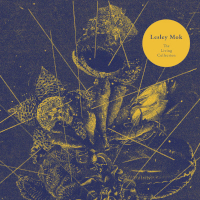 Although drummer Lesley Mok has a handful of small group improvisatory download releases to her credit, the Bay Area native truly announces her arrival with The Living Collection. It’s the debut of a larger band, ten-strong on this occasion, which offers a fresh take on that hoary conundrum of how to compose for improvisers. What’s striking about Mok’s solution is the fluidity and blend between forms she achieves. In that she’s wonderfully assisted by a forward-thinking squad of peers and more established performers who share her concerns.
Among them the names of pianist Cory Smythe and trumpeter Adam O’Farrill stand out, celebrated in their own right, as well as for acclaimed collaborations with Tyshawn Sorey and Mary Halvorson, respectively. While others may not be as well known, of the reedmen Yuma Uesaka has a fine album Streams (Not Two, 2020) with Marilyn Crispell, and David Leon helms a marvelous quartet on Aire De Agua (Out Of Your Head, 2021). Completing the cast are trombonist Kalun Leung, the electronics of Weston Olencki, and the strings of violist Joanna Mattrey, cellist Aliya Ultan, and bassist Florian Herzog.
As is obvious from that line up, Mok has an almost unlimited palette at her disposal and she uses it in subtle and pleasing ways. The ten pieces take their titles from an extract from Jorie Graham’s poem “Scarcely There,” to give the suggestion of a suite, but one in which the final shape is mysterious. The same almost but never quite tangible feel extends to the writing too. While there are relatively few unison passages to signal charts, the abundance of loose counterpoint and drifting consonance hints at intent. However, the unmistakable trace of a controlling mind manifests through the ways in which elements and combinations appear, recede, shimmer, and alternate throughout.
Mok explains the elusive mechanics in an interview with Jazz Speaks thus: “Rehearsing over the course of a month, I gave simple prompts to each musician: play loudly, play this pitch set, explore this motif, ask a question, respond emphatically! A prompt might ask someone to play in their lowest register, only to have someone else respond in their highest register. Another prompt might disperse a linear melody amongst the ensemble.”
One of the joys comes from how surreptitiously some of the episodes arrive, such as the gentle trombone melody which wafts over outbreaks of restless piano midway through “It Wants,” picked up later by Mattrey’s viola, then serving as a haunting thread around which the instruments never quite coalesce towards the end of the track. Some of the tonal colors remain correspondingly ambiguous, almost indeterminate in their source. Is that cello and bass clarinet rendering that soft line or trombone and alto flute?
However, such touches are swathed in ensemble interplay and textural juxtaposition. Sometimes stylistic touchstones emerge – like the curdled Bill Evans piano trio which materializes during the opener, or the near Baroque air which surfaces during a dramatic string trio on “Floral And Full,” or the jazzy surge topped by Leon’s yearning alto saxophone on “Again, All” – but they are inevitably subsumed within or undercut by wayward impulses which transport the music and the listener towards unexpected destinations.
Another of the pleasures derives from the way in which each member puts their individual stamp on proceedings while still furthering compositional ends. Everyone gets to shine. Sometimes such opportunities arise as brief vignettes or in duo or trio formation, but also occasionally solo. All fizzes, pops, and backwards sounding beeps, Olencki’s electronics provide an arresting start to the whole enterprise, before latterly merging with bursts of percussion and rippling piano. Similarly startling, Smythe’s piano interior scrapings loom from silence in an ominous beginning to the ultimately swelling affirmation of “Full Of Its Fourth Wall.” Mok’s tappy percussion also features prominently at the start of “Its Furious Place,” establishing a tone world accentuated by Uesaka and Leon’s woodwind plosives.
However, Mok’s achievement is that the expressive flourishes of such a talented crew adorn the overall construct, not the other way round. No-one cuts loose to shoot for glory. On the whole a meditative, restrained chamber vibe predominates. As in any such venture where so much agency is invested in the communal give and take, there are times where the tension flags. Indeed, the final “Quite A Spectacular Dusk” perhaps doesn’t quite muster the heft to conclude the album with the exclamation points it merits. But such instances are rare and do nothing to detract from an outstanding outing, which promises much more to come.
–John Sharpe
Michiko Ogawa + Lucy Railton
Fragments of Reincarnation
Another Timbre at213
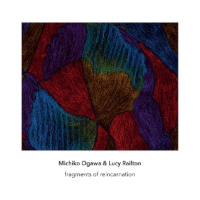 If the opening sonorities from a Baroque-period Sonata da Chiesa were updated and then transfigured, the results would bear some resemblance to Michiko Ogawa and Lucy Railton’s Fragments of Reincarnation, their first disc for Another Timbre. While obviously not their intent, this 45-minute work for Sho, Hammond organ, and cello proffers new and ambiguously fascinating melodic and harmonic transcultural relationships that still, and equally elusively, harken back to spiritual aspects of yore.
As the ever-informative interview on Another Timbre’s website explains, overdubbing occurred as part of the recording process, rendering the duo a trio. Consequently, or at least relatedly, sonorities and melodies occupy spaces both familiar and luminously obscure. Neither cello nor Sho are playing anything resembling Baroque melodies, but often, their range and disposition conjures shades of the continuo harmonies and their attendant linear relations. When Railton’s cello heads down into single-pitched depths, as it does several times throughout the movement, its overtones resonate so strongly with the organ strains that the relationship becomes not only physically palpable but nearly tangible, as if bygone eras were brought into a physical present. While this sometimes antique registral hierarchy is often maintained, Ogawa and Railton’s glacially pointillistic approach to melody tends to be much more capacious. The instruments state and restate in alternation, a kind of slow dance amidst the alternating and ever-evolving translucencies and dank but warm distortions that form an integral component of this particular organ’s voice. Even to label the Sho and cello melodic instruments misleads as much as elucidates, as they breed their own literal and implied sonorities at every turn, feeding off the bright or grittily speckled centers the organ creates.
What centers they are! Such chordal beauty in flux is extremely rare, especially in just this way. One of the most felicitous production decisions involves the recording of the organ. It occupies the center of the sound spectrum while remaining diffuse, almost a spatial obfuscation around which the other instruments offer their own starker delineations. The organ serves the supportive continuo function while transforming the very concept of harmony into a flowing entity, a prism of coloristic curves and what might be called fluid zones of intensity, to combine descriptors courtesy of Hector Berlioz and Edgard Varèse.
There are many more avenues into this music, including timbre, that could be explored, and the piece deserves that kind of analysis. Mostly though, an overall impression of what brands the music involves time and temporal eschewing. Each sonority passes and simultaneously refuses to evaporate, all becoming a kind of amalgamation, a journey of static but never stagnant liquid gesture. Given proper listening circumstances and a willingness to enter into the piece’s somehow grounded but labyrinthine structure, immersion proves transcendent. As with so many Another Timbre releases, metric concerns take a back seat in favor of “tonal” exploration amidst the expansive calm of a form and structure that find themselves as they unfold, to the music’s multifarious advantage.
–Marc Medwin
Anthony Pateras
A Dread of Voids
Another Timbre at214
 The Australian composer Anthony Pateras’ work is new to these ears and also to Another Timbre. Nevertheless, and based on the disparities of approach between the two lengthy pieces under consideration, Pateras has produced a body of work well worth investigating. One of the music’s most positive talking points involves ensemble construction. “Patterned Language” affords a combination of strings, both plucked and bowed, and a compliment of keyboard instruments, not to mention sine tones to fill out the texture. This live performance makes the evolving form’s accumulations and de-escalations abundantly clear as dyads lead the way toward more complex harmonies. While the music breathes what could easily become the stultifying air of near tonality, the gradual unfolding of sonority in the service of excellent ensemble playing, Pateras’ chosen timbres, and the overall subdued dynamic irradicate any such concern. The intricacies of registral interplay, timbral intrigue, and overlapping phrases rest just beneath a surface of quasi-consonance in constancy. Related centers emerge only to converge with the next as it glides by along a fluid path of hushed pointillism. While repetition abounds, it is continually offset by the music’s floating quality and the gorgeously layered sensations of struck and unstruck sounds in combination. It is often the case that a very different and equally intense energy pervades quiet playing, and a similar investment in listening opens up the piece’s levels of beauty and contrast. Watch out for the occasional chromatic pitch to add a bit of spice to the brew.
The titular piece is similarly pointillistic and has its roots firmly in modality, but that’s really all it shares with its disc-mate. Its circuitous path, dotted and spread with sonic disparities, is also much more difficult to encapsulate in useful verbiage. If the opening work finds Ligeti’s micropolyphony and Webern’s dotted timbral planes lurking in the shadows, Music For Airports-era Brian Eno makes an appearance on “A Dread of Voids” but only in the fascinating juxtapositions of sound and silence. The forthright quality of the studio recording and the addition of wordless vocals might conjure memories of the vintage Philip Glass ensemble, but again, the music is worlds apart. Bass clarinet, bass flute, and double bass are often stretched beyond their supposed limits, and the resultant breathy timbres add another sonic layer to an already rich pallet. As threads of tone are woven and then unwoven, any harmonies are just as much implied as stated. It is tempting to hear canonic procedures in play, or in nascent states, as single notes and minuscule motives lurch forward, but that’s probably an illusion. Any motion is constantly thwarted, and the music is more intriguing for it.
Every musician on the disc plays with the requisite dedication and rapt energy, but it seems that these pieces are about ensemble more than individual voices. Beyond any concerns of motivic transformation and attendant timbres, this is a communal statement of sublime introspection, a world in which to lose track of time in two extremely different ways. Even supposedly familiar timbres can be confused, a case of individual identities submerged in a communal whole. As usual, an interview on Another Timbre’s site details compositional circumstances and gives the composer’s perspective on yet another superb entry in Another Timbre’s catalog.
–Marc Medwin
“Making a journey to a Bright Nowhere” series – marking Eddie Prévost’s 80th birthday
Volume 1: A Company of Others
Matchless MRCD 109
Volume 2: The Art of Noticing
Matchless MRCD 110
Volume 3: Widdershins
Matchless MRCD 111
Volume 4: Last Calls
Matchless MRCD 112

 Eddie Prévost makes pointed word choices in his writings. Such is the case with “Making a journey to a Bright Nowhere” series – marking Eddie Prévost’s 80th birthday. His use of “marking” instead of “celebrating” says a lot: the four-concert series held at Café Oto in July 2022 was not the generic milestone victory lap. Comprised of concerts by three of the forums the percussionist convened in recent years – “meetings with remarkable saxophonists,” an altered Sounds of Assembly ensemble, and a large group of musicians who have attended his longstanding workshop – as well as the final performance of AMM, the series constitutes not a portrait, per se, but a study in motion. Perhaps comparisons to Muybridge are a bit of stretch, but the recordings do minutely document Prévost’s as an art of process, and render it frame by frame.
Lining up a half-dozen saxophonists gave the proceedings a presumably unintended JATP-like patina; however, the music of A Company of Others is light years from “Perdido.” Instead of revelry, altos Jason Yarde and Seymour Wright, tenors Tom Chant and Susan Lynch, and baritone Alan Wilkinson, go full bore, fully cognizant that this was the last round, and determined to leave it all on the bandstand. Cutting through this massive front line – as well as the forceful contributions of Veryan Weston, Marcio Mattos and NO Moore – Prévost leads the charge with incisiveness and urgency. Long gone are the days when he was dubbed the Blakey of Brixton, but Prévost still summons thunder when called for. While any assessment of his work must front-load the extended techniques pioneered with AMM, this recording confirms that Prévost’s abilities as a catalytic kit drummer should not be marginalized.
The quartet heard on The Art of Noticing is an outgrowth of the foursome heard on Sounds of Assembly, which hibernated for eight years before being issued in 2021. Violinist Jennifer Allum, cellist Ute Kanngiesser, and John Butcher had, by then, worked extensively and had recorded with Prévost, with Kangiesser and the saxophonist additionally being part of expanded AMM configurations in the late 2000s. Despite Allum’s unavoidable absence and the addition of pianist Marjolaine Charbin for the Bright Nowhere series, there are threads of continuity between the two discs – a deliberate pace in developing materials from sparse sounds; a regard for space; and close listening – which leads to nuanced interactions and, conversely, to one improviser stepping aside for another. Within these parameters, there is a richness of subtly shifting colors and granular details throughout the two extended tracks. Prévost’s work with these improvisers merits greater prominence in the big picture of his art.
Widdershins features members of Prévost’s weekly workshops, a diverse lot that reinforces the idea of that the improvised music in London that is commercially released represents just the tip of the iceberg. One needs to be a fastidious observer of the scene to recognize more than a few of the 15 improvisers who performed in various-sized groups. There are several who are immediately impressive. The banter of singers Iris Ederer and Emmanuelle Waeckerté galvanizes the album’s first two tracks, a septet and a trio with bassist Tom Wheatley. Deep in the album, saxophonist Mark Browne, clarinetist Chris Hill, and trumpeters Gerry Gold and Mirei Yazawa stand out in a series of quartets. By the end of the album, it becomes obvious that the resources of this community are increasingly vast. Community music is usually associated with John Stevens and Maggie Nicols, but Widdershins makes a compelling case to include Prévost in the same breath.
Last Calls documents AMM’s much-anticipated last concert, which, at the last minute, promised to be anti-climactic, due to John Tilbury medically-indicated absence, and the reduction of the also ailing Keith Rowe’s setup to a CD player, a loop pedal, and a very small mixer. Still, Rowe’s and Prévost’s resourcefulness recalled their vivid work in the 1980s, as one of AMM’s several duo iterations. Rowe repurposed influential source materials – Henry Purcell, gagaku, and clips of solo piano (presumably Tilbury) – to give his often thickly layered sounds a subtext of summation, as they mingled with Prévost’s daubs, smears, and washes of color. The performance steadily builds to an end point that feels right: it was the last call, and Rowe and Prévost responded with the collective scrutiny that has propelled AMM since its inception in the mid-1960s. Several months later, Tilbury recorded “Postscript,” a space-privileging solo brimming with the luminosity for which he is renowned.
–Bill Shoemaker