A Fickle Sonance
a column by
Art Lange
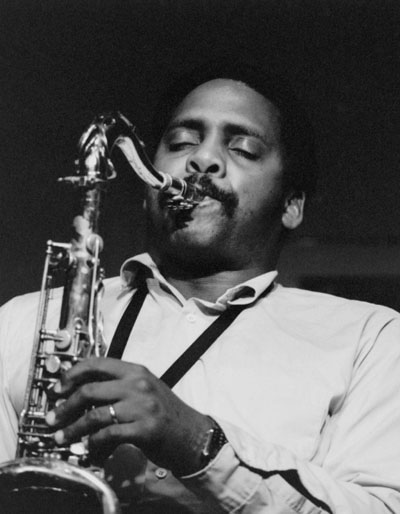
David Murray, 1983 Michael Wilderman©2007
One Spring day in 1986, I was in an office at Warner Bros. Records in New York. I had just finished interviewing Ornette Coleman and Pat Metheny on the occasion of their collaborative album, Song X. Andy Freeberg was photographing the pair, separately and together, for the Down Beat cover, and had asked that they bring their instruments to pose with. In between shots, Metheny sat on his amp, noodling random phrases and fragments on his guitar. At one point, he casually played something that sounded familiar to me. “Isn’t that ‘Dewey’s Circle’ by David Murray?” I asked. “Never heard it,” replied Metheny.
Now, the guitarist may have struck upon that
particular succession of eighteen notes by
coincidence, or he may have heard Murray’s
tune at some point and either not remembered
or realized it, and the theme—a simple
but striking ascending scalar passage—stuck
in the back of his mind. Or, possibly, he might
have known the theme from an earlier incarnation….
A few months later I was listening to a Charlie
Parker reissue on Stash when I heard a phrase
that snapped me to attention. Of course I
knew the tune—it was Dizzy Gillespie’s “Bebop,” here
played by Bird and trumpeter Howard McGhee
in a 1946 performance. But this time, I made
a connection I had never thought of before.
Sure enough, Dizzy’s initial melody,
following the fanfarish introduction, was
the same theme as “Dewey’s Circle” and
Metheny’s noodle, phrased differently,
and ending at the octave, thus cutting off
the final four notes. But the body of the
line was unmistakable.
Gillespie’s first recording of “Bebop” was
released in 1945. Did he come up with the
theme on his own? Quite likely. But it wasn’t
long before the plot thickened. Relistening
to a chunk of Ellingtonia while preparing
a review of RCA’s Black,
Brown & Beige collection, I came across Duke’s 1945
remake of “It Don’t Mean a Thing…” and
pow! There, smack in the middle of Al Sears’ booting
tenor saxophone solo, amid massed brass explosions,
was the same theme—again, rephrased,
but this time with the four-note tail heard
in Murray’s version. (There’s
no trace of it, by the way, in Ellington’s
original 1932 recording.) Of course, knowing
Murray’s penchant for Ellington’s
tenor saxophonists, there’s a possibility
this is where he encountered it.
But then, while I was doing research for a
piece on Shorty Rogers, the theme popped up
again, as a background saxophone riff behind
Red Norvo’s vibes solo on the Woody Herman
band’s 1946 recording “Backtalk.” (Rogers
and Norvo penned the tune; Rogers was responsible
for the arrangement which included the theme.)
Three recordings (not counting Parker’s
remake of “Bebop”) making use of
the same theme within a year’s time.
Had Sears heard Gillespie’s new record
and spontaneously quoted the theme? Did Rogers,
consciously or not, borrow from the master,
Ellington, or from fellow trumpeter Diz? Could
these similarities be due to sheer, unrelated,
chance?
There the question might have remained, strictly
a jazz footnote, but for my hearing a Folklyric
compilation of calypso protest songs relating
to Turbal Uriah “Buzz” Butler,
a well-known local worker’s reform
leader. The introduction to “Commissioner’s
Report” by one Atilla the Hun (calypso
singers, like reggae stars, rappers and DJs,
liked to adopt colorful sobriquets), played
by the Cyril Montrose String Orchestra was,
note for note, our friend, the theme. Recording
date: February 26, 1938.
Discovering the theme on an obscure 78 rpm
calypso disc from Trinidad was a surprise,
I must admit. Not that I thought this was
where the melody had originated, for by now
the frequency of its appearance had convinced
me that it was just a case of cosmic coincidence,
a common sequence of notes stumbled upon
by a variety of musicians. After all, it’s
an almost comically obvious pattern; unornamented,
in the key of A, on piano it is merely an
alternation of white keys up the scale in
a two-step forward, one-step back chain,
minus G: that is, A-C-B-D-C-E-D-F-E-A. But
what is it about this melody that is so addictive,
so capable of inspiring such distinctive
musicians to set it into different tempos,
phrasings, moods? Hard to say. But it did
worm itself into my brain, and all this time,
while checking and double-checking the different
versions, running the theme in its various
phrasings and instrumental tones through
my mind, I could hear a vague echo of it
in yet another guise, but I couldn’t
quite place it. Low register brass instruments
growling, a slow, swaggering tempo…
It wasn’t long before it dawned on
me. The trail once again led back to Ellington.
And not obscure Ellington, but his original
theme song, “East St. Louis Toodle-oo.” The
dark, ominous initial melody, with its panther-like
tread over which, in all three of its 1927
recordings (for three different labels, by the way), cornetist Bubber Miley snarled
so passionately, is another version of the
theme—minus a few redundant notes and,
significantly, turning back down the scale
just before landing on the octave. James
Lincoln Collier, in his controversial 1987
book on Ellington, credits Miley with the
invention of this theme, and it’s certainly
possible, given Ellington’s documented
tendency to rework material that emerged
from band solos. But couldn’t it be
that the tune’s foundation—the
theme, so provocatively orchestrated—was
the work of Ellington, while Miley conceived
the pungent brass countermelody which he
played so persuasively? Moreover, since it’s
also known that Ellington, a one-time wannabe
visual artist, saw note combinations on the
keyboard as shapes, which he used as motives
and melodies, wouldn’t this succession
of white key notes be a readily apparent
design for him to visualize and adopt?
Not that it matters if Ellington was the
originator either. More than ever I suspect
the same theme will turn up in a Bach cantata,
or maybe a Turkish taksim, one of these days.
But knowing more of its past uses does seem
to affect the way we relate to its various
transformations. For example, the big band
ornamentation of David Murray’s “Dewey’s
Circle” (on Live
at Sweet Basil Vol. 2, Black Saint) wears its raucous New Orleans-style
polyphony well, but the intimation of “jungle
period” Ellington seems stronger than
ever. Even more so, Murray’s 1980 octet
arrangement (on Ming, also Black Saint) now
sounds like an act of homage, whether intended
or subconsciously implied. The frenzied,
hell-bent, boppish phrasing of the theme
that opens and closes the performance nods
to Dizzy, while the wah-wah brass, the band
riffing behind George Lewis’ trombone,
and cornetist Olu Dara’s lovely Miley-esque
spirit and tonal distortions, bow to the
Duke. It’s not a matter of history
repeating itself, or even of one artist or
another borrowing from the past—especially
if you agree with William Faulkner, when
he wrote: “The past is never dead.
It’s not even past.” It’s
simply how art spreads, survives, and thrives.
Art Lange©2007
