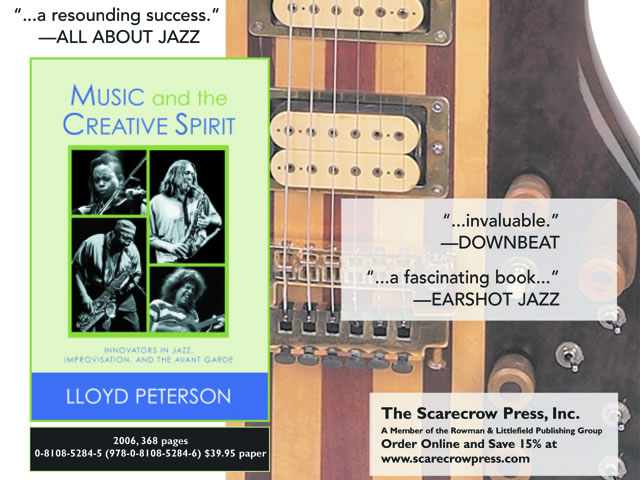
Music and the Creative Spirit
Innovators in Jazz, Improvisation and the Avant Garde
by
Lloyd Peterson
(The Scarecrow Press; Lanham, MD; Toronto; Oxford)
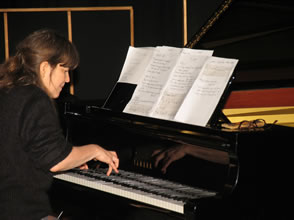
Marilyn Crispell Laurence Svirchev©2006
an excerpt from:
Chapter Eight: Marilyn Crispell
Her notes
crash like waves, at sea, on a stormy winter’s
night; they gently float and slowly fall like
early morning mist; yet it's the silence --
the silence between the notes, which provide
the haunting poetic beauty that is the music
of pianist, Marilyn Crispell.
Lloyd Peterson: Is there a decrease in listeners for creative music today?
Marilyn Crispell: I think jazz is under fire - the concept of jazz. I have noticed a change in Europe since the walls came down that a certain amount of interest has seemed to move away from that arena. Whereas in the states, where it hasn't been as prevalent or understood, there seems to be more interest and open mindedness towards it but I could be totally wrong. But it's also very hard to be objective when you're in the inside doing it.
LP: Are people looking for things that have more depth or creative and artistic value?
MC: Things do tend to move in cycles and there are always people who are more aware of things than others and unless a global catastrophe happens, the majority of people continue with what they're doing. I don't think in general it's that easy to find out the truth about many things and a lot of people don't bother because it's all they can do to keep their own lives together. And it's very possible that people will get tired of all the backward looking imitation stuff and become open to something new. I know that when I play in this country, I get a very good response. Almost across the board really. I mean, I cannot think of anywhere where I haven't and there is kind of an openness and warm heartedness. I find people very receptive and in most of the country, there's no "we've heard it all before” attitude. And people are always asking, "How come we haven't heard this music, where can we find the CD's and where can we hear more of it?" I really think it's about educating people and making the music available. If it's not available, they don't know it exists and they can't appreciate it because there is no way to hear it. I feel very lucky to be on what I consider a major label because it does allow more people to hear what I'm doing. There are also people who are not in that position, who are great musicians and do not get heard by the majority of the people here.
LP: Does society today have difficulty with creativity that is not easily explained, understood, or identifiable?
MC: I think we like to romanticize the past and I'm not sure human nature has changed all that much. If you look at what's happening politically, socially and economically in the world right now, it's parallel to what's happening in the art world in general.
I think our culture is very much shaped by a corporate marketing mentality and that's part of the reason this music isn't appreciated here. Therefore, it's important for musicians to take the music into the schools to kids who are very young and still impressionable, who are still too young to know that they are not suppose to like something. I also wish there were more national touring programs combining education and concerts. More of what they do in Europe where they are really proud of their artists and try and educate young kids.
Basically, we spend money on what we think are all the important things (necessary to sustain our physical life, pay the rent, etc.) and if there is something left over, maybe something is given to the arts and that says something about our mentality. The arts are considered frivolous here but I know someone who worked with kids in Harlem and brought a lot of kids off the street through painting activities and taking exhibitions around the country. It's given the kids a chance to express themselves, and learn and receive respect and that's just one example. People in Western culture think that only something material and tangible is worthwhile and things having to do with the spirit or the soul are not considered important. There again I'm making a separation. Everything has to do with the spirit or the soul. Everything has to do with it, including the things we think of as separate from it.
I think there are also this other phenomena happening where this glut of information is out there which perhaps wasn't the case thirty years ago. There's an overwhelming amount of information available so unless people are introduced to something or something catches their attention, they're probably not going to be interested. When I pick up a newspaper, unless there is a photo with something in particular that catches my attention, I'll tend to just glance through it. Or when you walk into a supermarket and there are thirty different brands of some product, you feel like walking out and not buying anything. I also think the computer age is overwhelming us and zillions of people putting out CD's or selling their own CD's on-line. It's hard to keep track and how are you suppose to find out about anything? It almost starts to feel homogenous.
LP: Have become more of a visual society and place less emphasis on various aspects of sound?
MC: I would doubt that. David Bowie said that
the eyes are hungrier than the ears and that's
part of what opera and the theater are all
about. I don't think anything has changed or
has become more visually oriented. I think
we have always been visually oriented. In a
certain sense, sound is a more abstract thing.
You can collect a painting and look at it for
the rest of your life but with music, the true
nature of sound is very ephemeral. It happens,
it passes by and then it goes out into the
eaves somewhere and keeps traveling on.
When I first started playing music; I never
wanted to record. I never wanted to freeze
the sound. However, I have been very influenced
by recorded music even though my intuitive
feeling was, play it and let it go. I think
more than saying that we are a visually oriented
society; we're a materialistic society. So
if there is something that you can have and
own and touch, maybe you are more likely
to pay attention to that or spend money for
that than on something that will be gone.
Of course you can own a sound recording,
but the music is still not as tangible as
a painting. Thus the artists themselves become
commodities; they are just used to make money,
often in our society.
LP: Is what's happening in creative music is too forward thinking for society today?
MC: Bach said that there would always be a
limited number of people who could relate to
some of the best stuff ever made and he was
talking about his own music. I kind of believe
that people who are meant to be drawn to anyone's
music in particular will find you or will hear
you through word of mouth or from the radio
or by accident. I think that's always the case,
all of the time and I don't think it's too
forward thinking. They say that the reflection
of the time starts with visual arts and then
it goes down through other arts. And I think
what's happening now, and what's been happening
since the late 50s', early 60s', is the deconstructed
reflection of what's been happening in the
modern world. But I also think there is now
movement to begin reconstructing and that's
just something that I feel.
I don't really separate this time from other
times as it's all connected. But I do think
things are changing faster because of technology
and again, there are a lot of world views
like that of the Tibetan, the Hindu and Hopi,
which talk about the different cycles and
ages of man, of creation and destruction
and supposedly we're in that downward phase
of one of those cycles called "Kali
Yuga." And when things go faster, and
faster and faster, everything is gone and
then a new cycle starts. Many people feel
there is a big spiritual rebirth happening.
I see a lot of that on the Internet and here
in Woodstock, there are a lot of people involved
in that. A change in the way people are using
their minds, not just practical technological
but maybe more intuitive. The feminine side
is starting to emerge to balance out some
of the stuff that's going on in the world,
which is pretty macho stuff.
LP: Are traditionalists having a difficult time accepting that a music form considered "American" now has international and diverse aspects within it?
MC: I think people want to hang on to something
that has historical significance and validate
themselves by doing that. There certainly is
a validity to the history of jazz having it's
roots in blues and black music and it would
not have existed without that. But most of
the history of jazz is integrated and it has
always been open to other influences and other
ideas. It's about creativity and doing new
revolutionary and evolutionary things and now
all of a sudden rather than being a living
process of change, it's become a rigidly protected
museum piece. Whenever someone has to defend
or protect something that way, they are usually
concerned about giving up some kind of power,
rather than having the security to feel open
and let things happen. To my mind, and who
am I, nobody can say that jazz is this or jazz
is that. But people like Wynton Marsalis and
Ken Burns have been very successful in convincing
other people of exactly that. As far as I'm
concerned, I'm ready to say that I don't play
jazz and to hell with it. I just play my music
although I consider jazz to be a primary influence
on my playing.
Music is one of the most intangible of the
arts as opposed to a visual art that you
can see, touch and hold. It's very ephemeral.
It's there and then it's gone. It's a universal
language that doesn't need words to communicate
so it's a pretty powerful medium. It has
given birth to a lot of other forms and possibilities
that we now call traditional jazz but were
not considered traditional jazz in their
own time – by the way.
I have wished for a long time that somebody
would do a film called the "The Lost
Decade." About the lost scene in the
60's and all the incredible creative music
that happened at that time. A lot of these
people are not paid attention to by the mass
market but as far as I'm concerned, it was
one of the most brilliant periods of the
music. I can't mention everyone's name but
people in particular who come to my mind
with whom I've had personal contact are Cecil
Taylor, Oliver Lake, Anthony Braxton, The
Art Ensemble of Chicago, George Lewis, Sun
Ra, Wadada Leo Smith, Billy Bang, Abdullah
Ibrahim, Reggie Workman, Anthony Davis...
There are just so many and I don't know where
to start or end. I also don't want to leave
the impression that these people are overlooked
or ignored but in other cultures, they would
be considered national treasures and I don't
feel they have received the support and place
they deserve.
LP: Does the global situation today affect you artistically?
MC: Things can get so bad that you can sometimes
feel as if you are butting your head against
a wall. Have you ever seen the film, My
Dinner With Andre? It's a great film and the guy who
made that film, Louis Malle, talks about times
like these, where it feels impossible to do
anything. And rather than waste energy fighting
it, he retreats to underground pockets of light.
Things do tend to turn around but I think
that because we live in a technological age
with so much information available; people
are overwhelmed. It's not like the old days
where you'd go to the concert and were able
to hear this music. Now, people can just
put on a CD. And everyone is putting out
CD's and you can burn them at home. People
are overwhelmed by a glut of information,
which I think can have an affect not only
on me but also on many other performers.
I feel like being an artist is a political
statement in a certain sense. Just by the
very fact that you are being an individual
and you are doing what you do and not bowing
to big market corporate influences and are
being true to your soul. You are trying to
put something real out to the world and people
do hear it and I know it affects them because
people tell me that it does.
LP: For many, music is a way to get away from all the garbage that surrounds us.
MC: I think the arts feed the soul. They are a very important part of our society equal to technology and science. There is a great book called Care of the Soul by Thomas Moore. It's wonderful and he talks about the place of art in everyday life, not just by going out to galleries and to museums, etc. There are aesthetics and beauty in everyday life.
LP: Do you connect to any of your music spiritually, politically or socially?
MC: Spiritually. It's interesting because
these are all just words and music is something
that happens on a very instinctive level. And
though I don't necessarily work within those
contexts, I do feel that it does come from
a spiritual place and is very connected with
that for me.
If music doesn't reach me emotionally, then
I'm totally not interested in it. And there
are techno wizards on their instruments who
just don't get to me at all. As a friend
of mine recently said after a concert, "It
was brilliantly forgettable. There was nothing
in it that curled around my heart and stayed
there." And I thought that was a very
beautiful way to put it.
LP: Cecil Taylor said that "Music has to do with a lot of areas which are magical rather than logical; the great artists, rather than just getting involved with discipline, get to understand love and allow the love to take shape." How much of your music is from logic and how much from this other place that Cecil Taylor describes?
MC: You do music as a whole person, with your intellect and your heart. Everything. And I also totally relate to what Cecil says about love. And I agree with him about magic. For me, performing is like a ceremonial ritual; almost a kin to a kind of Shamanism.
LP: Do improvisers have a unique ability or awareness of what is all around them?
MC: I think everybody has that awareness.
LP: Is it on a different level perhaps?
MC: Perhaps different levels of being connected
to it. Cecil Taylor gives another great quote
when asked about practicing. He said that he
practices when he's walking down the street
or going shopping. In other words, his whole
life is his art. He doesn't separate them.
To perceive life as art and everything in life
as the teacher.
People tend to make a separation between
those in the arts and other people and I
feel that's a mistake. In many nonwestern
cultures, music is very much a part of everyday
life and it relates to every aspect of life.
There is music for work, healing, celebrations;
there is music for everything. I guess what
I'm trying to say is that anybody can have
an awareness to look at life as art in whatever
it is they do, even if it is something that
is not traditionally thought of as artistic.
Anything that you do can be art if it's done
with a particular kind of awareness.
LP: Do women and men create differently or does it have more to do with individuality?
MC: I think it has more to do with individuality. I have said for years that I don't believe in men's music and women's music but I think if you are a woman, you are obviously playing women's music. If you are a man, you are playing mans music. We all have masculine and feminine elements and people like Bill Evans and Keith Jarrett play some very feminine lyrical stuff and there are woman who play some very hard ass stuff. Women have babies and that takes incredible strength. There is this tendency to think of women as weak and frail little flowers and men are these big strong.... I mean you can fill in the words here. I don't know if we create differently but I wouldn't think so but there are people who believe that.
LP: When you compose, are you envisioning what you want the music to do for the listener?
MC: I'm trying to figure out what concept is trying to formulate itself and I try to find a way to express it and this is on an intuitive/intellectual level. I'm thinking in terms of what I hear and what I want to put out and not how it's going to affect somebody or what they are going to think of it. I think you do something that is intrinsically yours and that's your gift that you have to give. If you are trying to modify it in some way to impress or please someone, then it's not going to be a pure expression.
LP: What do you look for from drummers and bass players and how much of it has to do with their rhythmic approach with each other?
MC: I'm looking for people who are very versatile and have a background in traditional jazz but can also cross lots of borders. People who are aware of more contemporary developments in improvised music and can relate to it and not just say, "Oh, I'll play free" but can really relate to it from the heart. People who are sensitive and know how to listen. People who can relate to what I'm doing and respond in a way that makes sense and with respect.
LP: Can you explain your relationship with time in the musical sense?
MC: First of all, time is a very complex thing. Anthony Braxton talks a lot about pulse feels which is kind of like a heart beat. You have your own rhythm and if you are playing a phrase that has a pulse feel of its own and if you are playing with "intention" within that pulse feel; for me, that has a sense of time. In fact, one of my favorite things is to play simultaneous but different things like say the bass player and the drummer are playing the feel of a certain time. 4/4 time. I like to be able to fly on top of that and go in and out of it and come back to it. It's like they are laying down a carpet of time that I can weave complex patterns over. I think African drumming is also a concept that has very complex time. I am not a free jazzer who abhors playing in a time, 4/4 time or whatever (laughs) - contrary to what some people think.
LP: Don't you just hate the term, free jazz?
MC: I really do and avant-garde, I hate even worse. Because most of the stuff that is happening now is not avant-garde; it's been happening since the 50's. There is very little new stuff that I'm aware of.
LP: I was just having this discussion with a friend who owns a music store and we were talking about how to categorize the section within avant-garde. Where does it start and end? Like he said, "Do I start with Charles Mingus who was avant-garde when he originally hit the scene?"
MC: Charlie Parker was avant-garde during his time and people didn't know what to do. They couldn't dance to it, or at least they didn't think they could. It wasn't the big band stuff they were used to. He was an intellectual, an explorer and was way out there. Leroi Jones (Amiri Baraka) wrote a book called Blues People and talks about how jazz is a process of change and how it's traditionally been a revolutionary music which always comes up from underneath and upsets the status quo. He talks about African music and music from other countries and the differences they have with the Western world and that's really about process. He says that here, you do something and then you put it in a museum and look at it like an icon. So it becomes like Archeology and becomes an archive rather than a living changing process.
LP: How has your musical thinking evolved from your earliest compositions up until now?
MC: I use to be a composition major at the
New England Conservatory so I think there is
a sense of form in what I do. But I think playing
with Anthony Braxton had a big affect on me
as far as his sense of sound and silence and
also just learning from his compositional methods.
I became much more aware of the importance
of space and silence after playing with him.
The presence of space is important in order
to be able to define phrases. If you listen
to Cecil Taylor for instance, you hear a lot
of space between those phrases and notes. Prior
to playing with Anthony, I played lots of notes,
all of the time. Continuously, without much
of a break. It was about total energy and kind
of revving up and flying off the planet. When
I first started playing, I wanted to impress
everybody, which is a common feeling; kind
of immature. That has changed over the years.
Previously, you were talking about the importance
of sound. I would also say feeling and not
just sound, but I think it's about melody
and feeling and very much about energy and
intensity. A lot of the stuff I have been
doing with ECM is more about an inner intensity
rather than an outer one. I feel there is
a connection between the two states - wild
energy and extreme introversion - two sides
of the same coin. I do both and feel like
there is an organic connection between them
- an integration between them. With the ECM
recordings, I like the idea of playing things
so slowly that you are almost suspended in
time.
LP: I like music with the use of spacing that creates tension, it invites anticipation.
MC: I agree. I'm a very intense person. I am all about intensity. (Laughs)
LP: How do you create tension in your music?
MC: I think tension is created with unusual harmonies, melodies hanging in space, rhythmic complexities, the tension and release of melodic lines.
LP: How much of your compositional approach would you say comes from musical intellect vs. intuition or instinct?
MC: I think separating the two is a very western concept. It's not like we have one body that has a mind and the other one that has intuition. It's all-together in one brain (laughs). There is a description of a state of mind, which is compared to the tuning of a string. It shouldn't be too loose nor too tight. It should be just right and in perfect balance. This concept is used to describe a state of mind when you are doing meditation. With all the music I've played, heard and studied, there is a sense of composition and form. There is an intellect at work, guiding the direction although the direction seems to be mostly dictated by intuition and then guided by intellect but not too tightly. Sometimes I'll start out with an idea to play something and it just doesn't seem to be happening and what I usually do is just let the music go where it wants to go. But before, when I was talking about time, and I used the word "intention"; I think that that's a really important word. Really, really important. Carlos Castendos talks about it. Anything you do and anything you are trying to focus on requires intention and that makes all the difference between something working or not working. I think first of all, you need to have the intention to focus your mind in a way, which is very aware, very pointed and very relaxed. It's almost like you are standing back and letting something happen but at the same time, that sense of form, which is internalized, is guiding things. It's very difficult to describe.
LP: Is it possible to put into words what are you trying to do with your music today?
MC: I would take it apart phrase by phrase and show the contour of the line and how I've worked within whatever time frame I'm using. About how one line leads to another. I would also talk about sense of form and germs of the ideas and how melodies come to me and how I work them out. Mostly, I'll have people do this on their own and I'll work with them on ideas on how to express themselves, find out what their about, what they want, what they hear. I also try to work with intention because a lot of times people are nervous and not really into what they are doing. They'll just play something but there is no intention behind it. It's just something they can do like ironing a shirt or taking a bath or whatever. But the intention, the focus, is not there. I've even heard very skilled musicians do that.
LP: What do you see for the future of creative music or for yourself personally?
MC: I tend to be optimistic and feel that people are creative beings. Our souls are creative and there is a hunger for that. I also think the future of jazz will always be affected by that hunger. I think the pendulum is swinging pretty far to the right but things never stay the same - they always change. It's anybody's guess what's going to happen. I mean people are still playing Bach and renaissance music hundreds of years later. Maybe they'll be playing traditional jazz a hundred years later. That's fine. The attitude that exists towards change and progression and what it's called – who cares. I just know that I was very influenced by what I would call jazz. By Coltrane, Cecil Taylor, Anthony Braxton, Ornette Coleman, Sun Ra. People who brought improvisation into contemporary Western classical music, which is an important synthesis.
LP: Do you have a common philosophy that you try to impart on young students or musicians?
MC: Just to have the courage to be true to your own voice.
LP: What have you learned from the risks you have had to take?
MC: I have done things because that's where my spirit or inner feelings led me and I have always followed my intuition that way but I haven't particularly looked at those things as risks. I've pretty much always have done what I have wanted to do and have hoped that people will like it but I haven't done anything based on what anyone might think.
LP: Where do you get your inspiration and who are the people that have influenced you most?
MC: Everything I hear inspires me but I definitely
came into this music through Coltrane. I was
inspired by Cecil and Abdullah Ibrahim and
to an extent, Paul Bley, Keith Jarrett, Pharoah
Sanders, MCCoy Tyner and there are also the
following European trios: The Bobo Stenson
trio with Anders Jormin and Jon Christensen,
the Joachim Kuhn Trio with Danile Hunair and
J. F.Jenny-Clark, the Barry Guy, Evan Parker
and Paul LyttonTrio and also Anders Jormin
as a composer. Additionally, African and Indian
music along with other world music also are
influences along with baroque classical stuff
that I'm very, very into. Many contemporary
classical composers. But Coltrane was the first
and foremost inspiration for getting into this
music, period.
Playing in Anthony Braxton's Quartet was
a very, very important part of my musical
life and just my life actually. Working with
someone who had these kind of concepts very
much influenced my sense of space in composition.
The quartet was like a family and it was
good to have the opportunity to work with
such incredibly creative people. It was a
very profound ten years or so of my musical
life.
LP: You sound very appreciative of those around you.
MC: I'm trying to make more of an effort to be aware of things in a different way and to appreciate things today because they may not be here tomorrow. To appreciate the distinctive qualities of each person and each thing. Everybody is so involved with themselves. They go through daily life not noticing a lot of things or don't have the time to notice a lot of things. I think about this because my parents are both in their late 80's and I'm very aware that I won't have them forever. In many ways, they have been a factor in my thoughts and in my awareness. I'm very aware of the impermanence of things and the ephemeral nature of life.
LP: Do you have a philosophy or some way of looking at life that you would be willing to share?
MC: I think that kindness, sensitivity, and awareness of the world around you are important. Life is like a dream in the sense that it's real, yet at the same time, it's compared to of a reflection of the moon in the water. The reflection is there, you can see it; you can touch the water but the reflection is really ephemeral. And the real moon is like the basic mind which is non-conceptual. The search for truth is important; seeing beauty in all forms - an acceptance of all of life. The beautiful, the ugly, the sad and the happy. Don't be afraid to follow your spirit and your dreams – don't let anything stop you.