Moment's Notice
Reviews of Recent Recordings
(continued)
Mostly Other People Do the Killing
Slippery Rock!
Hot Cup 123
 The liner notes to this CD by “Leonard Featherweight” should be carefully studied for their concise account of jazz’s origins in rock-and-roll and how jazz’s traditional smoothness got subverted into the perversities of straight jazz. Unfortunately they also may lead unwary customers to expect this album has some relation to smooth-jazz procedures. Despite a few brief bass vamps, I do not detect anything like smooth jazz here. I demand my money back.
What Mostly Other People Do the Killing often recall is Hal Russell’s beloved NRG Ensemble of the 1980s. Like Russell, leader-bassist-composer Moppa Elliott writes themes that transform familiar hard bop and mainstream outside-jazz like Ornette Coleman and Roscoe Mitchell into his own crazy-mirror idiom. Mostly Other doesn’t quite play NRG’s high-nrg – I mean energy – music, yet again and again they get into really hot, together passages. Solos are few and short, for this quartet’s medium is ensemble improvisation; themes aren’t reprised. Jon Irabagon switches among four saxophones and plays a bit of flute while Peter Evans toots three kinds of trumpets and drummer Kevin Shea kicks everyone along – again, NRGish.
The foreground of MOPDtK is the two horns’ interplay. Irabagon plays straightforward, swinging freebop sax, mostly alto or tenor, in post-Ornette phrasing that often sounds like Dewey Redman. But there’s singular purpose and flow in Irabagon’s lines. He tells stories, though he sometimes tosses them away with double-time passages. Hear his grand design in “Dexter, Wayne and Mobley,” for instance, or the way he expands a repeated “Sayre” lick into a complete statement. While he’s responsible for so much of this music’s linear/formal movement, he’s also often dueting closely with Evans: the hot-jazz part.
Around and about the sax, Evans plays nonstop with an endless stream of small notes, his rhythmic momentum constantly slowing, speeding, ever in flux – think of young Audrey Hepburn leaping and pirouetting around old Fred Astaire in Funny Face. Evans is a mean cuss with a fierce attack and big sound, his free moves contrast with Irabagon’s weight. His sense of form is looser; while he sometimes gets into a fast, breathless rut, at other times lyricism combines with his intensity (“Yo, Yeo, Yough”). The two fly high (sopranino sax, piccolo trumpet) in “President Polk” and reach heights of togetherness in “Is Granny Spry?,” lyrical tenor over growling trumpet and barnyard sounds to conclude.
Elliott’s lines are just right, and spare compared to this century’s other bassists. “Heart’s Content” is an especially colorful, active theme and I like the funky hard bop of his “Sayre” theme, as well as the total lack of hard bop in his “Dexter, Wayne and Mobley.” The powerful Shea is as ready with free pulses as with backbeats, and while he sometimes switches tempos or suddenly plays softly, he’s a band player, at the service of each song.
This is a band.
–John Litweiler
Didier Petit + Alexandre Pierrepoint
Passages: A Road Record – Woodstock-New York-Chicago-Los Angeles
Rogue Art ROG0042
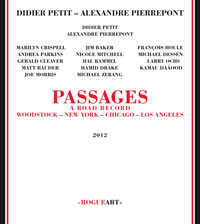 Here’s the next step on from Miles’s L’ascenseur pour l’échafaud and Carla Bley’s Escalator Over The Hill. It’s a movie for the ears, but also a “transduction.” The McGuffin is the central “contraption” marked DP/AP, a combination of cellist and poet, the conceit a journey across the continental landmass in emulation of Sir Martin Frobisher’s ill-starred attempts to find the Northwest Passage east to west in the late 16th century. The “transduction” involves not just the naturalisation of world musics – whether that involves Marilyn Crispell playing Bach, or a Bach-like canon, at the beginning, or more exotic ethnomusicologies – to Petit’s cello strings but also the vocal transformation of Pierrepoint’s Le Jardin des cranes poem in the recitations of Kamau Daáoud and other guest readers who are not necessarily Francophone and whose grasp of French pronunciation is, to put it mildly, idiosyncratic. These guests and the other musicians involved – who include, non-exhaustively, Matt Bauder, François Houle, Nicole Mitchell, Joe Morris, and Larry Ochs – are encountered at “random” on the transcontinental journey.
So far, so very French. Pierrepoint’s brand of surrealism is in an approximate line from Lautréamont and Henri Michaux, but it has a more didactic and utopian strand than that lineage implies. The individual encounters that make up Passages (the word implies or carries with it “rite” as well as mere movement) are complex negotiations, not only between individuals (who are mostly unknown to the two protagonists), but also between their respective “contraptions” (which in this sense is a yoking together of instrument and idiom, between cultures (whatever “between” means in this context) and crucially between text and music. The gradual transformation of Pierrepoint’s poem results in a dissolving of the known maps. There’s no epiphanic discovery of “the West” here. “West” has probably ceased to exist as an existential category anyway. One finds oneself in delightful no-place delimited not by geography or topography but entirely by human encounters and entirely by their aural dimension, which are presented, sotto, as “secrets.”
To the best of my knowledge, Pierrepoint does not refer to Busse Island, but if he knows the Frobisher story it’s almost inconceivable he didn’t come across the legend of Busse, or Bus or Buss, in the North Atlantic, a seemingly mobile Laputa of the cold currents which when it was recognised as geographically improbable simply “transducted” into another of the world’s legendary sunken lands. Unlike “Crocker Land,” which was a hoax, and Groclant and Friisland, which were simple misreadings of real terrain and known territories, Busse expresses a yearning for landfall. Like Passages, it is a state of mind rather than a location.
This is a remarkably beautiful record. It finally makes sense of the irritating usage that describes any recorded item as a “track.” These are tracks across a trackless empty quarter, the kind of footprints one finds fossilised in the Rift Valley (much of this music has an African provenance) where a chance encounter between unknown hominids is preserved for ever. The climax, with Petit, Daáoud, Ochs and the poem fragment that begins “La bonne combinaison des décalages dans l’immensité de reel, ses valises faites” is heart-breaking, the idea of reality having its “bags packed” a delightfully quiet way of registering how surrealism – as Messiaen understood – isn’t just a matter of setting improbable entities side by side, nor is it a cheap psychoanalytical tool but reflects the way we live and communicate in the world as half-deaf monoglots separated by seas and mountains.
–Brian Morton
Pat Thomas
al-Khwarizmi Variations
Fataka 4
 Pat Thomas’ first solo piano album since 1999’s Nur (Emanem) was inspired by Abu Abdullah Muhammad bin Musa al-Khwarizmi, the 9th Century Persian scientist and mathematician who is the grandfather of all search engines because of his development of algorithms. However, the dedication should not suggest any numerically driven concepts on Thomas’ part; on the contrary, with only a few days to prepare for this solo recording, it was Toumani Diabate’s music that was then of keenest interest to him. Still, aside from a passage brimming with vigorous direct manipulation of the strings, coupled with strong, rhythmic use of the pedals, there is not much on the album that leads the listener back to the kora master. Nor is there the overt nod to a jazz icon like Monk with which he closed Nur.
Instead, the ten “variations” – the usage is way loose, as they lack the thematic underpinning of Goldberg – are best heard as individual pieces. Thomas runs the gamut of techniques, splashing clusters, weaving contrapuntal lines and building elaborate structures from the inside out. Despite their variety, they share a fundamental quality – they truly sound like spur of the moment creations, not the final draft of ideas mulled over for weeks, if not months on end. Their impact is enhanced by one of the more effectively engineered piano sounds in recent memory, one that puts the piano right in your lap. The value of this is felt immediately, as the first variation is brimming with above-the-staves clusters that are wincingly bright. Conversely, Thomas creates china-rattling thunder when he plunges into the bass register.
Thomas’ discography includes several enduring recordings, including Company ‘91 and the two albums by Gail Brand’s Lunge, one of the finest improvising ensembles of the past 20 years – however, they emphasize Thomas’ inventive and audacious use of electronics and keyboards. al-Khwarizmi Variations proves Nur not to be an outlier. He is at his core an immensely resourceful pianist.
–Bill Shoemaker