Moment's Notice
Reviews of Recent Recordings
(continued)
Neil Metcalfe + Olie Brice
brackish
FMR CD301-1210
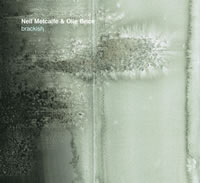 Ambrose Bierce, the centenary of whose disappearance is coming up in the next year or two, defined the flute thus: ‘A variously perforated hollow stick intended for the punishment of sin, the minister of retribution being commonly a young man with straw-colored eyes and lean hair’. Not much of this relates in any useful way to Neil Metcalfe. Straw-colored hair might at one point have been relevant, but there it rests. Metcalfe is one of the nearly famous men of the British improvising scene, regularly sighted, always impressive, but somehow never in anyone’s off-the-cuff list of the most important or accomplished players in that small world, despite being associated with a late version of John Stevens’ Spontaneous Music Ensemble. I was involved with a BBC recording in 1993 or 1994 of that SME which eventually came out as A New Distance and, saving the gracious presence of John Butcher, Metcalfe was the most interesting participant on that occasion, partly because he was least familiar and enigmatically withdrawn in person but largely for what he played.
In Metcalfe’s hands the flute neither ministers nor rebukes. In fact, it is quite radically drained of emotional cathexis of any identifiable sort. Its sounds are naturalistic but not associative, more like the precise logarithms of birdsong than any human music. The mostly water-associated titles of brackish make perfect sense of the music, but “Samphire,” “Almost High Tide,” “Ebb and Flow” don’t set you hunting around for pictorial or metaphoric correlatives to the music. They are, if you, like simply what the music is.
I’ve no idea how and where Metcalfe met Ollie Brice, but it’s now an established partnership, and palpably sympathetic on this first duo release. There’s something perversely fitting about a flute/double bass duo, and something gently comic – Neil and Olie, Stan and Ollie? – about a partnership where one guy can tuck his instrument under his arm or through a belt loop, while the other has to play Atlas and lug in on his back. But sonically it works, and works wonderfully. For me, no fluteophobe, there are few sounds in the orchestral palette lovelier than the low end of a piccolo’s range. Metcalfe seems to favor that same approximate area and timbre on his concert flute. He rarely reaches for those aerie, pagan tones that make one think of “Syrinx” or of incipient riot in a Paris theatre a hundred years ago. It’s a modern sound but also a timeless sound. The only other contemporary player who has treated the flute in such a fresh and foundational way is Robert Dick. It is as if they both picked it up, looked it over, and then wondered what sounds it might possibly make. You don’t listen to them and immediately think they’ve studied Georges Barrère and Gazzelloni.
If this is too much about one half of a partnership and not enough about the other, then that’s because I come to Olie Brice with even less history. I’ve never seen or heard him play other than in this format. Which is good, because in every regard he defines it. He’s not content simply to play the earth tones, the “woody” sounds. Brice makes the entire body of his bass sing. He has the ability, as on “Swarming” and the closing “Ebb and Flow” to deliver a fractal line that is as purposeful as any by the great jazz bassists, but to do so within an entirely abstract setting. His work on “Samphire” is immediately arresting, and there are, almost inevitably, moments when one does have to bend in close and wonder whether a particular set of sounds is coming from a variously perforated stick or from a wound string sharply stroked downward. Brice plucks rich harmonics out of the middling parts of his bass. He’s not so obviously interested in the batsqueak end or in drones, though here and there a massive pedal note floats across this (non-)landscape, something anomalously substantial in an otherwise uninflected environment.
With one track less, this would have been an almost perfect record. No particular track for the chop, but even at a modest duration – just 40’ – it feels a whisker too long. That’s testament to its quality, and in no way suggesting that more than half an hour of bass and flute is too much for anyone’s patience. It’s neither “exquisite,” nor ”cinematic,” nor “expressive,” nor any one of a dozen other pre-formed honorifics. It’s just formidably good music. Congratulations to them and to the undersung FMR who do what they do very well indeed and often with boldness and real imagination.
–Brian Morton
Rova
Planetary
SoLyd 407
 Here’s a paradox. I actively dislike saxophone quartets. Antipathy tips over into toxic shock on exposure to the tight, clean, “proper” sound of a classical saxophone quartet. In fact, legit saxophones in any formation. Even the very eminent London Saxophone Quartet’s unimpeachably playful incidental music for Death to the Daleks...
On the other hand, and with perfect perversity, I’d number at least three Rova recordings among my very favorite albums of all time. I adore Bingo (Victo). I play the collaborative Electric Ascension (particularly the second version on Atavistic) at least once a week and I have a long-standing affection for Favorite Street (Black Saint) from 1984, a Rova-plays-Steve Lacy project on which the composer’s benign influence tightened up the group sound considerably. So, go figure: three desert island choices in a form I’d otherwise avoid like the very plague.
To be fair, ROVA comes out of a very different language-world from the likes of the World Saxophone Quartet or the 29th Street Saxophone Quartet who were more concerned with filleting out a Four Brothers-y big-band sax section sound. ROVA was influenced by the Chicago avant-garde – the initially drummerless Art Ensemble, those all-reed aggregations of AACM players – and has maintained a hardcore commitment to exploratory sound, the relatively bankable Ascension projects notwithstanding. Like WSQ, the group has often added guest or collaborative elements to the music and it is now almost half a decade since the last pure quartet record, 2007’s Juke Box Suite on the Polish NotTwo imprint.
So what of Planetary? Well, it jumps straight into the upper echelon, and with a bullet. It is, arguably, the most calmly achieved and magisterial Rova record yet. The two pieces labeled “Parallel Construction,” both by alto player Steve Adams, who’s the main composer this time, invite comparison with the unemphatic and quietly complex drawings of a Sol LeWitt or an Agnes Martin (the dedicatee, incidentally, of John Zorn’s Redbird). “#1” makes for a relatively accessible opening, with none of the alienating wallop the earlier ROVA liked to deliver. It’s music that fascinates and because it’s only five minutes long, it doesn’t outstay. It does also deliver a tiny Easter egg in the shape of a fleeting allusion to a famous Vernon Duke/Yip Harburg song towards the end. Forget I said that, and its appearance will surprise and delight.
Larry Ochs’s “S” is hard to place. There’s a Balkan influence, hints of Miklós Rósza, or someone similarly filmic, and then a dark ostinato that could only be by these four men. It proceeds for a time and then submits to the inevitable fission, breaking up into solo elements that in themselves seem like starting pieces for other works. Adams’s “Flip Trap” has a more obvious provenance and one that perhaps explains the album title, for the presiding spirit here (surely?) is Sun Ra, and behind Sun Ra, Fletcher Henderson. Here’s where ROVA do consciously look back at the spirit of big band swing and they do it with bravura self-reliance and originality.
“Glass Head Concretion” is fascinatingly brief, a new-music structure that sits enigmatically at the centre of the record, neither out of place nor quite in tune with its surroundings. What follows, though, is classic ROVA: the roiling, shifting title track and the second of the “Parallel Construction” pieces, which taken in sequence represent just about the best half-hour in the group’s three-decade history. It’s difficult to find verbal equivalents for these structures. Like my father, who admired architecture, had good instincts for quality and a remarkable strike rate in identifying the work of great architects, but no specialist vocabulary for the elements, I don’t know how to explain what makes this music so distinctive. There are timbres that give away the players’ identity and Ochs has become a significant enough figure in his own right to pick out of the crowd, but the real unquantifiable magic lies in how the quartet interacts and works together, which is the work of many years, separate lives and common purpose, the regular refreshment of collaboration but at bottom a commitment to ROVA as a musical idea with its own inimitable logic and direction. Which is a breathless way of greeting another small masterpiece from a group whose longevity probably invites a kind of benign but irritating neglect from the critical establishment.
–Brian Morton
Craig Taborn
Avenging Angel
ECM 2207
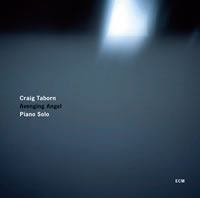 This is Taborn’s first recording as a solo pianist though it’s a role to which he’s devoted substantial attention. For anyone who’s paid attention to his work in an assortment of bands, the direct link here between his creative resourcefulness and his technique will come as no surprise. Avenging Angel—evidently a series of free improvisations – presents a fully formed musical personality, the individual equivalent of the controlled multi-dimensionality that Taborn achieved with his Junk Magic groups.
In the 70-odd minutes of Taborn’s performance here, he touches on myriad moods, from sparking kinetic improvisations like the dense “Glossolalia” to the frantic etude-like lines of “Neither-Nor.” He’s capable of mining tradition, too, as in the hauntingly limpid ballad called “Forgetful.” What’s most evident here, though, is Taborn’s intense focus, his ability to take a phrase, a couple of contrasting figures, and explore them for all the meaning that he might wring from them. The title track is a kind of brilliant rhythmic argument, a back-and-forth tug-of-war that embodies all the ambivalence of its title.
One can catch many of the usual touchstones of piano improvisation here – harmonic approaches and timbres that might offer ready suggestion of Bach, Debussy, Prokofiev, Scriabin and Satie (the mysteries of Monk and the majesty of Mussorgsky turn up in close proximity at one point) – but it’s much more appropriate to follow the thread of Taborn’s musical thought, the range of variation and combination he can employ as he develops and expands his fundamental elements.
One of his key inspirations here is the sheer sonority of the piano he’s playing and the acoustics of the recital room at Studio RSI in Lugano, Switzerland. This is, after all, an ECM solo piano record and there’s an attention to sonic detail in Manfred Eicher’s production as well as in Taborn’s own playing. The openness to resonance and hang-time approach the extraordinary beauty of Paul Bley’s Open, To Love (ECM). The final “This Is How You Disappear” is a miracle of piano touch, from the rapid fluttering iterations on a single key to the play between dynamics and dissonance, Taborn initially playing with the contrast between diminishing volume and expanding harmony.
–Stuart Broomer
David S. Ware + Cooper-Moore + William Parker + Muhammad Ali
Planetary Unknown
AUM Fidelity AUM068
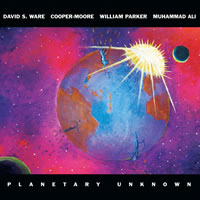 David S. Ware plays with such solemn power and majesty that his soloing begs comparisons to mountains or waterfalls. In fact, it’s hard to avoid ecological metaphors when discussing his latest album, Planetary Unknown, so completely do Ware, pianist Cooper-Moore, bassist William Parker, and drummer Muhammad Ali create their own world of sound, a landscape in which one can sense the presence of the divine in much the same way that Walden inspired Thoreau or Yosemite John Muir. Listening to this quartet makes Transcendalists of us all.
Ware has always been heard to best advantage with a piano in his band; the piano’s orchestral fullness and percussive weight complement his big sound and urgent delivery. For a decade, Matthew Shipp held the pianist’s chair in Ware’s classic quartet and along with Parker provided continuity as the drummers changed. Ware has led ensembles with different instrumentation as side projects during the years he fronted the quartet and as working bands since he broke it up, but until last year’s trio with William Parker and Warren Smith, none of them had quite the authority of his traditional jazz quartets, or the staying power. In the newest quartet, pianist Cooper-Moore changes the dynamic of the quartet configuration with a less rubato ensemble approach. He’s more given to thunder-clap chords, tight harmonies, and pointed riffs to punctuate Ware’s solos, and less likely to draw on classical influences than Shipp, nurturing his sound more exclusively on African American music sources. With drummer Ali, a ‘70s-vintage free jazz drummer (and brother of the late Rashied Ali), in the mix, this album sounds like a more “traditional,” less post-modern free jazz record than most other Ware releases – and that’s not meant in any negative sense.
In fact, the make up of the new quartet contributes the music’s force-of-nature spirituality. “Passage Wudang” rushes forward like a river torrent, powerful, ineluctable, but glad of heart. Ware’s whaleback arcs of notes are tossed against Cooper-Moore’s granite-boulder chords and channeled by Parker’s river-bed bass, earth-solid and imperturbable, while Ali’s drums and cymbals splash and leap like foam on the waves. It’s a glorious cascade of sound that subsides into calmer pools in the end.
“Crystal Palace” and “Divination Unfathomable” are slower, more diffuse performances, their energies dispersed to multiple centers, but still delimited by a common sense of purpose and aspiration. Ware’s soprano saxophone playing is more unassuming than his stern-visaged tenor; his lines feel their way forward like sensitive tentacles, reaching joyously, but deliberately, heavenward at a meandering pace.
On “Divination Unfathomable,” Parker’s arco bass lines gather around Ware and seem to pull him upward into the light. “Duality Is One,” a duet for Ware and Ali, is surprising airy. With Ware’s tenor suspended in the tornado swirl of drums and cymbals, the music levitates and hangs in space, a hovering mass of bright-hued sound and rhythm.
Cooper-Moore and Ware haven’t recorded together since the days of Apogee, the band they co-led in the late ‘70s, as they made the transition from student days in Boston to the Canal Street loft in New York where they both lived. Ware’s hat Hut LP, Birth of a Being, is essentially an Apogee recording, on which Cooper-Moore was playing by the name of Gene Ashton. Both have changed and grown as musicians since then, but they reconnect beautifully after roughly 30 years. Their duet passage on “Divination,” is like a haunted standard, a song that doesn’t quite fit a conventional form, but sorts its way through harmonies and snatches of melody in search of itself. Cooper-Moore is all ears in group improvisations, able to encapsulate the collective energy while making contributions that fill his niche within the band ecology.
To sift through the profusion of living sounds on tracks like “Divination Unfathomable” or “Shift” is to be a naturalist of divine landscapes, an observer of the workings of a system in which each part meshes in a harmonious celebration of creation and the creator. It is not harmonious, however in the sense that it is always pleasant or soothing or consonant, indeed the music is often rough, tumultuous, and dissonant. But music can be confrontational, assault and overwhelm the senses and remain harmonious if each element is working together in concert, not in conflict. In that sense, this band is one of the most harmonious on the planet.
–Ed Hazell