Moment's Notice
Reviews of Recent Recordings
(continued)
Samo Šalamon Trio
Almost Almond
Sanje SAZAS S1241
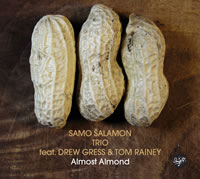 Young Slovenian guitarist Samo Šalamon has garnered a wellspring of international praise for his recent trans-Atlantic recordings, which typically alternate between European and American sidemen. Almost Almond, his 11th release as a leader in as many years, features bassist Drew Gress and drummer Tom Rainey – one of New York City’s finest rhythm sections. To Šalamon’s credit, he admirably demonstrates his range with these elite veterans.
A former student of John Scofield who first picked up the guitar after hearing Pat Metheny’s The Road To You (Geffen), Šalamon has been forthcoming in his admiration for the work of such guitarists as John Abercrombie, Bill Frisell and Kurt Rosenwinkel. His variety of techniques and use of multiple timbres occasionally recalls these influences, yet his overall conception sublimates them into a singular approach towards phrasing and tone production. Favoring a mostly clean, classic hollow-body sound, Šalamon occasionally shades his lines with overdrive, saving bursts of searing distortion for climactic passages.
Šalamon’s nimble fretwork is impressive in its meticulous logic; dazzling, but not ostentatious. His intermittent use of a volume pedal is telling, as it allows him to modulate gracefully between extreme dynamics with the finesse of a horn player. His crystalline runs on the richly voiced “Pleiades” hearken back to the seminal efforts of Jim Hall, while the scorching cascades he unleashes on the ebullient “Monkey Hands” and the appropriately titled “Monderous” recall contemporaries like Ben Monder and showcases Šalamon’s ability for crafting coiled thematic variations into hypnotic mantras.
“Dutilleux,” dedicated to the French composer Henri Dutilleux, ascends from cleanly articulated arpeggios to coarsely amplified runs, with a dramatic interlude dominated by swelling waves of feedback. Such moments are fleeting however, as Šalamon’s primary focus is one of pastoral introspection and lilting swing, similar to Frisell and Metheny’s work for ECM in the ‘80s. Indicative of his impressionistic approach, austere ballads like “Too Emotional For This World” and the title track unfold as diaphanous tone poems resplendent with harmonious ruminations.
Though Šalamon’s circuitous cadences dominate the proceedings, Gress and Rainey offer more than mere time-keeping accompaniment. Their conversational interplay offers stimulating support in even the most reserved settings. Gress’ resonant tone and elastic sense of timing informs his neo-classical arco technique, which takes center stage on the regal ballad “My Amusing Muse,” while a brief detour on “Monkey Hands” displays his lyrical, pliant pizzicato. Channeling his facility for pummeling furor into a more stately approach, Rainey demonstrates an uncanny ability to convey driving forward momentum with the sparest of accents, at even the quietest of volumes.
Šalamon’s capacity for delivering new material shows no signs of abating. A diverse and enjoyable set bolstered by a stellar rhythm section, Almost Almond finds Šalamon poised for greater acclaim.
-Troy Collins
Keith + Julie Tippett: Couple in Spirit
Live at the Purcell Room
Ogun OGCD 034
Julie Tippetts + Martin Archer
Tales of Finin
Discus 39CD
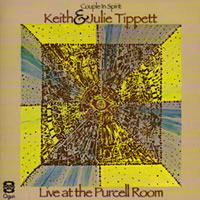
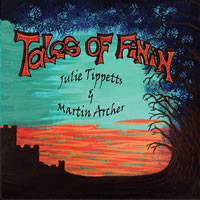 British vocalist Julie Tippetts works at the border where speech becomes song, where sound becomes melody, where voice becomes instrument, where tradition breaks up and gets reassembled into present. These two new CDs place her vocal explorations in two very different settings: in a live spontaneously composed acoustic duet with husband, pianist Keith Tippett, and in a studio-constructed, electronic environment created by Martin Archer. In each one, Tippetts’ unique vocal style and artistic vision – alternately dark and rapturous – mark her as one of the most original, restlessly experimental, and moving singers of her generation.
The Tippett duo is something special. Their improvisations are so intimate and seamlessly constructed that they give the illusion of composition, or of preplanning at the very least. It is a remarkable balancing act. Each musician is a strong musical personality, yet neither one nor the other dominates, and each retains his or her own voice as they build a joint sound.
On Live at the Purcell Room, recorded at the 2008 London Jazz Festival, they augment their primary instruments with a variety of little instruments, just as they do on their two previous recordings, Couple in Spirit (Editions EG, 1989) and Couple in Spirit II (ASC Records, 1997). But the music boxes, shakers, singing bowls, and wood blocks play a secondary, supportive role to the piano and voice. The performance is a continuous 45-minute set, beginning with percussion and music box that quietly draws listeners in to the duo’s sound world. From there, the set effortlessly flows to its conclusion as Julie interweaves a few of her poems and improvises wordlessly; Keith plays inside the piano, applies different preparations, spins counter melodies and offers harmonic support. There are times when their interactions are quite magical, such as when the pianist’s chords and the vocalist’s improvised lines move so closely together that it’s hard to believe it’s not composed. The emergence of the poetry from wordless vocalizing is breathtaking, a sudden dawning of concrete imagery that actually deepens the mystery of the music with its enigmatic meaning. Keith’s use of piano preparations throws in unexpected textures and colors, just another element of surprise in a performance that’s ripe with them.
Julie Tippetts’ performance poetry plays a much larger role on Tales of Finin. Though at times uneasy and quite bleak, the album is an oddly beautiful and occasionally transcendent series of vocal settings – they are not quite songs – of her poetry. The poems are all set in a vaguely Medieval unspecified time and place in the past. Tippetts’ use of a historical setting and folk-like melodies not only anchor it in an English past, the vividness of the tales and their timeless setting also give the poems a archetypal, dreamlike power. Many of the texts are set in and around a battle whose purpose is not really clear; they capture moments, not of heroic action, but of weariness, despair and anxiety, of covert, possibly military activity set into motion by a menace that never arrives. The cycle reaches a crescendo of sadness and regret, and a kind of rueful acceptance toward the end of the second CD, as the narrator measures “All you can feel” against “All you feel” on “Should I Go Home?” and finds the gap depressingly large. “Atonement” offers no promise of forgiveness, just the fact of suffering and guilt and unanswerable questions, but also the consolation of truth, no matter how harsh. Think Samuel Beckett in the Middle Ages.
Archer’s settings are appropriately claustrophobic, itchy with nagging strings, suffocating with layers of electronic sound, occasionally erupting with pent-up rock energy or cathartic free jazz saxophone. Tippetts makes use of the same range of techniques and approaches as she does in the acoustic duet, and the result is an unclassifiable mash up of jazz, sprechstimme, folk music, and electronica that haunts the memory long after it's over.
–Ed Hazell
Various Artists
FMP: Im Rückblick – In Retrospect 1969-2010
FMP 2010
 From the beginning, FMP was more than a record label. It was a musicians’ cooperative, a protest union, a concert production company, a booking facilitator, a vortex of new musical expression, a dynamic arena for contrasting creative viewpoints, and a seldom-if-ever-profitable business enterprise with a conscience. And yet if, throughout its rough-and-tumble history, FMP (originally Freie Musik Production) acquired a commonly-held, albeit shortsighted, reputation as a label identified solely with a particularly probing, compelling, and especially vehement style of European post-Ayler free improvisation, then this 40-plus-year celebratory package may help set the record (so to speak) straight.
A large part of this problem of perception has been that although they released 192 LPs (by my count) on FMP as well as associated labels SAJ and Uhlklang between 1969 and ‘89 – some of them legendary, many of them mere rumors in the U.S. – only two dozen or so have been reissued on CD (a few migrating to other labels like Atavistic and Intakt), with the remainder of this astounding catalogue unavailable for the past 20-30 years. Ironically, one reason for this regretfully enormous gap in free jazz recorded history has to do with the non-commercial nature of the music itself, along with the vagaries of sponsorship and governmental funding – not to mention some rather vicious and expensive legal battles. (Given the new technology and increase of online marketing, let’s hope that label chief, co-founder and savior Jost Gebers can in the very near future arrange a paid system of legally downloading all their out-of-print LPs.) For some time now, FMP’s most visible, and thus most popular and critically acclaimed, releases have been those of Peter Brötzmann, the Schlippenbach Trio, and Globe Unity – all from the founding generation of FMP musicians. Subsequent generations of musicians brought a broader stylistic outlook to the label, but when was the last time you saw an album by Friedemann Graef, Martin Theurer, Berhard Arndt, or Urs Voerkel? Moreover, not all the musicians on FMP followed what could even loosely be described as a free jazz party line – witness the presence of the percussion group Africa Djolé and Gambian griot Jali Nyama Suso, electronic specialists Hugh Davies and Michel Waisvisz, and classically-oriented musicians Vinko Globokar, Harald Bojé (a member of Stockhausen’s in-house ensemble), and Burkhard Glaetzner (a performer of the Baroque oboe repertoire), whose solo album actually consisted of compositions.
The twelve CDs that have been chosen to represent the label in this limited edition release are a curious mixture of the known, the rare, and the unusual; nevertheless, they do provide a concise argument in favor of the label’s vision and stylistic breadth. Brötzmann, of course, is here, with a solo album (formerly Solo, retitled Wolke in Hosen) that shows off the ripe tone of his New Orleans-influenced (specifically Omer Simeon) clarinet playing and some gossamer-edged alto sax, and a disc, previously unavailable in any format, by the Die Like a Dog quartet, where his usual proclivities are modified by a different drummer (Hamid Drake, whose tabla playing, for example, establishes an unlikely environment for the horns). Steve Lacy is given a disc containing his pungent, poignant, wry solo album Stabs and two of the four exuberant quintet pieces from Follies. Bill Shoemaker, in his accompanying essay, informs us that the decision to excerpt from this album was due to the deterioration of the original tapes. No doubt this is true; however, if this (and the similar partial album material included on several of the other discs) ultimately will prevent the complete album from being issued in the future, I disagree with the decision. Better-than-adequately sounding digital recordings have been released using clean LPs as source material; the importance of this music for future reference legitimizes the preference of a good LP dub to nothing at all. Likewise, the Schlippenbach Quartet (the usual suspects plus bassist Peter Kowald) is allowed the complete release The Hidden Peak but adds only side two of Three Nails Left, highlighting Paul Lovens’ unique percussion palette and impetus.
Luckily, pianist Fred van Hove’s disc combines two complete LPs, Prosper and Die Letzte, displaying his deftly strategized improvisation and spiky playfulness. Another frequent “outsider” pianist of distinctive personality, Irène Schweizer, is heard as part of a magnetic trio with reedman Rüdiger Carl and drummer Louis Moholo via their album Messer and one-half of Tuned Boots. Carl, featured on clarinet and accordion, is also a member of Manuela, a previously unreleased trio that includes Hans Reichel on guitar and daxophone, and violinist Carlos Zingaro, with guest Jin Hi Kim on komungo (a Korean version of the koto) – together, they offer a music of group empathy drawn from Korean, Japanese, Tibetan, and original voicings. The duo of trombonist Radu Malfatti and guitarist Stephan Wittwer projects delicacy and an attention to minute detail on their previously issued Und?, with the bonus of an untitled track of unknown provenance, possibly the same session. Another duo, cellist Tristan Honsinger and guitarist Olaf Rupp, debuts with a new release, Stretto, of free-floating counterpoint, alternating restraint and agitation.
The remaining three CDs contain previously unreleased sessions. The Manfred Schulze Wind Quintett carries on the legacy of the late baritone saxophonist and composer who released two albums on FMP; this new one, from 1998, Choral-Konzert, is a characteristic manipulation and extension of traditional and improvisational procedures. Was Da Ist (Live), from a 2000 concert by Peter Kowald, one of FMP’s patron saints, is a good showcase for his solo bass concepts, but an example from his several group recordings could have shown off his enormous spirit as a collaborator. Finally, Globe Unity’s exceptional concert at Baden-Baden ’75 is the most remarkable of the new material presented here. Only Kowald’s riotous and quote-laden “Jahrmarkt” (once issued on a Po Torch LP) has been heard before; the remaining four pieces, including a rare performance of an Anthony Braxton composition, show off the ensemble in a flattering new light. Overall, it’s hard to find fault with any of the musical selections, although several of the label’s primary figures – Albert Mangelsdorff, Baby Sommer, Sven-Åke Johansson, and Ernst-Ludwig Petrowsky among them – are conspicuous in their absence.
As much a selling point as the music will be the lavish, oversized, 218-page book. Necessary essays by Wolfram Knauer, Ken Vandermark, Bert Noglik, Bill Shoemaker, Felix Klopotek, Wolf Kampmann, and Bernd Mehlitz relate the history of FMP in factual details and just-as-valuable personal reminiscences. There’s a raft of stunning musician photos, and a series of documentational lists, including the full catalogue of LP and CD releases, all of the musicians who participated over the years, and all of the concerts and projects that FMP organized. True, the musicians list would have been more useful if it had specified on which recording or concert they appeared, and the catalogue of releases lacks song titles and other discographical information (fortunately, this latter is available on the website fmp-label.de). But anyone familiar with the label’s Cecil Taylor box knows how impressive this book is.
In his enclosed brief “Personal Statement,” Peter Brötzmann thanks Jost Gebers for the “unprecedented engagement” FMP gave him. That word, engagement, hits the mark in more than one sense – as security in a cause that matters, to mesh with others and bind together, to provide occupation (and, to the rest of us, experience), to hold our attention, and to enter into a relationship of meaning and consequence. That, in a nutshell, is why record companies like FMP matter.
–Art Lange
Marcin Wasilewski Trio
Faithful
ECM 2208
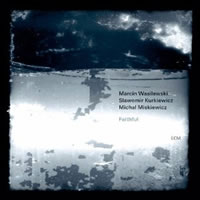 It’s a nice cultural shibboleth, this one. Soccer fans know Marcin Wasilewski as the big Anderlecht defender and Polish international who suffered that wince-worthy open leg fracture at the hands, or feet, of Standard Liège’s Axel Witsel (anathema sit!) in August 2009. Jazz fans knew Marcin Wasilewski as the quiet, classically-trained pianist in trumpeter Tomasz Stańko’s quartet who has more recently restarted his own career as leader at the head of a trio with old friends bassist Sławomir Kurkiewicz and drummer Michał Miskiewicz. Faithful is the group’s third and most ambitious record for ECM.
I first met Wasilewski at the Jazz Jamboree in Warsaw in the early ‘90s when the group was known collectively as the Simple Acoustic Trio. The three young men sat in a tight huddle round the BBC microphone and answered every question (and simple, acoustic questions they were) with earnest deliberation, as if it was a civil service examination. I had the odd experience of interviewing them before I’d heard a note of their music, and it was striking how closely Wasilewski’s music accorded with his verbal descriptions of it and his careful distinction between native, Polish, Romantic sources and outside influences. This was in a Warsaw still locked in late-Soviet frost but energized by Miles Davis’ legendary appearance at the Sala Kongresowa in 1983 (the start of what I once called ‘the Parachute Silk Revolution,’ though MD was quite soberly dressed on that occasion).
The quality that I sensed then is easily heard on material like “Night Train To You,” the multi-metered second track on Faithful which answers for all time the question of whether it really is possible to swing in odd-numbered time signatures. It’s a dazzling piece, constructed in interlocking loops round what Wasilewski has described (with a nod to the old group) as a ‘very simple melody.’ It follows the trio’s opening version of a wartime Hanns Eisler piece “An der kleinen Radioapparat” in which broadcast propaganda and psychological haunting overlap and blur.
The key track, though, is the title piece, an Ornette Coleman composition from the still wildly undervalued The Empty Foxhole (Blue Note). Its stark outline and blunt sense of direction clearly appeals to Wasilewski, whose pianism has a posterish directness underneath the lyricism. This was a brilliant choice of track, even if most listeners hearing it cold wouldn’t guess at the provenance, and the execution is equal to the selection. “Mosaic,” which follows (and a title which could be taken in two different ways), is a perfect sequel, another deceptively straightforward line full of splintery harmonic possibilities that seem to take on new significance with each fresh combination.
Even “Ballad of the Sad Young Men” takes on a certain unselfindulgent authority and gravitas under this group’s hands. Kurkiewicz and Mickiewicz contribute strongly and often provocatively, and one occasionally senses bass and drums in cahoots as they try to spin the meter away from the given line or more subtly just pressing up on the piano, hastening the note choices. I had the sense, right from the beginning that, like his namesake, Marcin Wasilewski was a tough, no-nonsense professional. It may be, though, that the pianist has fewer frailties than the soccer right back. His imaginative toughness becomes more obvious with each successive recording and Faithful is the work of a studied and case-hardened musician whose tactical and technical soundness allows him to take ever greater creative chances. He’s still someone to watch, still in that fascinating position where ‘promise’ runs ahead of delivery.
–Brian Morton