What's New?
The PoD Roundtable
moderated by Bill Shoemaker
(continued)
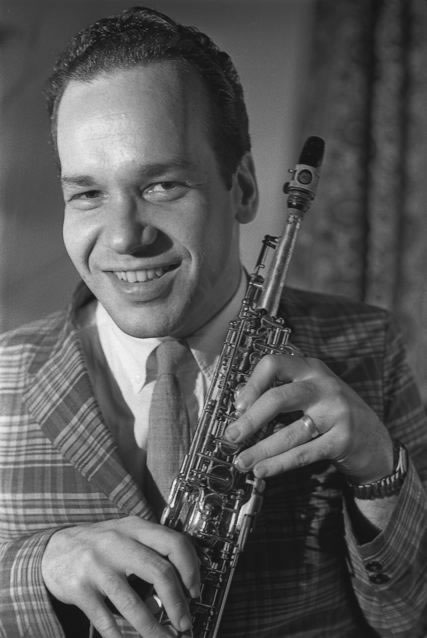
Steve Lacy, 1964 Larry Fink©2008
Shoemaker: The late Jack Sohmer is best known as a critic who mainly wrote about the mainstream jazz of the ‘30s through the ‘50s. He was also a tenor player on the New York scene during the ‘50s – Steve remembered him being a good player. Jack was exposed to Steve’s playing regularly then, and thought at the time that Steve was a little bit like a chameleon, in that one month Steve’s playing was straight out of Benny Carter, and then the next month Steve would be playing a lot of Lester Young. When I asked Steve about this, he said it probably was a reflection of what he was listening to at the time – one of his day jobs during those years was at a record store, and he was able to hear everything as it came out. So, the choices Steve made during these years were based not only on his knowledge of the jazz tradition but his ability to play in many styles. Steve was the not stereotypical avant-gardist who only played what he could play. His choices, even back in the ‘50s, were made with a well-informed discernment. His entire career can be seen as a series of choices: Cecil; Paris; art songs; etc. In your experience of him as a mentor and/or an educator, how did Steve discuss or demonstrate the issue of making artistic choices?
Chase: This is a tough question. Most of what surprised me in Steve’s teaching at NEC, as I heard about it from him and students and occasionally observed it, was his emphasis on traditional skills, knowledge, and lore, applied either to repertoire like Monk’s or to his own original compositions. I think the students (those who gathered around him) struck him as being in too much of a hurry to put swing and bebop behind them and go into conceptual, experimental music. So in a way he was putting the brakes on some students’ urges to define their own artistic choices and directions, probably because they were getting ahead of themselves by excluding things they hadn’t really mastered beyond a level of superficial competence. I also suspect that his return to the U.S. and close, constant contact with young musicians surprised him in a couple of ways. Some may have seen him as an avant-gardist without understanding the nuances of his stance, at first. I think being back in the U.S., maybe Boston particularly, brought back his own early experiences and made him want to pass on what he learned to people too young to play alongside Rex Stewart, Sam Woodyard, or Monk, or hear Duke Ellington or Charlie Parker live.
As a teacher, Steve’s choices and their clarity made a big impression. For students, he exemplified the mature artist who has built his strengths and passionate, long-term interests into an honest, uncontrived style. I think students who worked with him got a clear sense of what it takes to be a complete, continuously creative, sincere, original composer and improviser. There are a few other teachers around our conservatory who are able to teach that — Ran Blake comes to mind — but, Steve was a huge presence for those two years and I think it was life-changing for a bunch of students.
During those last few years, he seemed to have become even more focused on his own artistic choices. In repertoire, it was the art songs (poem and text settings), his own instrumental “classics,” and always Monk’s music. His playing was purer than ever, it seemed to me.
In teaching and clinics, he spoke fairly negatively about the kind of free improvisation that doesn’t have clearly stated, shared constraints on form or material. He talked about free playing autobiographically as a period of research in the past that was of its time (mid- to late 1960s, Italy and Argentina, The Forest and the Zoo) and yielded some useful results, but was over and done with. He explained that it was useful in that it helped him try out material, weed out unwanted things, and it led to his own much more structured compositions with guided improvisation.
He seemed to have very strong guidelines in mind about improvisation, even ostensibly free, open-ended improvisation. When I played in his Precipitation Suite with him and the Boston-based Jazz Composers Alliance he was very definite about what he wanted me to do in an improvised duet, and gave similar instructions for larger group improvisations. And the few other times I got to perform with him, we played 12-bar blues (“Misterioso”, or “Baghdad Blues” with a short, conducted, programmatic group sound improvisation).
These glimpses of working with Steve matched stories I heard from Lee Konitz about their playing “free” together, and about his interactions with Third Person (Tom Cora and Samm Bennett) and perhaps ROVA. Steve seemed to prefer working with his own material or with pretty strictly controlled structures for improvisation, in his later years. When he performed in off-campus clubs or galleries with students while teaching in Boston, they played largely Monk tunes, sticking to the forms and changes, or (much less often) his songs.
Delbecq: I can’t say I have spoken that much in detail about this with Steve. He really loved Duke, Bird and so many other greats. But also Steve Potts, Jean-Jacques, Oliver, Bobby, John, George Lewis, Irène, and all his musical mates, he was always praising his accomplices who were so dedicated to his music. Of course, he would speak about them with such enthusiasm.
Steve’s musical constructions and sounds have deeply contributed to the way I make artistic choices. It was a very direct relationship to Steve, as I would hear him almost each time he played in Paris. This influenced me more than anything else I believe. The way he would speak to me would be a way to tickle my knowledge of all arts, especially post 1950s painters, poets. We never had such long discussions; it was always quite short-ish conversations, I must admit I didn’t ask him that many questions. I guess his music was saying so much.
The first recording I ever played him was a duo with a musical partner of that time in 1986, violinist Pascal Morrow, and it was a free improvised music for a short motion picture about an artist, Christine Bouvier. We listened to this music together at his place, and he was nodding from time to time. He told me he liked some ideas in the music, some colors or lines or rhythms, and encouraged me to get going in my own direction. At the time, being 20 years old, I was probably expecting more method from him. On that same day, he told me about Slominsky (he knew him as many musicians did), and not only about his thesaurus of scales, which I had already been introduced to. That day he lend me an autobiography of Slominsky, a very interesting book where Slominsky writes about so many decades of great musicians he’s met and exchanged ideas with. That gave me a lot of keys for my own thinking. What I can dare say is that Steve’s interest in all arts has given me a confirmation that keys to inspiration shouldn’t be always found in music. When I first became a father in 1997 I bumped into him a few days later, he asked how I was going, and I said “I’m a father now!” and he said “Oh, that’s creative indeed !”.
On Steve’s own music scores I had noticed there was always a little photo print of the artist or person his tunes were dedicated to. This detail has been a key-point in my relation to him. It also arrayed an idea of humbleness from Steve, it really did, as each tune of his seemed to have a source in somebody else’s work or existence, “real presences” to quote George Steiner.
Something else was quite inspiring. I have often seen Steve at written contemporary music concerts in Paris. I remember him at a performance of “Monument-Selbsportrait-Bewegung,” this extraordinary two-piano piece by György Ligeti written in 1976. Also, I saw him on another day to hear “Mantra” by Stockhausen… at various concerts at Pompidou-Centre in Paris, dance shows in Théâtre de la Ville, the Festival d’Atuomne, at Peter Brook’s Bouffes du Nord... To see him in the audience was showing me he remained a curious person, it felt nice and we sometimes had a little word of comment after the show. Steve was very curious about composers of all kinds. Attending concerts is also a way to build your artistic personality, and meeting Steve at those concerts showed me I was maybe on a good direction!
His warm-ups before a set were also a lesson of music. I was trying to arrive an hour prior to the show at the Sunset in Paris. Steve was in the basement, and I would sit on the stairs behind the cellar door. I was always impatiently waiting for Steve to get to the higher tones practice – there were such strong musical statements, it felt incredible to feel the sound in real, a music from the Milky Way it felt, and Steve would slowly get higher and higher, playing some bits from “Hocus-Pocus” for instance. His practice always felt musical, so musical. This has showed me a way to organize my practice, for sure.
Back to your question, my relation to Steve was in a mode of shyness, I was impressed by him and, even then I was fluent in English, it was not so easy for me to approach him and speak in my earlier years – of course there was always a lot of friends of his around when he was playing in Paris, and I was just enjoying listening, and saying hello.
I know how his existence has had an imprint on mine, I am so grateful of all the attention and help he gave me, and I miss the live thrust of sounds he was giving us when playing. The happy thing with listening to his discs today is that you can physically remember his sound in a mental image. Now his Socrates-like teaching lives by itself, propelled by his most original inspiration.
Shoemaker: For me, one of the keys to understanding Steve’s approach can be found in what he called “the Magic Order,” the sequence of pitches he used to practice scales and arpeggios to counter the natural pull towards chromatics and cycles: Bb; E; C; F#; D; Ab; B; F; Db; G; Eb; A. You can also hear this ongoing pushing back against reflex in recordings of pieces he played for years on end, be it his own compositions like “The Bath” or Monk tunes like “Shuffle Boil.” He was always finding a note that would round off a phrase and turn it inside out at the same time, a pitch that was consonant and dissonant, simultaneously, and tweak your ear just like the intervals in his Magic Order. And, that’s when he would take off and lift the bandstand. Are there elements in Steve’s playing that you hear as indicators that he’s really swinging?
Delbecq: I think Steve’s playing was expressing a thrust of a very intense swing, maybe not a regular back and forth idea of it (meaning a clock-like time division of it), but more in the momentum of floating time, an elastic time feel, a certain idea of bouncing, and an incredible way to assemble ideas all together. I think his magic number thing has a lot to do with what I was mentioning on Slominsky earlier. Scales or musical increments as a ladder you climb and descent for a certain purpose. I would give the example of an old ladder to pick cherries in a cherry tree. Well, imagine you have a few broken steps on that ladder, if you go up and down all day, you’ll have a physical memory of the ladder. If you use it for another tree, it'll feel different even then it's the same ladder.
I totally agree, his work was focusing on what I happen to name the attitude of the note, also its altitude towards other notes, the relation to a note according to its tone and pitch relation to others. For instance, he’d hold a note and bring it to another dimension because he would bring another idea to make the note shine differently. I think his way to craft some ear “trompe l’oeil” phenomenon was one
of his goals. Steve’s intense swing was the result of a great number of parameters rather than just the strict time division and feel focus. I believe he was deeply influenced by abstract painting and, I could easily hear him play a sort of a description of Pollock’s swing for instance, or Rothko’s light, see ?
I remember Steve and Mal playing a duo at Instants Chavirés, Montreuil near Paris, say in 1992-3. The house was really packed out. Everybody was closing their eyes. At some point I opened my eyes and saw the audience, standing on its feet as they had removed all the chairs, which was involved in a very unique swinging momentum with the whole body. A sort of slow movement, never saw that since, it was a very unique situation. Of course, Mal too had something very special, very unique. As early as his early discs like “Evidence”, Steve has a very particular way to swing, his own way. Something of Sidney Béchet, maybe. Also definitely imprinted with the Duke’s time fee0 l… but, it’s a subjective subject – what I know is that my memories of Steve playing live is connected to a certain feel of swing, which also had is bands, a unique blend for sure, a certain "savoir-faire" in rhythm and spirit.
Chase: I agree with the way you put it. A lot of Steve’s note (and rhythm) choices have that quality of sounding perfect and a little strange at the same time, and the timbre and attack also have that quality – it brings you into the present while also relating to memory and structure in time. It’s a taste and idea that has an obvious relationship to Monk’s melodic and sonic sense, but not only that, and it’s not a literal imitation of Monk by any means.
When you asked this question, I put out a call to about ten New England Conservatory alumni who worked closely with Steve and asked them what he told them about specific notes and pitch material. Maybe this is a place to share some of the answers I received.
First, the answers were pretty consistent with one another and with what’s in Steve’s book Findings. Several people said the “Magic Order” came up in lessons and that he did it to avoid predictable clichés and especially to keep familiar things like scales sounding fresh to his own ears. He suggested that students work with small pitch sets in various ways. A commonly mentioned example of this was 2-3-6-b7 (i.e. 9, 3, 13, b7) on dominant 7th chords, which is interesting in that it avoids the root and fifth and is an interval set or voicing “shape” that ‘60s modern players like Herbie Hancock used all the time – yet somehow Steve sounds nothing like that style when he uses it.
Several people said that Steve liked to use (and instructed them to use) the pitches in the introductions of his pieces as the basis for the improvisations. Sometimes these pitches written out as a scale at the bottom of the page. I find it interesting that it’s the pitches of the intro, not the main melody!
One person said that he asked Steve about what he might play on a particular chord (a dominant 7th with #11) and that Steve replied that he should be honest and not try to “find detours” through questions like that. He said “The way is straight.”
And two singers said that he never discussed pitches with them. (When he first came to NEC, he had the view that the singers shouldn’t do vocal improvisation on his songs – something that hit me as almost offensively old-fashioned, although I see the appeal of the singers’ roles in swing bands and so on. But after he heard our singers, most of whom are very serious all-around musicians and work hard on improvisation, he did open up the songs to vocal improvisation.)
Steve’s students who replied to my question were saxophonists Josh Sinton, Dan Blake, and Adam Schneit, pianist Eleftherios Kordis, and singers Sofia Koutsovitis and Panayota Chaloulakou. (I’m hoping to hear from two other excellent former students of his, Jeremy Udden and Monika Heidemann.) I’m encouraging them to create some kind of website where they can share some of Steve’s teaching ideas and stories about their work with him. They’re all taking Steve’s music and ideas to some interesting places in their own work.